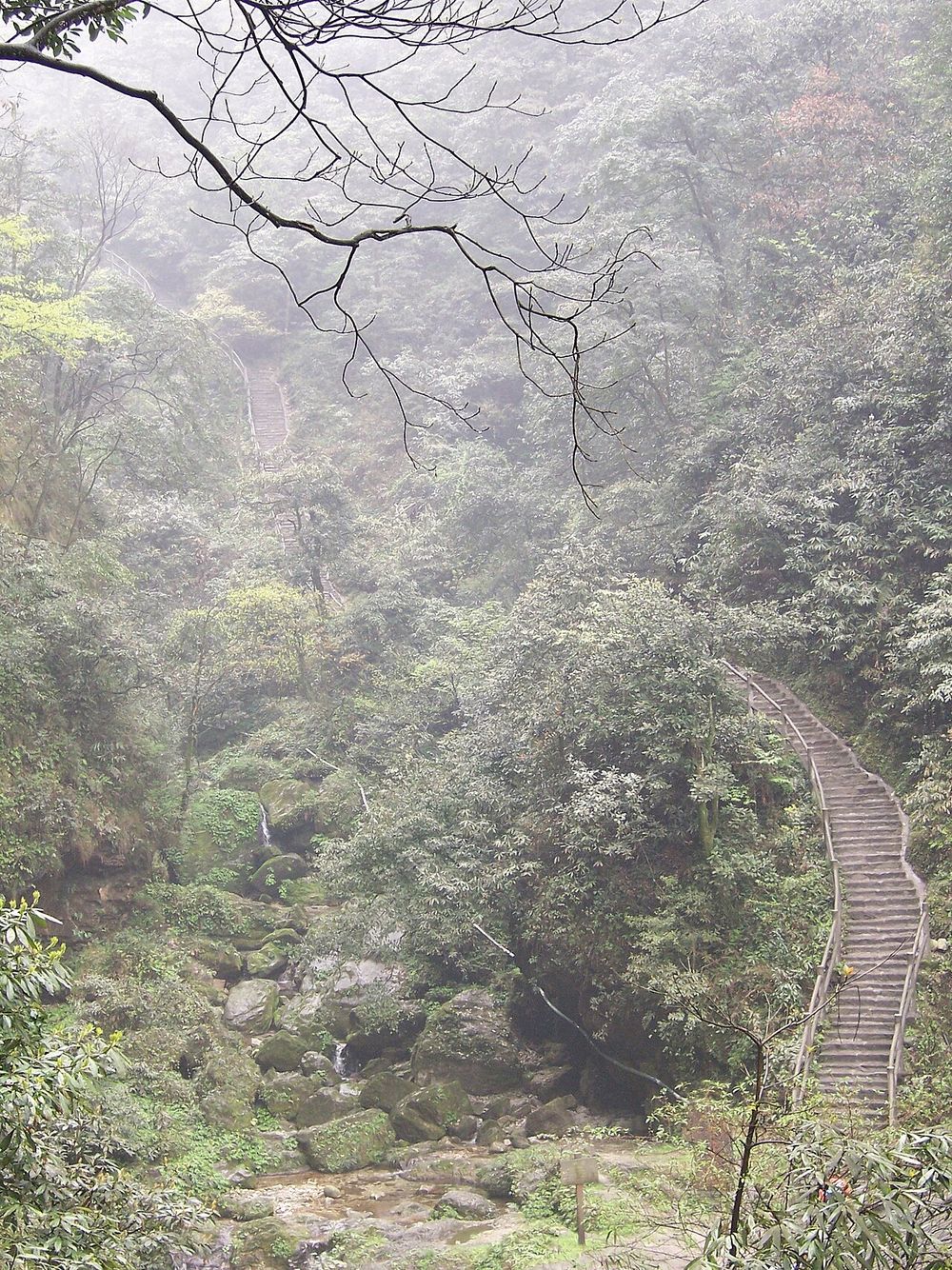
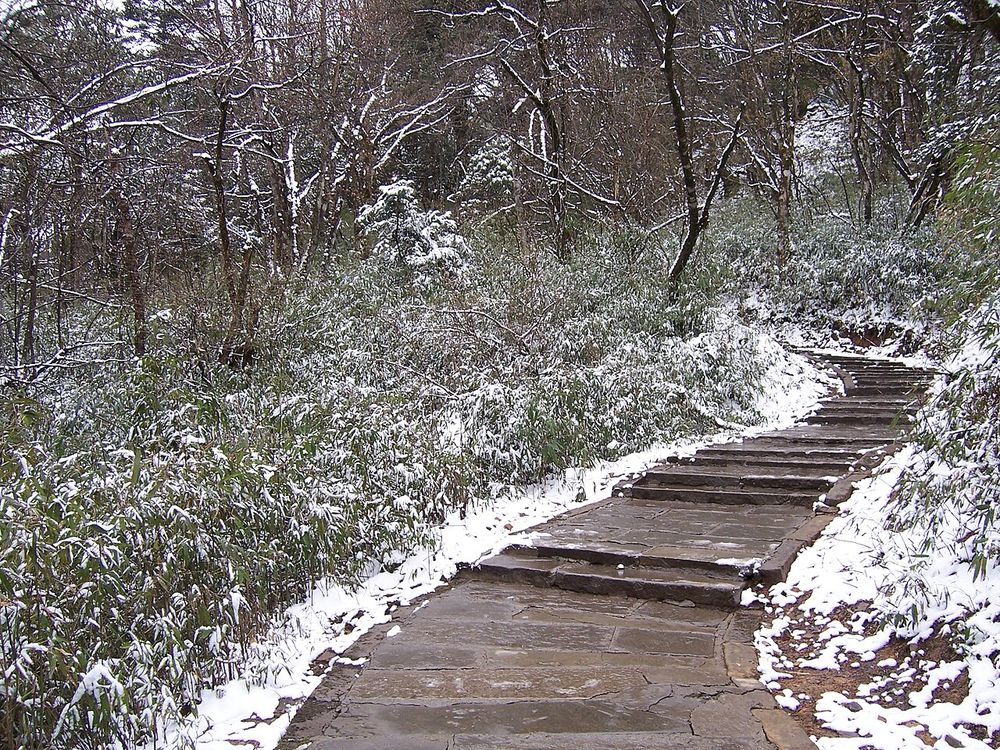
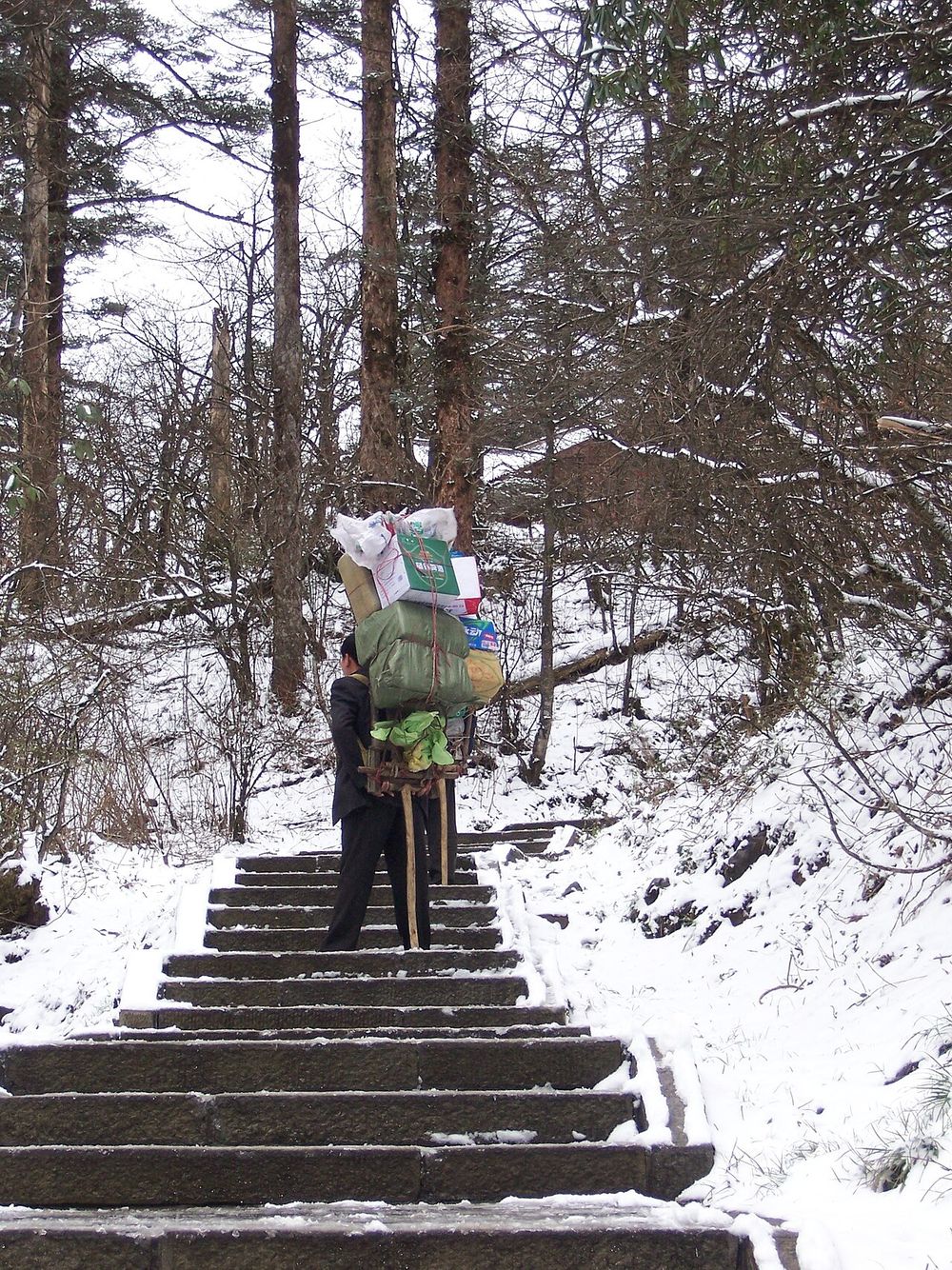
One of the four sacred mountains of Chinese Buddhism, Emei rises from the Sichuan plain to a cliff-edged summit over 3,000 metres high, where a golden statue of the bodhisattva Samantabhadra rides four elephants above a sea of clouds. Pilgrims once took days to climb it on stone steps, past temples, monkeys and forests of fir; today buses and a cable car do most of the climb.
Photo: Yumeto, CC BY-SA 4.0, Wikimedia Commons
The story
Emei is the mountain of Samantabhadra, Puxian in Chinese, the bodhisattva of practice, who is shown riding a white elephant with six tusks. Buddhist monks were building temples on its slopes by the Jin dynasty, about 1,600 years ago, and at its height the mountain had over a hundred monasteries. Its name means "moth eyebrows": seen from the plain, two of its ridges were said to curve like the brows of a beautiful woman.
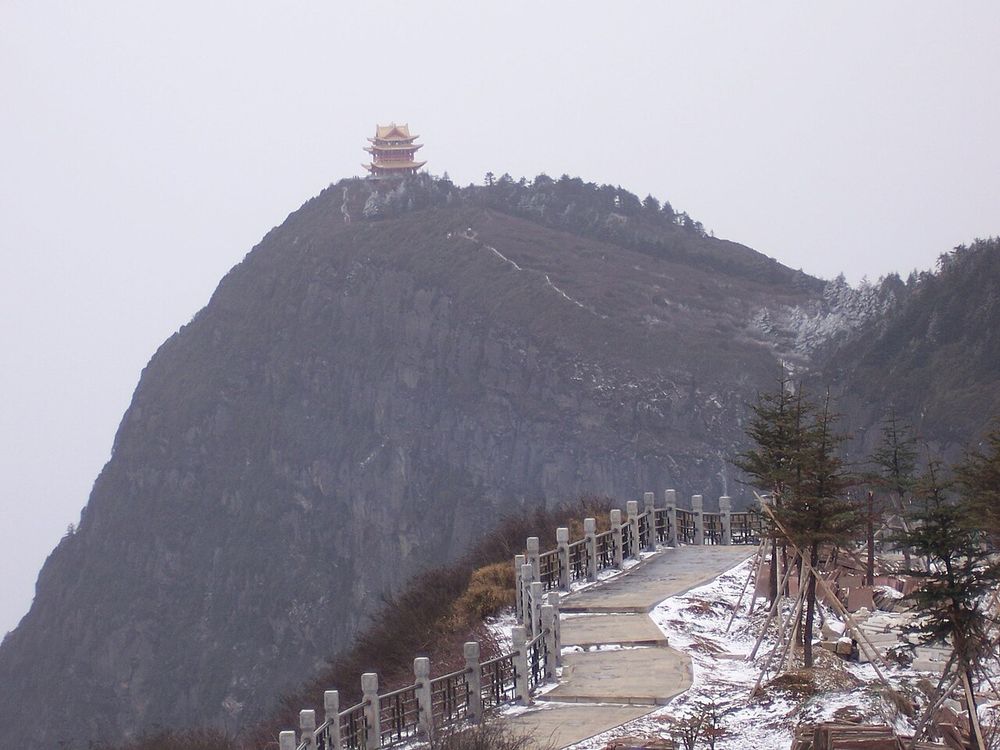
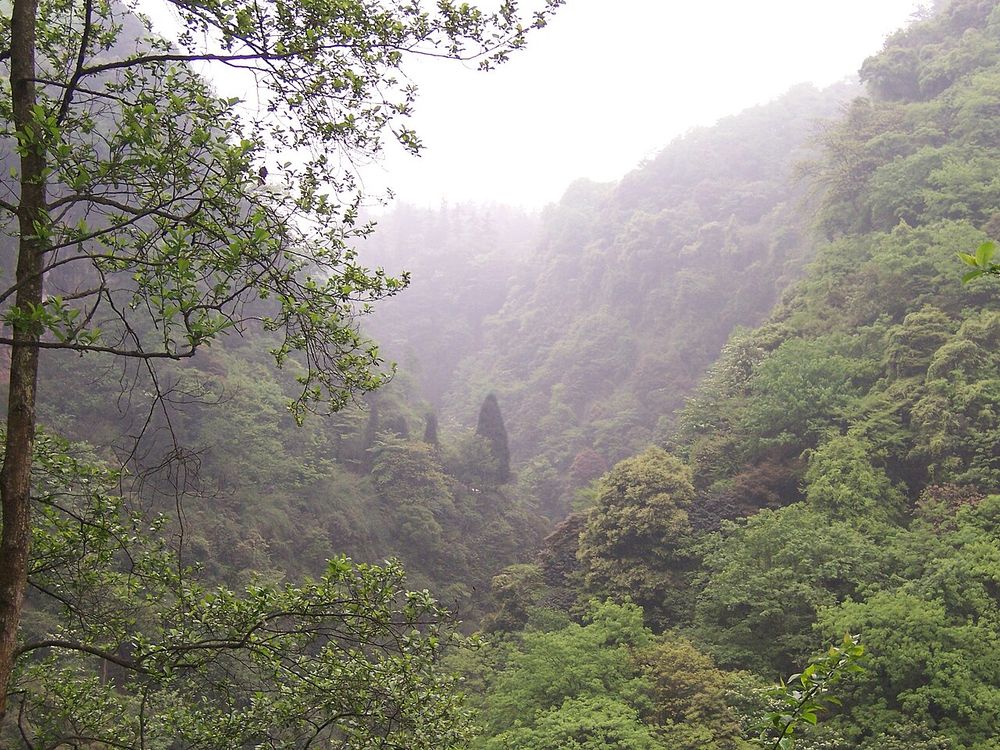
The mountain rises from about 500 metres at Baoguo Temple to 3,099 metres at Wanfo Ding, with the Golden Summit, the pilgrims' goal, just below at 3,079 metres. On the way the climate changes from the warm, wet forest of the foothills, full of monkeys, to fir woods and winter snow at the top. In 1996 Emei and the Giant Buddha of Leshan were listed together as a World Heritage Site, for both their temples and their plants.
What is here
The mountain ticket is 160 yuan in the main season and 110 yuan in winter; since 1 January 2026 the temples charge nothing extra. Buses and cable cars are paid separately.
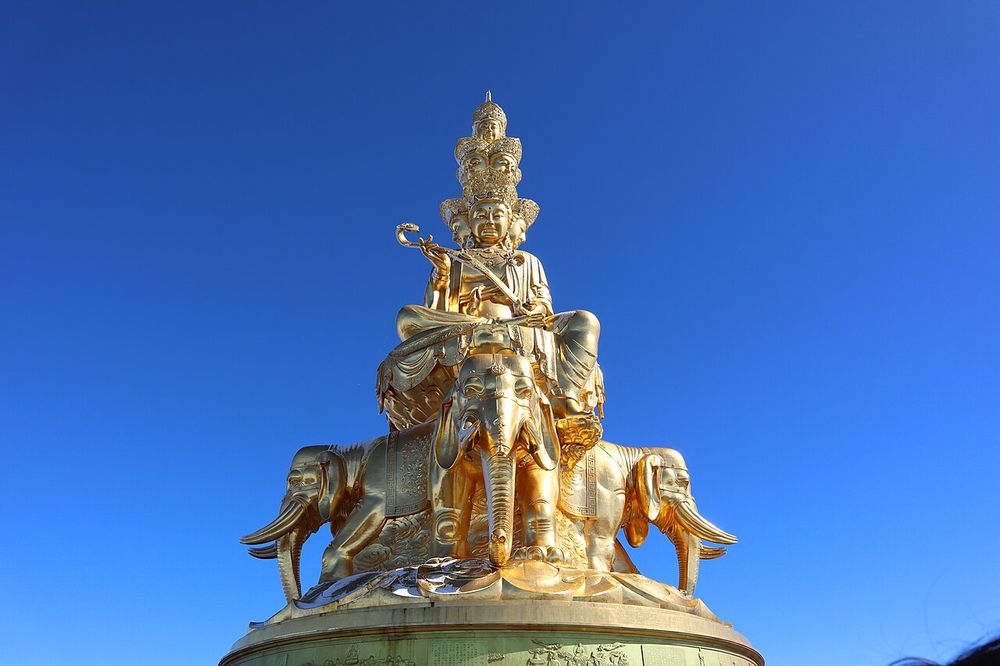
The Ten-Directional Samantabhadra, 2026AkakiBalanchivadze, CC BY 4.0
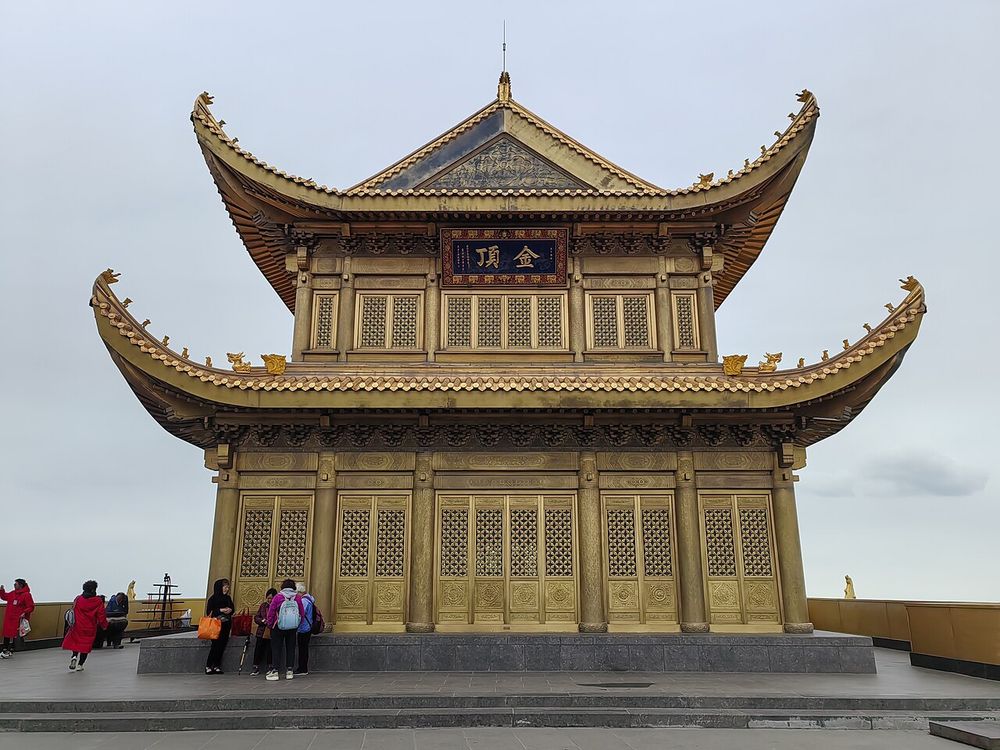
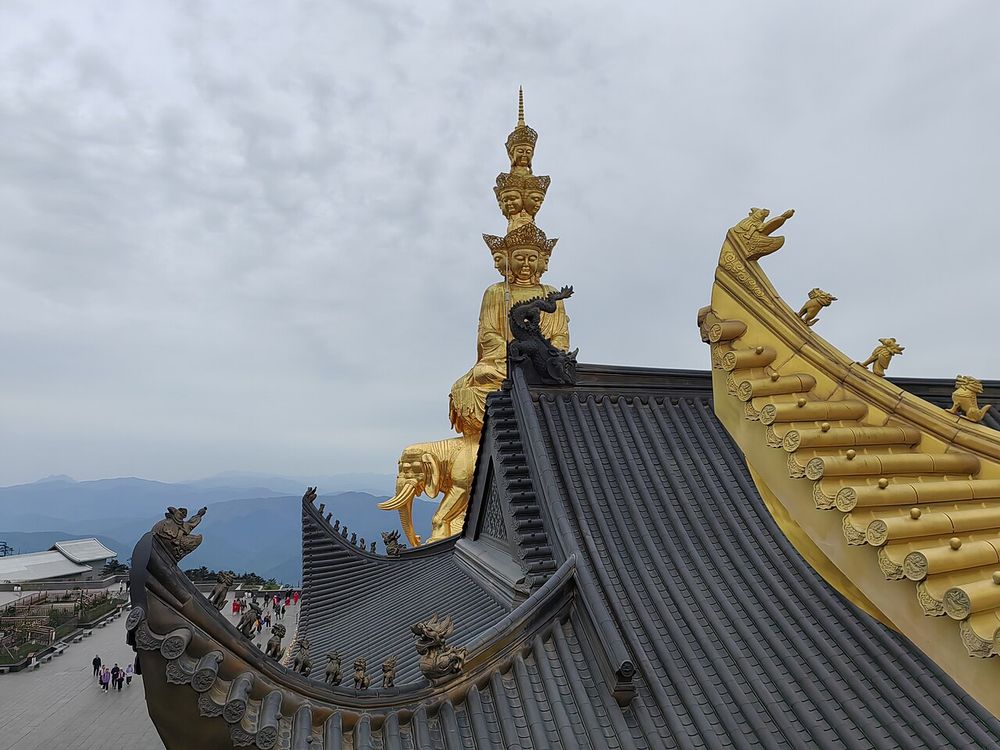
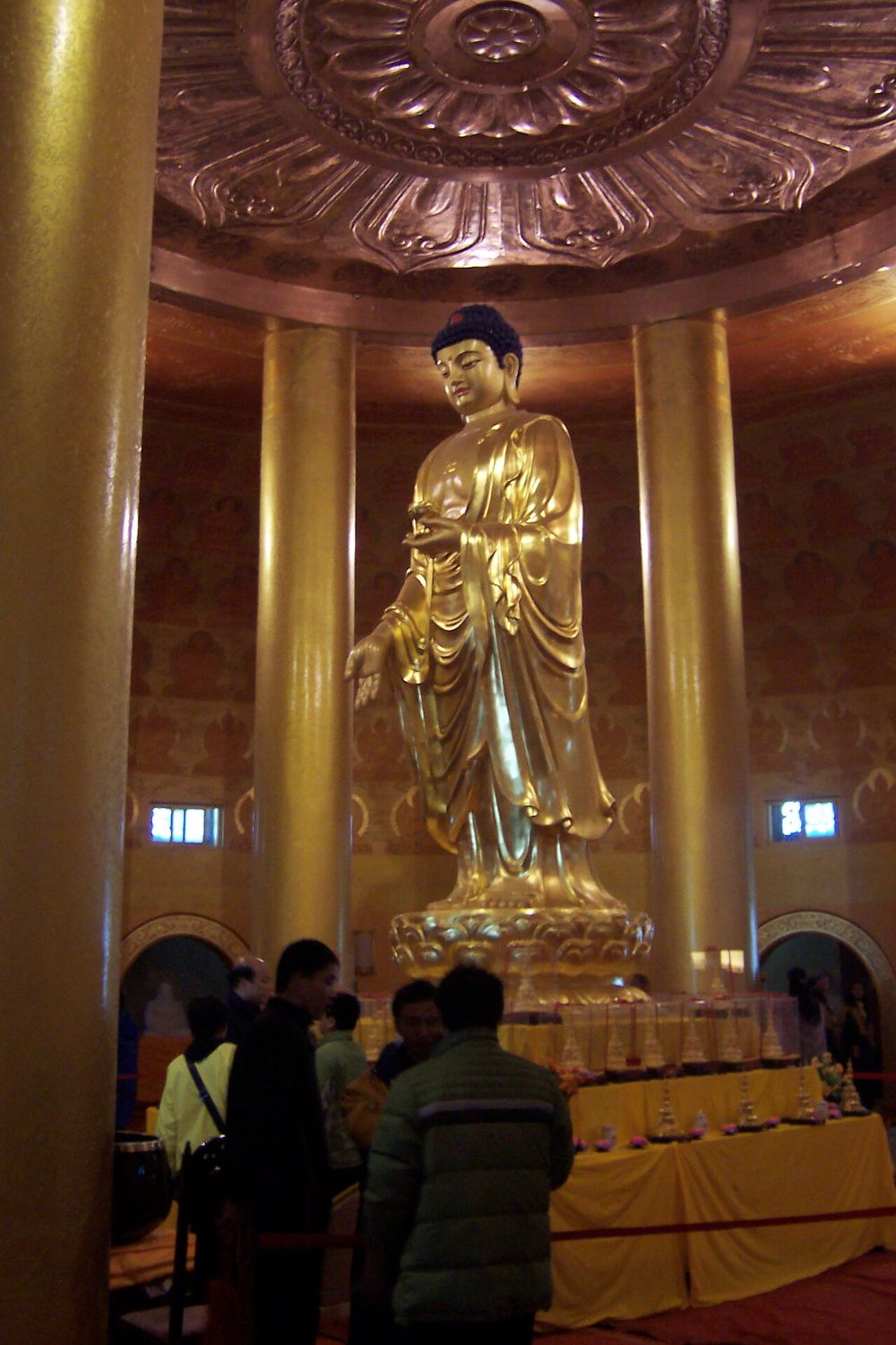
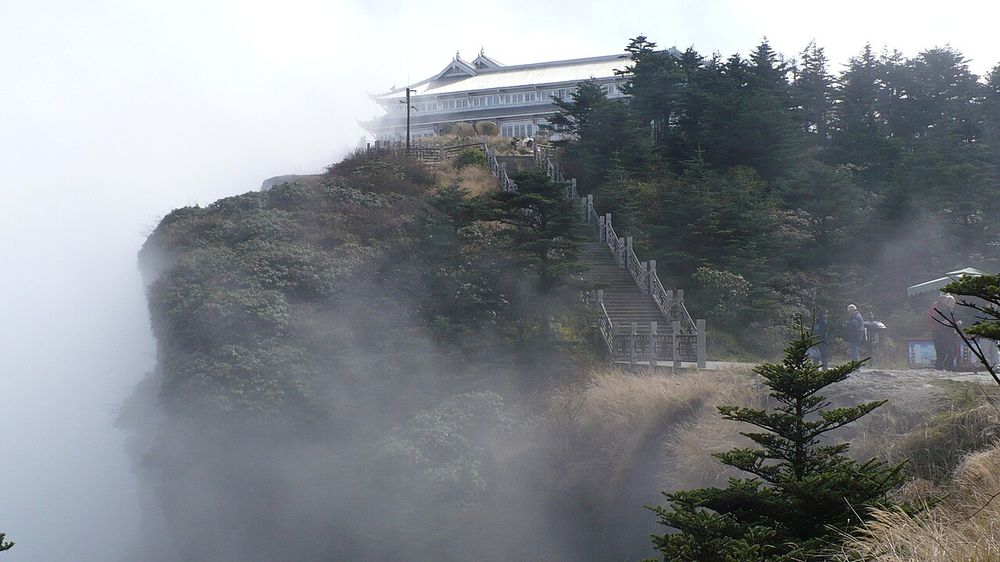
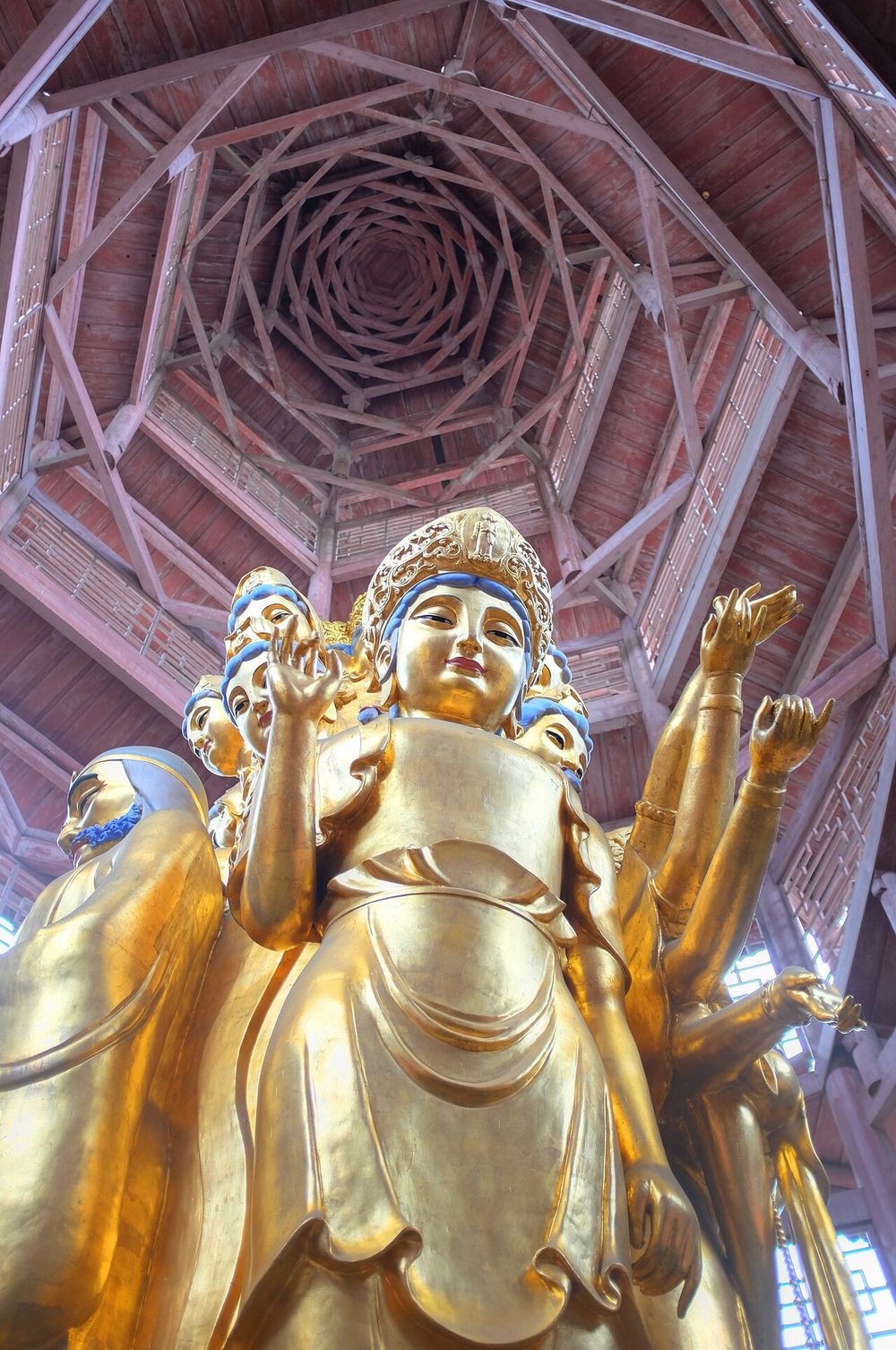
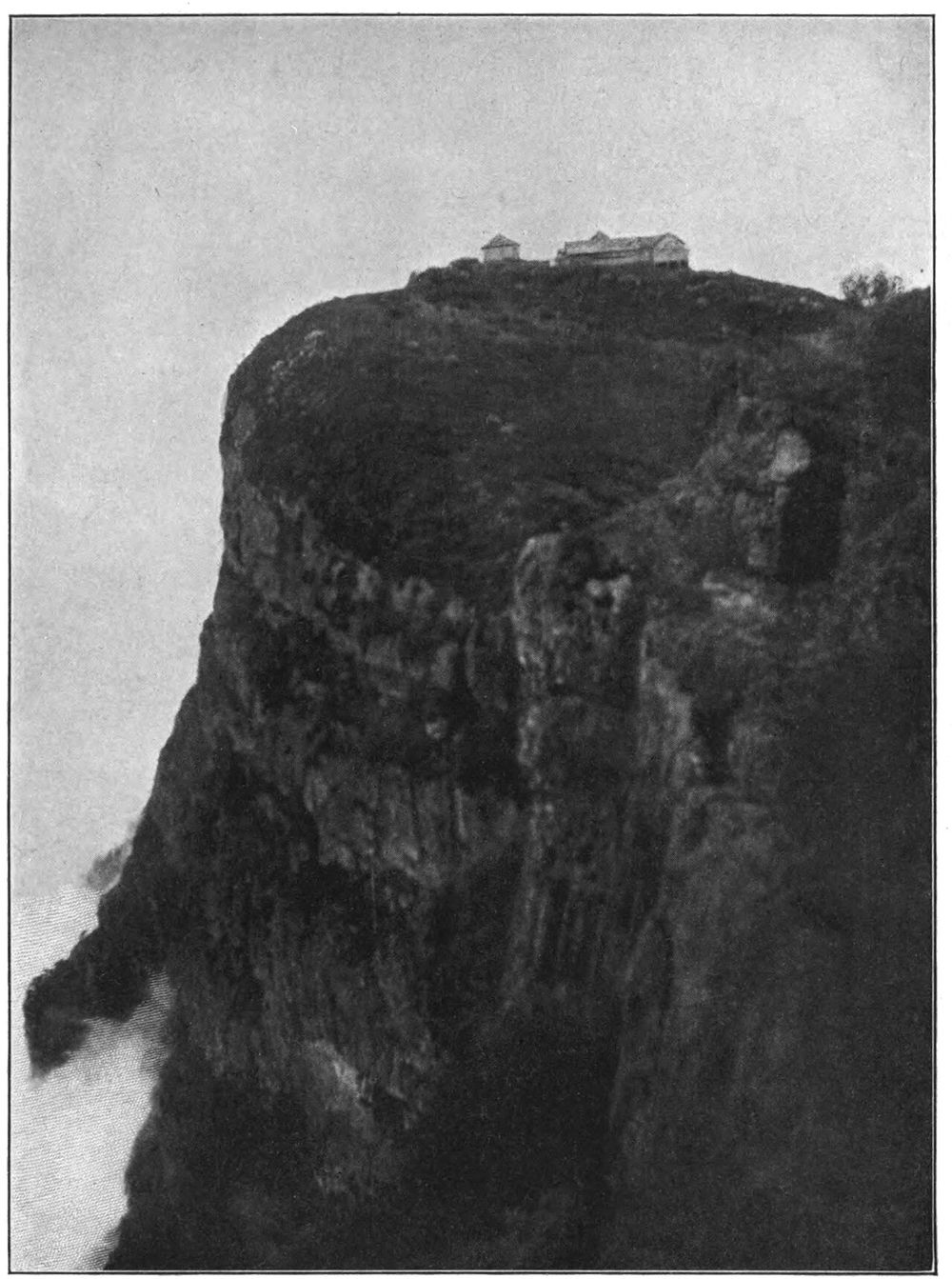
At the top stands the Ten-Directional Samantabhadra, a gilded statue 48 metres high finished in 2006: ten heads facing every direction, seated on four elephants. Behind it, the Golden Hall gleams with gilded walls. The summit ends in a sheer cliff over a thousand metres high.
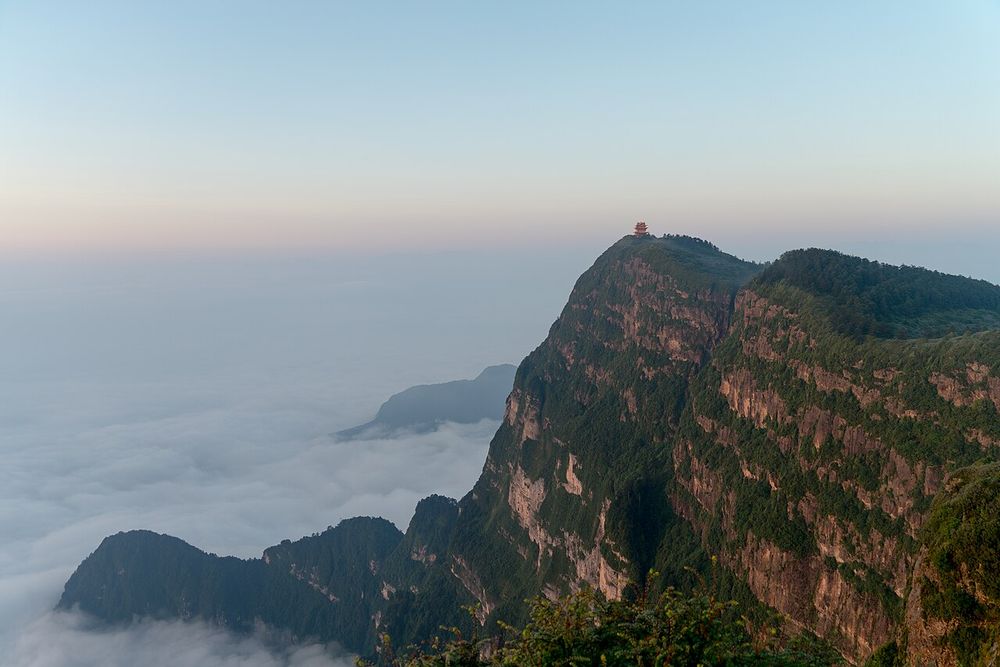
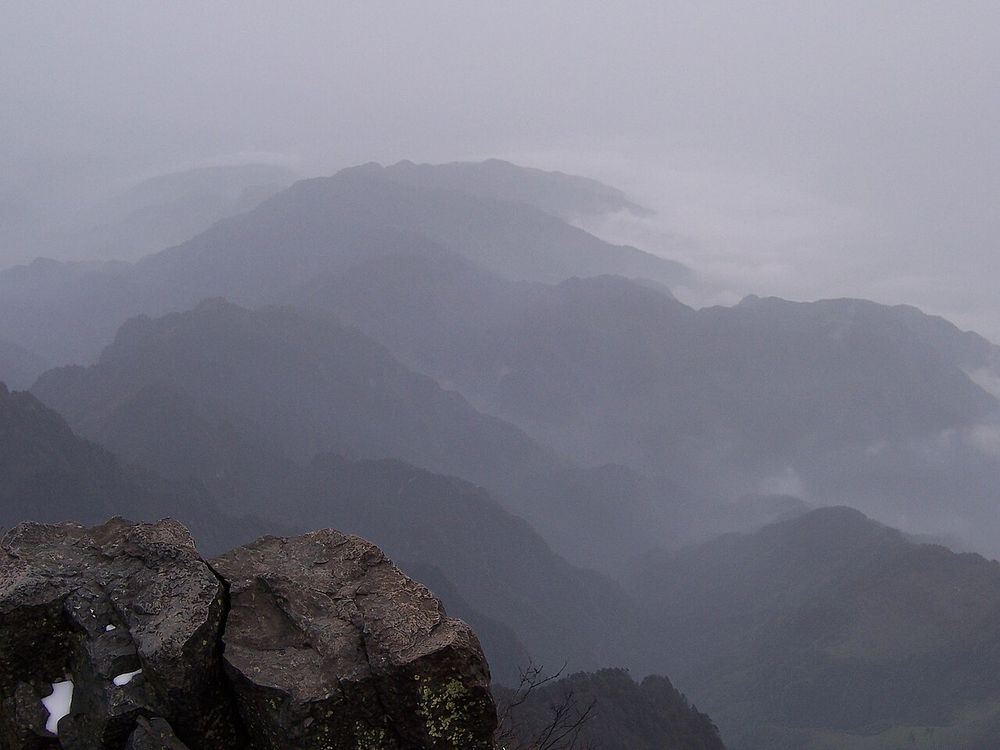
On good mornings you look down on a sea of clouds and, far to the west, the snow peaks of the Gongga range. On rare afternoons, with the sun behind you and cloud below, a rainbow ring appears round your own shadow on the clouds: the "Buddha's light" pilgrims came to see.
A peak above the sea of clouds, 2017George N, CC BY 2.0
Things people often get wrong
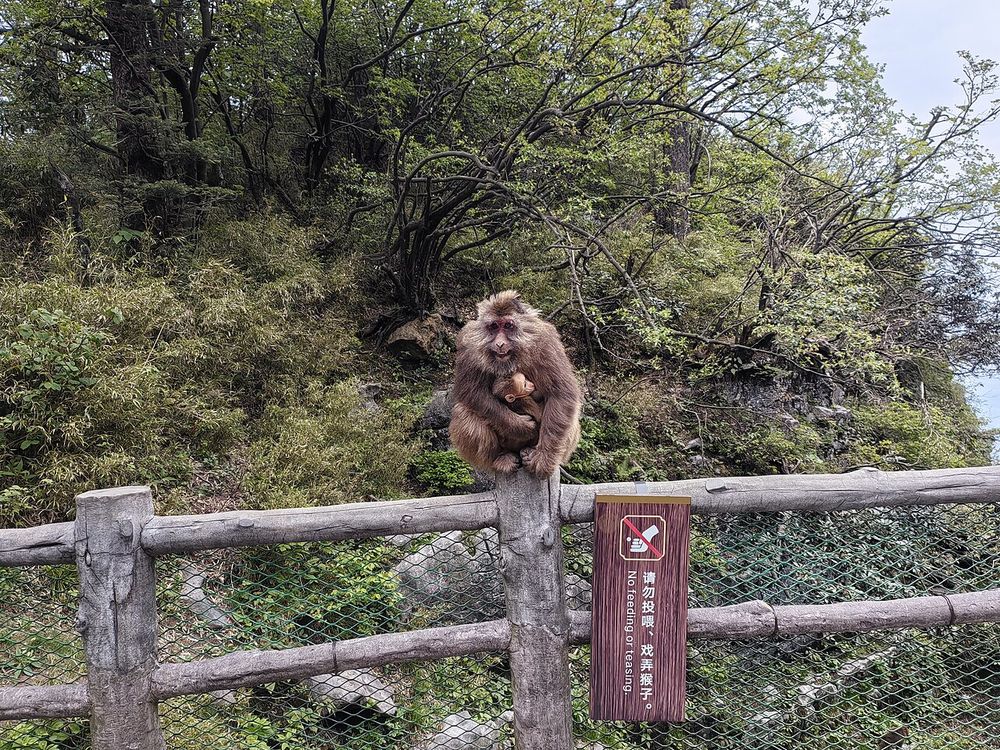
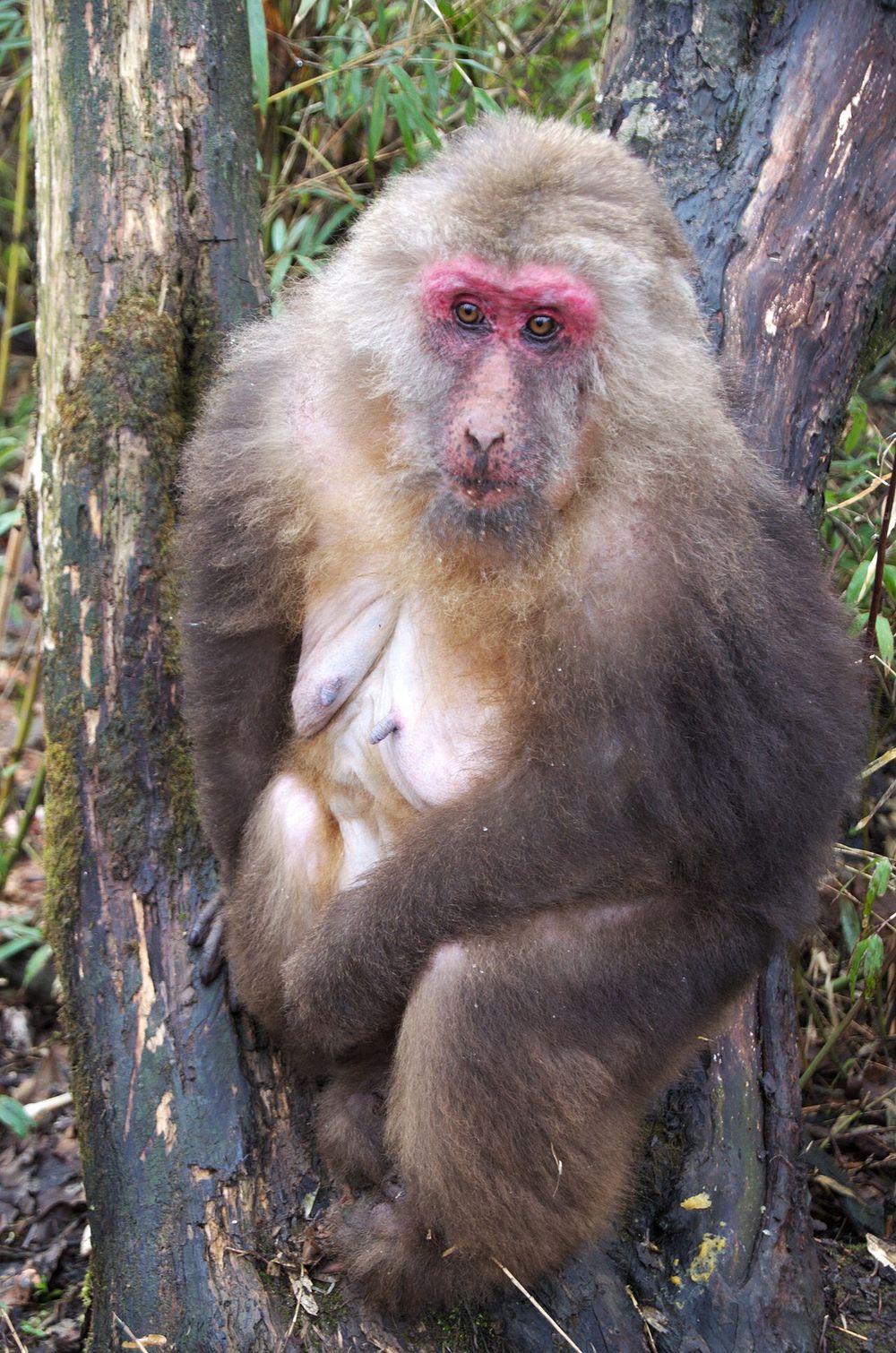
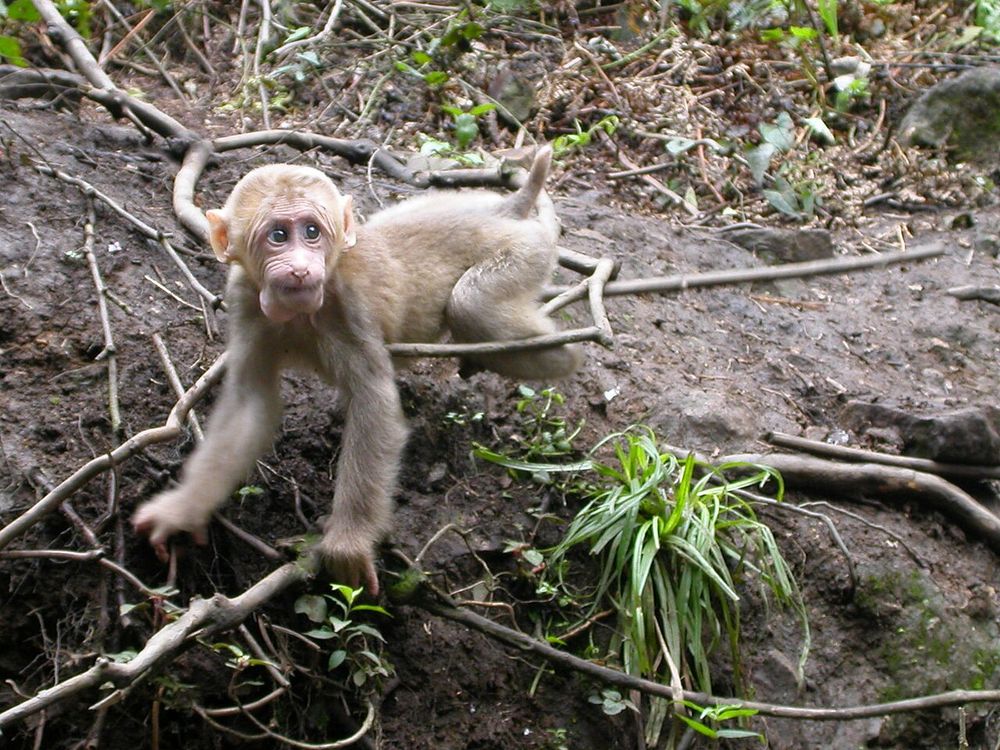
"The monkeys are tame." They are wild Tibetan macaques used to people, and they snatch food and bags. Do not feed them, hide plastic bags, and keep your distance.
"Emei is a day trip." Going up by bus and cable car takes a long day; walking takes two or three. Many people sleep on the mountain to see the sunrise.
People who stood here
We searched Chinese sources first for this list, then English and German ones.
Li Bai (poet, 701–762)He grew up in Sichuan and wrote "Song of the Moon over Mount Emei", one of the best-known short poems in Chinese.
Fan Chengda (poet and official, 1126–1193)He climbed to the summit in 1177 and described the Buddha's light in his travel diary, one of the first careful accounts of it.
Ernst Faber (missionary and botanist, 1839–1899)He collected plants on Emei in 1887; the fir that covers the summit, Abies fabri, carries his name.
Elizabeth Kendall (traveller, 1855–1952)The American teacher climbed Emei and photographed its summit cliff for her book "A Wayfarer in China" (1913).
Guo Moruo (writer, 1892–1978)Born in Shawan, at the foot of the mountain, he called Emei the mountain of his childhood.
Go deeper: six stops from Baoguo Temple to the Golden Summit7 stops · about 1 min to read
The classic route goes by bus to Leidongping, on foot to Jieyin Hall, and by cable car to the summit; coming down, stop at Wannian Temple and walk to Qingyin Pavilion.
1. Baoguo Temple
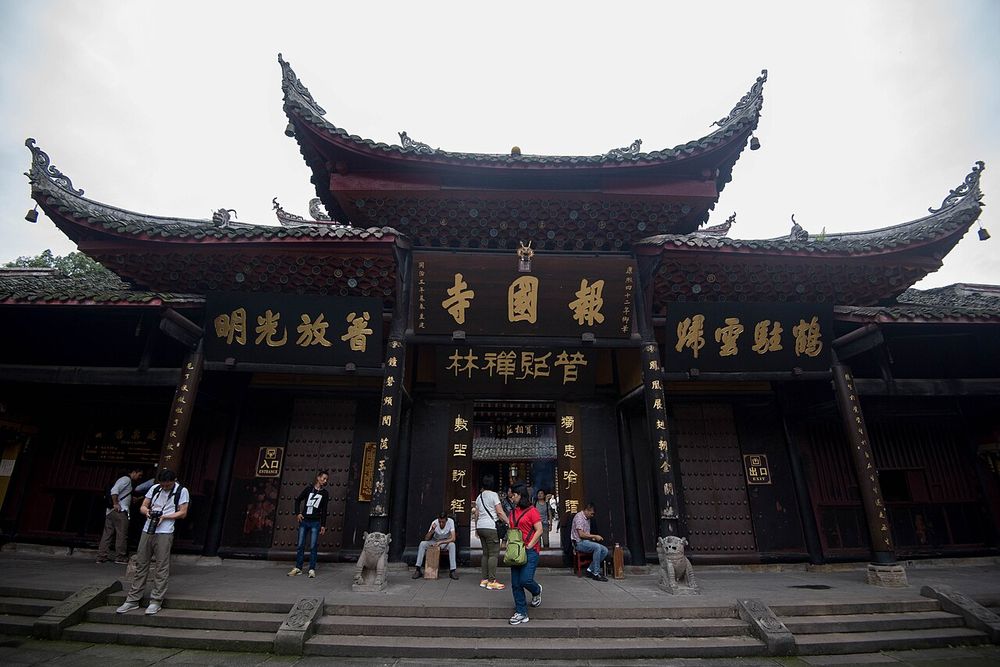
Baoguo Temple, 2017Siyuwj, CC BY-SA 4.0
At the foot of the mountain, the largest temple and the traditional start of the climb, rebuilt in the 17th century.
2. Fuhu Temple
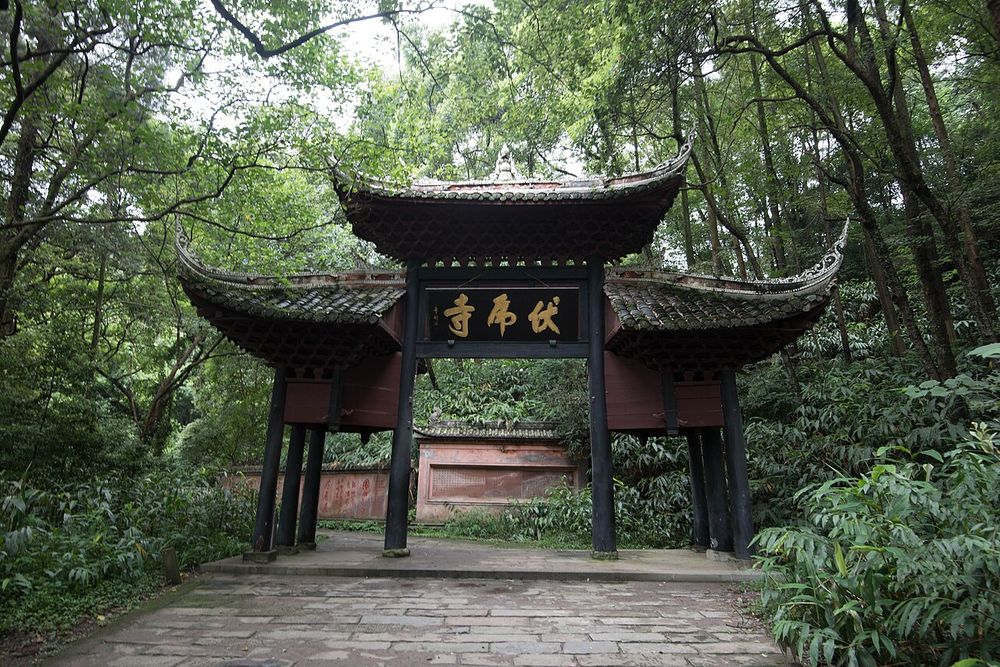
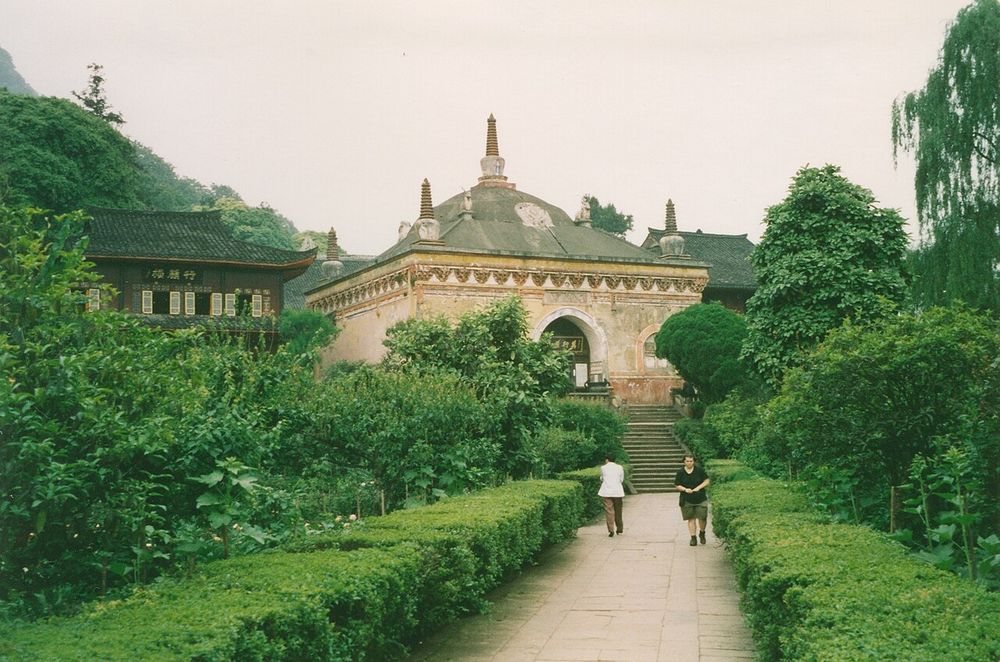
The gate of Fuhu Temple in the forest, 2017Siyuwj, CC BY-SA 4.0
A temple hidden in deep forest just above Baoguo; its name, "Subduing the Tiger", comes from a story of a monk who calmed the tigers that once lived here.
3. Qingyin Pavilion
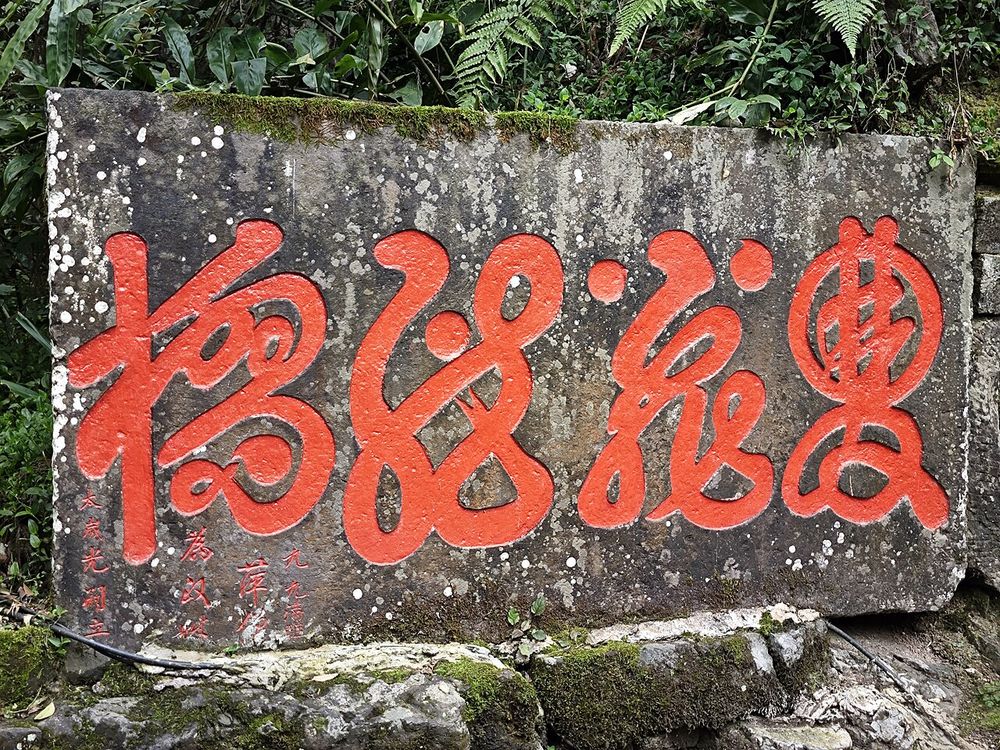
The carved words "Pure sound of the twin bridges", 2026Liuxingy, CC BY-SA 4.0
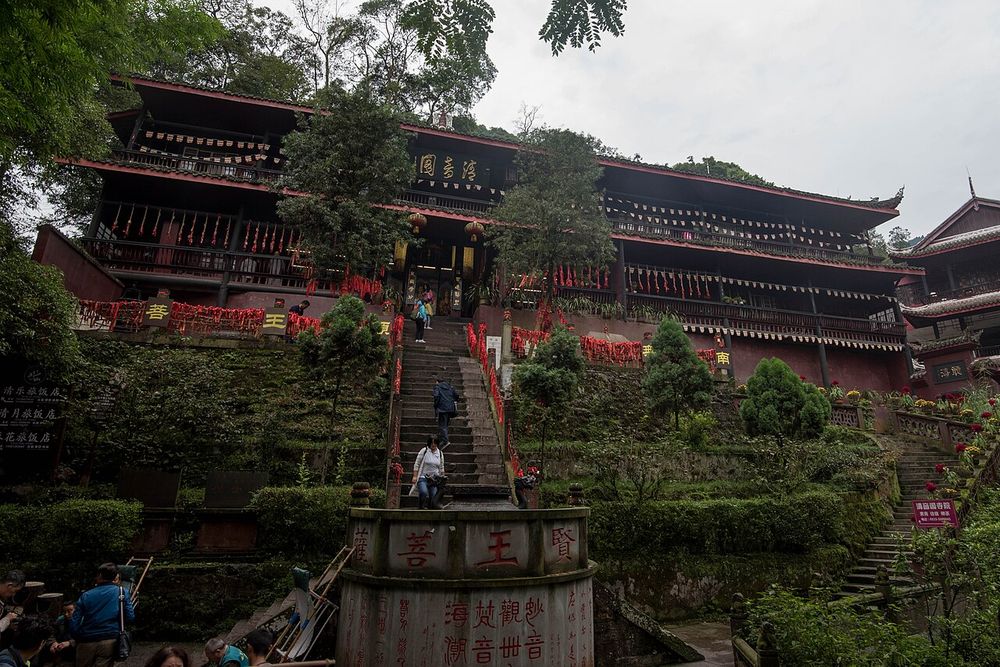
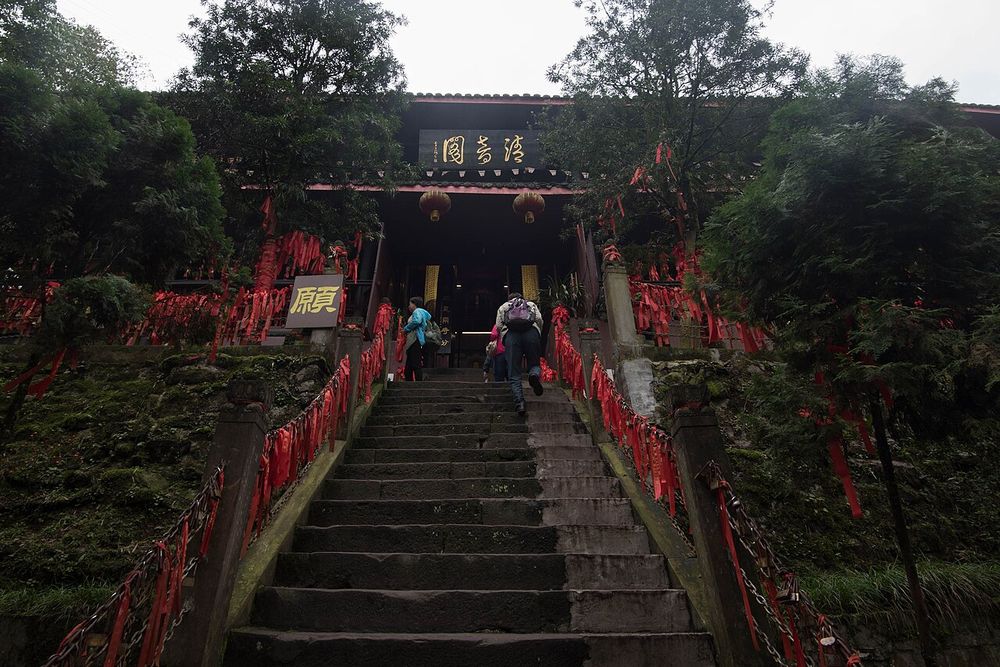
Two streams, one dark and one clear, meet under two little bridges; the sound of the water gives the place its name, "Pure Sound". The path from here to the monkey area is the shady heart of the lower mountain.
4. Wannian Temple
The beamless brick hall of Wannian Temple, 1995Arian Zwegers from Brussels, Belgium, CC BY 2.0
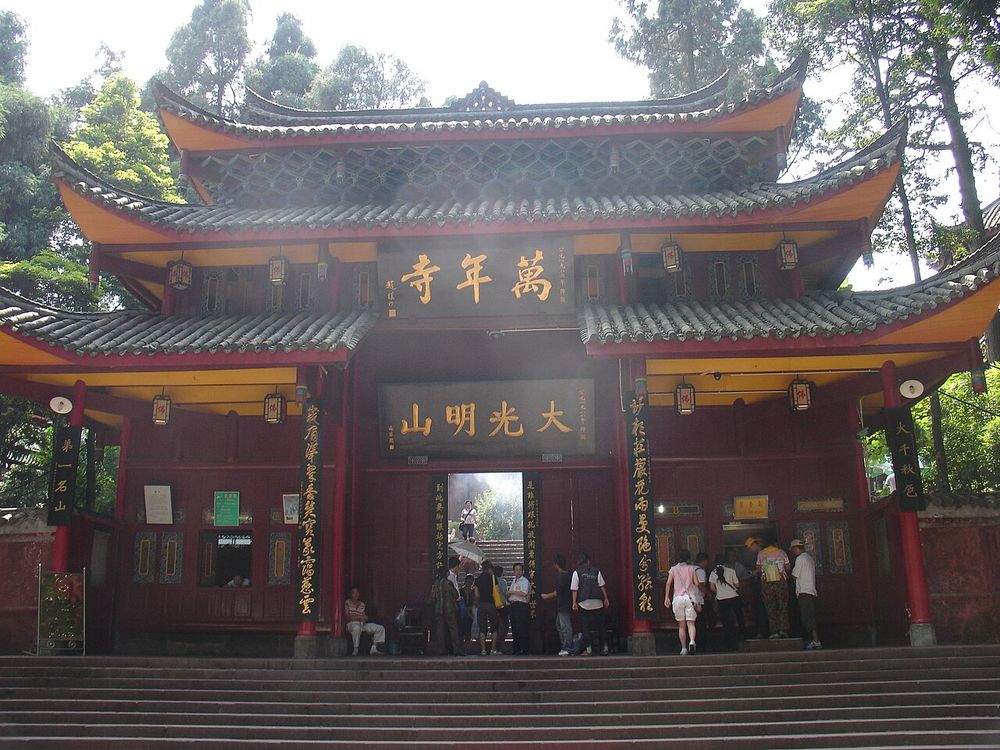
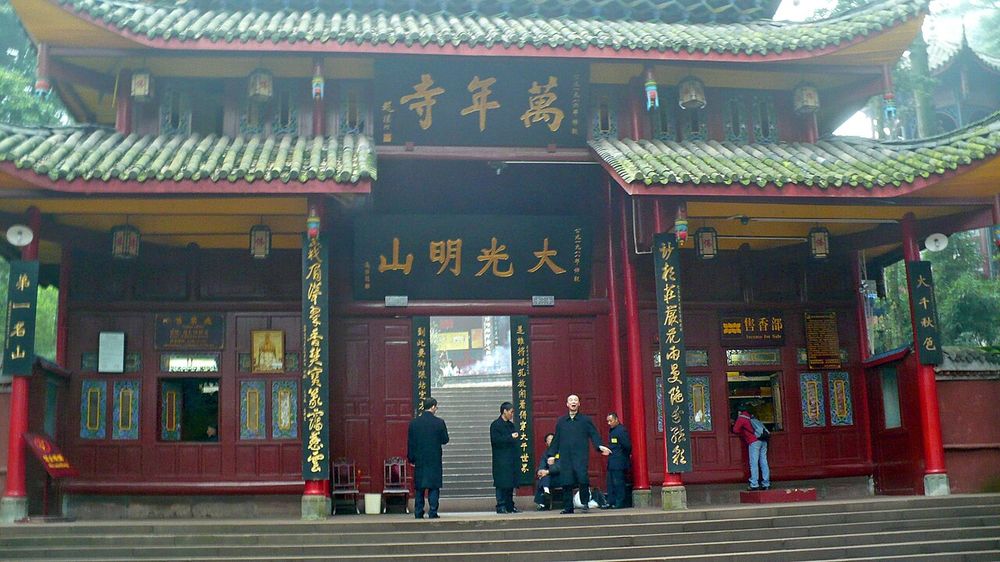
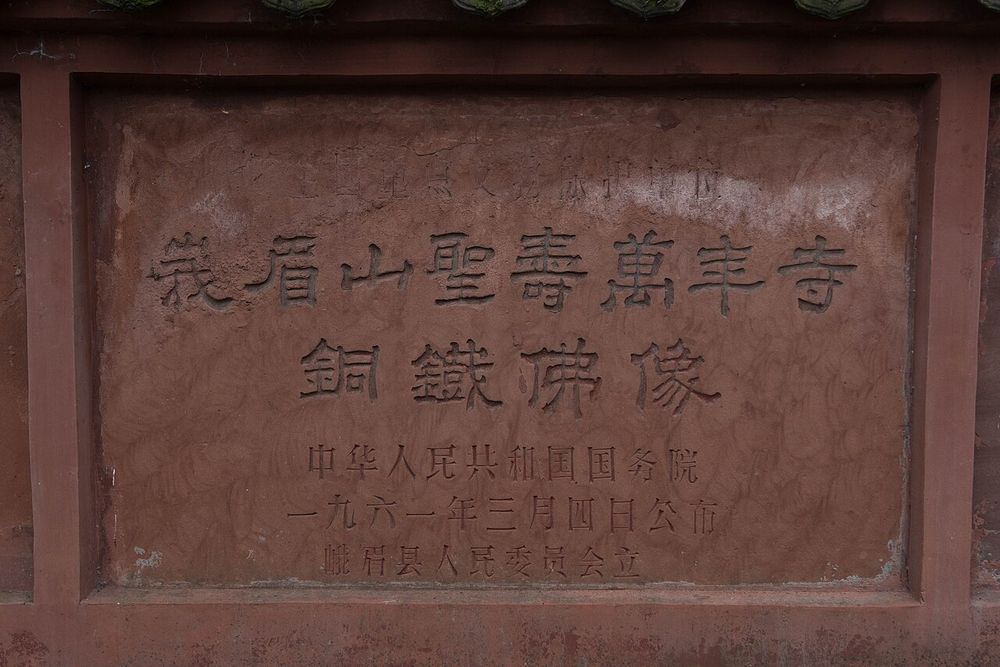
Its brick hall, built in 1601 without a single wooden beam, shelters a bronze Samantabhadra on a white elephant, cast in 980 and over seven metres high. It is the oldest great bronze on the mountain.
5. Elephant Bathing Pool
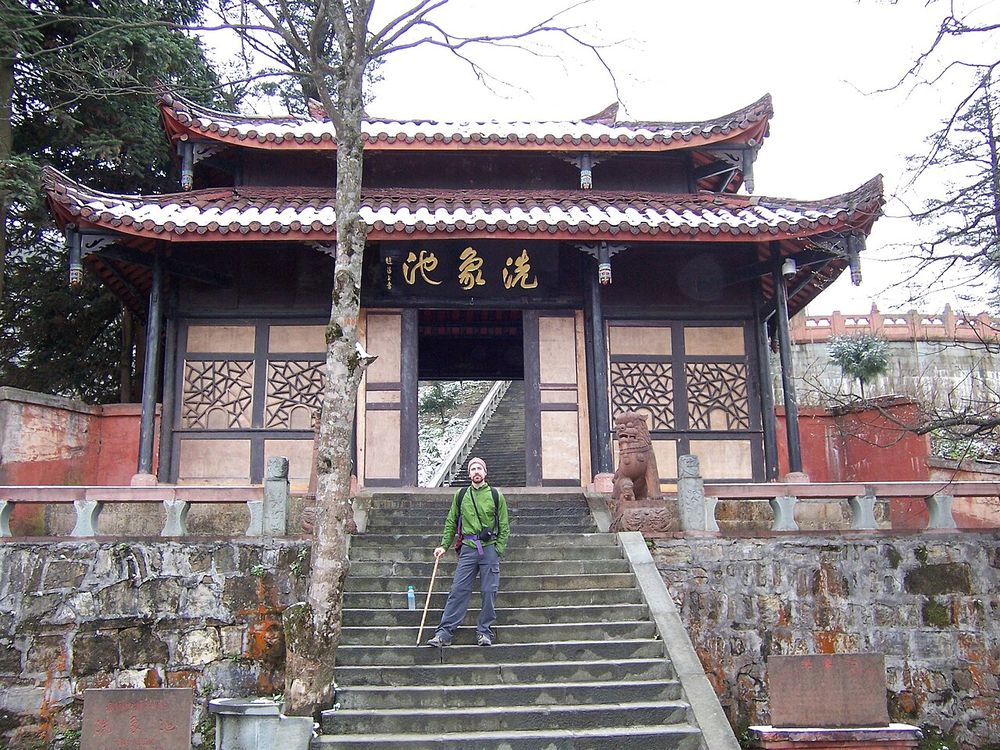
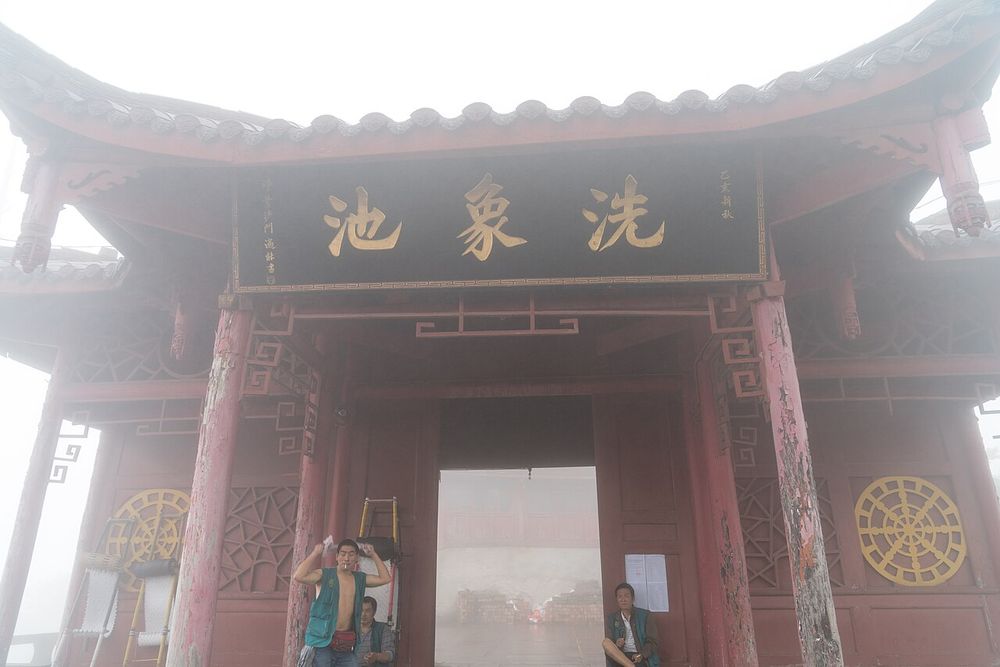
The Elephant Bathing Pool temple, 2006McKay Savage from London, UK, CC BY 2.0
Halfway up the high mountain, a temple by a small hexagonal pool where, the story goes, Samantabhadra's elephant bathed. Monkeys gather here too.
6. The Golden Summit
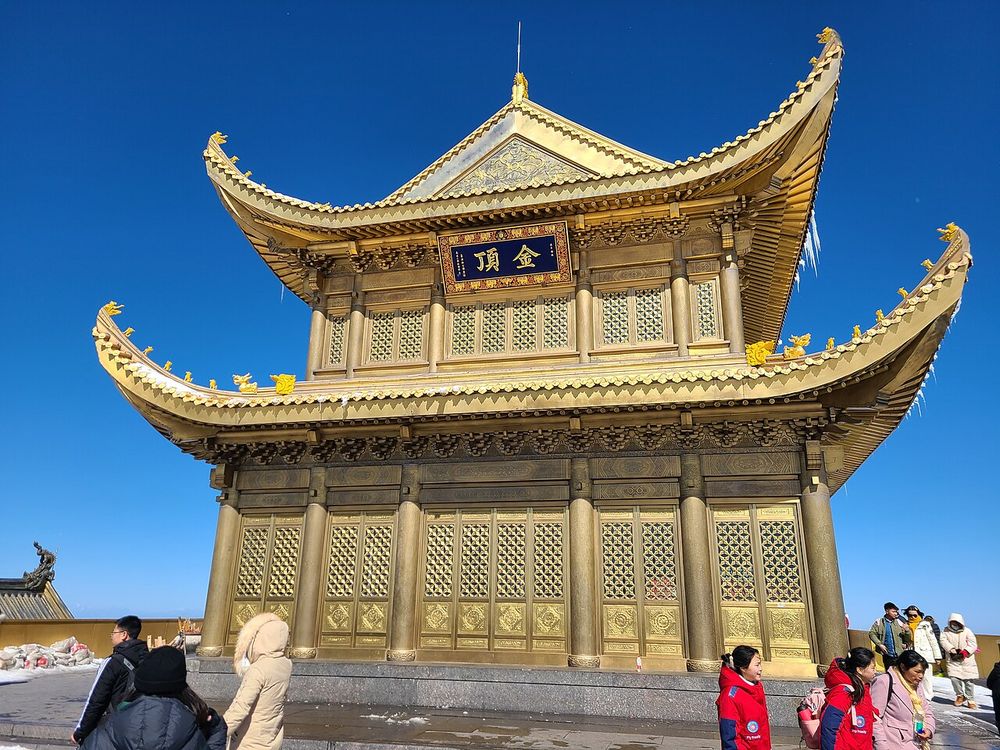
The Golden Hall under a clear sky, 2022Zhou Yuji1028, CC BY-SA 4.0
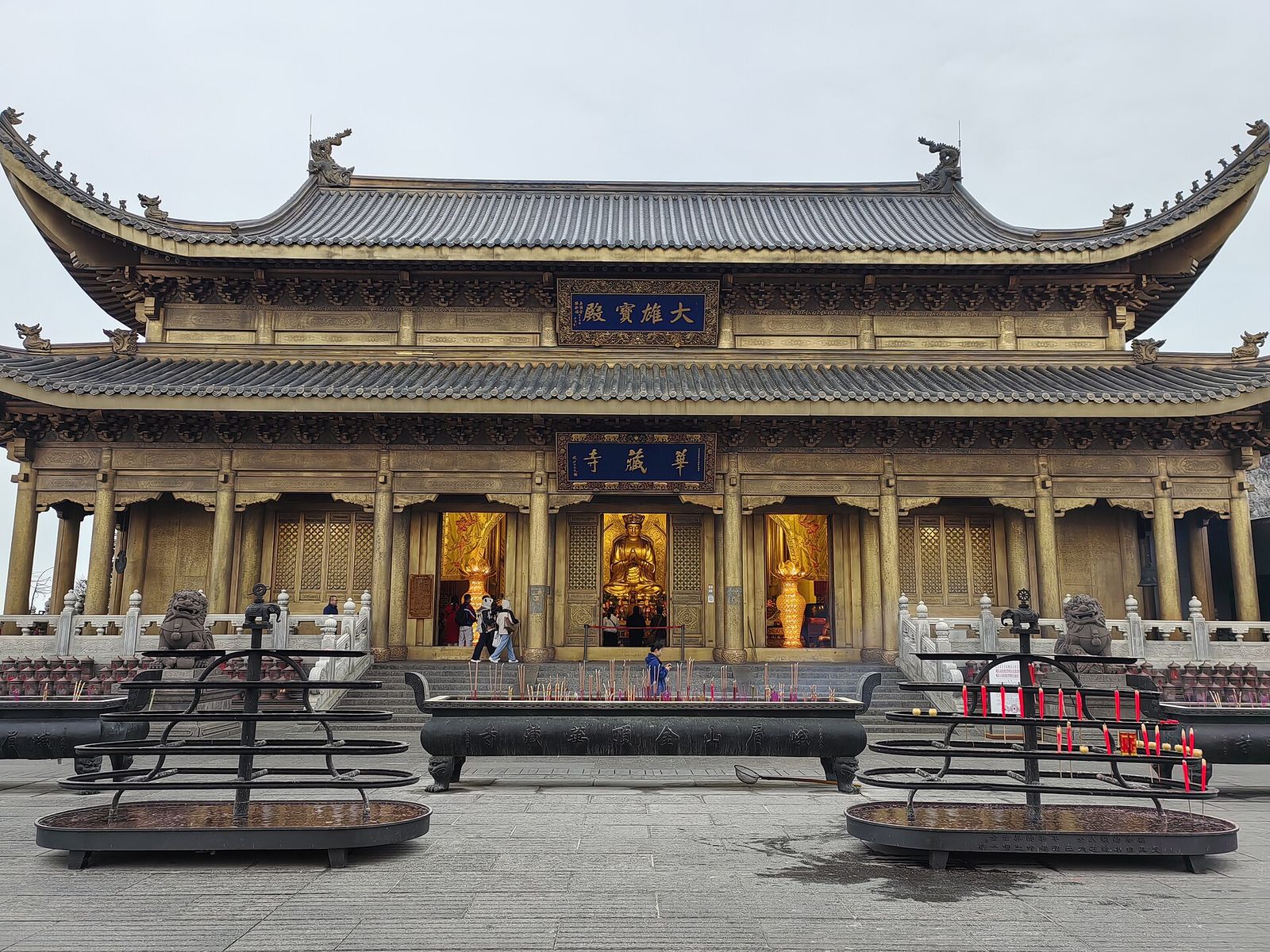
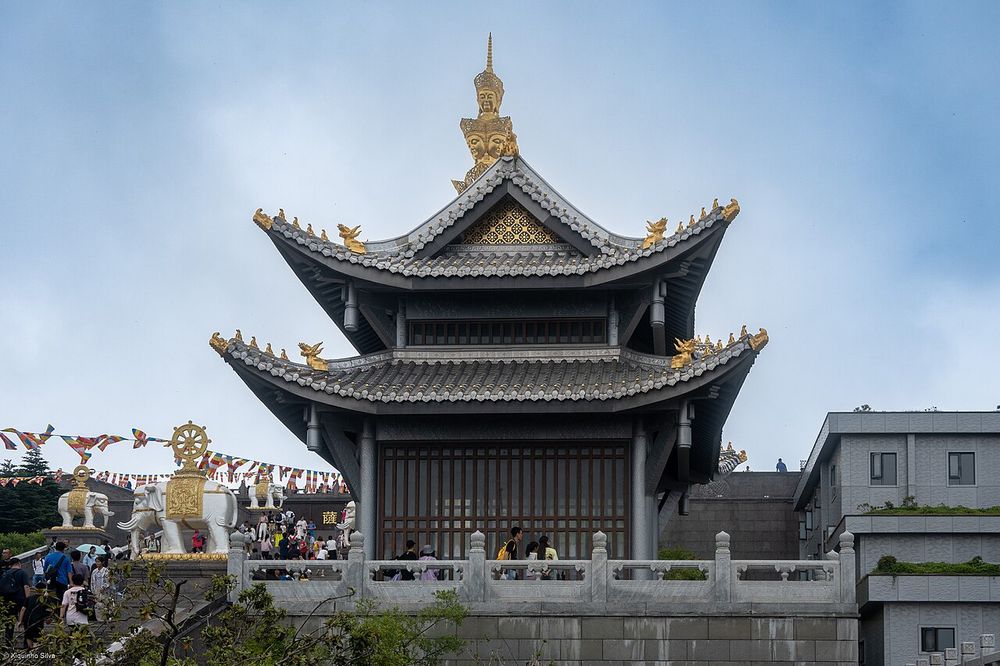
The Huazang Temple, the Golden Hall, the great statue and the cliff edge. Come at dawn for the sunrise, and stay into the afternoon for a chance of the Buddha's light.
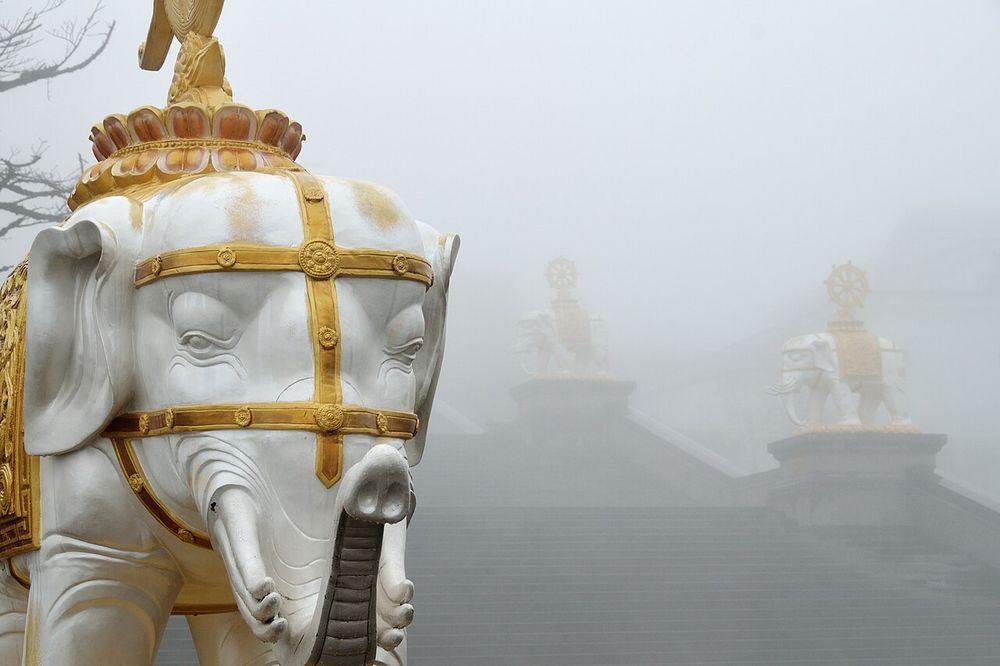
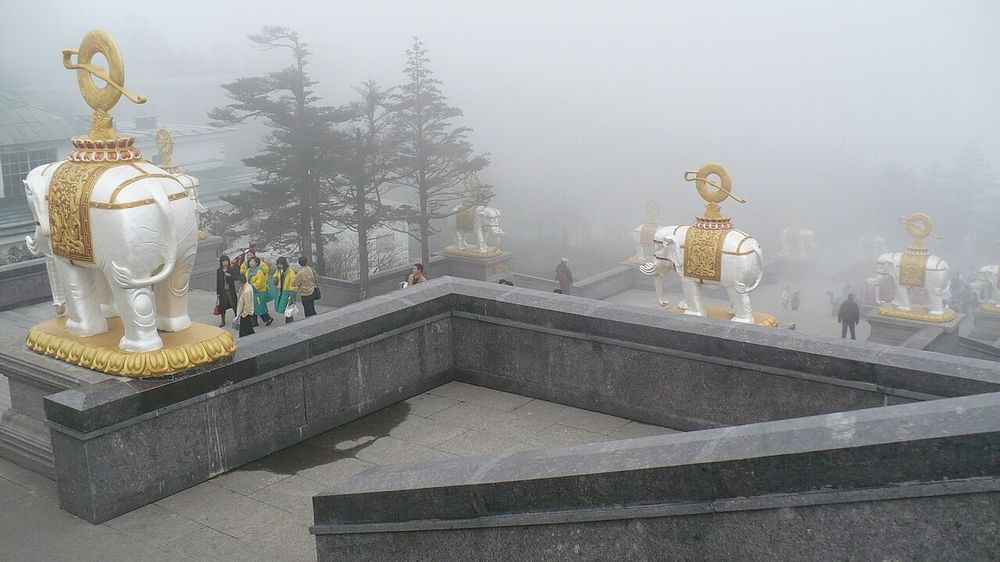
White elephants lining the steps in fogPieCam, CC BY-SA 4.0
The mountain and the same years elsewhere
The bronze Samantabhadra of Wannian Temple was cast in 980, the year Avicenna, the great Persian doctor, was born near Bukhara.
Meanwhile in the world
Year
Here
Elsewhere
980
The bronze Samantabhadra of Wannian Temple is cast
Avicenna is born near Bukhara
1177
Fan Chengda climbs to the summit and sees the Buddha's light
Saladin is defeated at Montgisard in the Holy Land
1601
The beamless brick hall of Wannian Temple is built
Shakespeare's "Hamlet" is first staged around this time
1996
Emei and the Leshan Giant Buddha become a World Heritage Site
Dolly the sheep is cloned in Scotland
2006
The Ten-Directional Samantabhadra is finished on the summit
Pluto is reclassified as a dwarf planet
One line to remember: a mountain of stone stairs and monkeys, with a golden bodhisattva on four elephants above the clouds.
From the foot to the Golden Summit
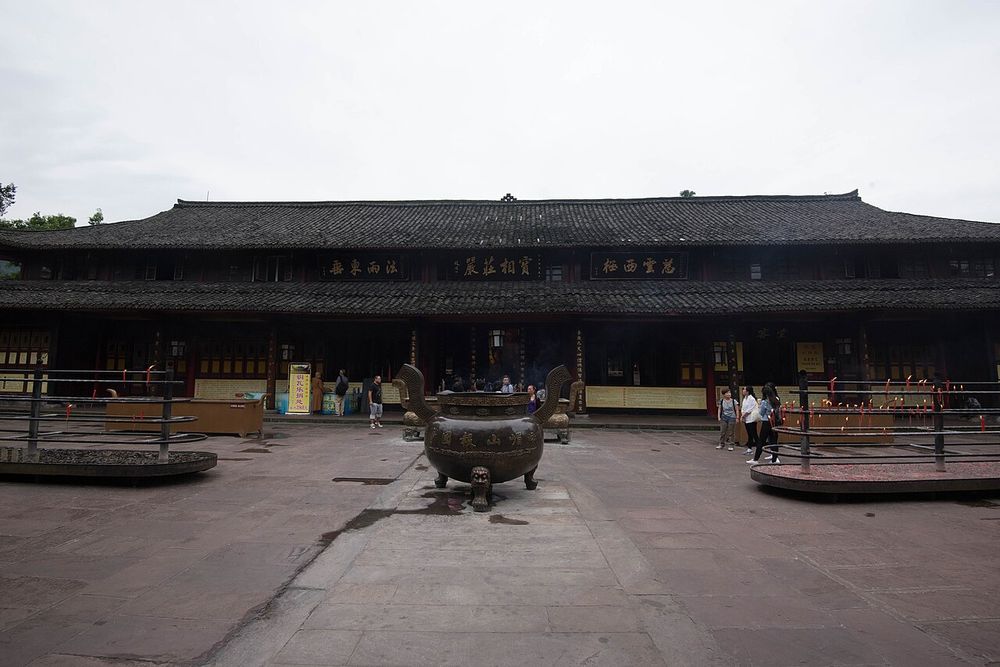
The gilded halls of the Golden Summit, 2025Yumeto, CC BY-SA 4.0, Wikimedia CommonsThe Golden Hall, 2025Yumeto, CC BY-SA 4.0, Wikimedia CommonsThe Golden Hall under a clear sky, 2022Zhou Yuji1028, CC BY-SA 4.0, Wikimedia CommonsGilded roofs on the summit, 2025Yumeto, CC BY-SA 4.0, Wikimedia CommonsThe Ten-Directional Samantabhadra, 2026AkakiBalanchivadze, CC BY 4.0, Wikimedia CommonsA gilded statue in a summit hall, 2006Truthven, CC BY-SA 3.0, Wikimedia CommonsWhite elephants lining the steps in fogPieCam, CC BY-SA 4.0, Wikimedia CommonsThe elephant avenue to the statueColin W, CC BY-SA 3.0, Wikimedia CommonsA hall on the summit, 2024xiquinhosilva, CC BY 2.0, Wikimedia CommonsA gate on the summit, 2024xiquinhosilva, CC BY 2.0, Wikimedia CommonsA peak above the sea of clouds, 2017George N, CC BY 2.0, Wikimedia CommonsEmei firs on the cliff edge in fog, 2007yvr101, CC BY 3.0, Wikimedia CommonsA pavilion on a peak near the summit, 2006McKay Savage from London, UK, CC BY 2.0, Wikimedia CommonsHills wrapped in cloud, 2006McKay Savage from London, UK, CC BY 2.0, Wikimedia CommonsMisty forest on the lower slopes, 2006McKay Savage from London, UK, CC BY 2.0, Wikimedia CommonsStone steps through the forest, 2006McKay Savage from London, UK, CC BY 2.0, Wikimedia CommonsSnow on the steps, 2006McKay Savage from London, UK, CC BY 2.0, Wikimedia CommonsA porter carrying goods up the snowy steps, 2006McKay Savage from London, UK, CC BY 2.0, Wikimedia CommonsBaoguo Temple, 2017Siyuwj, CC BY-SA 4.0, Wikimedia CommonsA courtyard of Baoguo Temple, 2017Siyuwj, CC BY-SA 4.0, Wikimedia CommonsA hall of Baoguo Temple, 2017Siyuwj, CC BY-SA 4.0, Wikimedia CommonsThe gate of Fuhu Temple in the forest, 2017Siyuwj, CC BY-SA 4.0, Wikimedia CommonsA gilded statue under a carved dome, 2015Min Zhou, CC BY 2.0, Wikimedia CommonsThe gate of Wannian Temple, 2006张元柏, CC BY-SA 3.0, Wikimedia CommonsA hall of Wannian TempleColin W, CC BY-SA 3.0, Wikimedia CommonsThe beamless brick hall of Wannian Temple, 1995Arian Zwegers from Brussels, Belgium, CC BY 2.0, Wikimedia CommonsAn inscribed stone at Wannian Temple, 2017Siyuwj, CC BY-SA 4.0, Wikimedia CommonsA temple near Qingyin Pavilion, 2017Siyuwj, CC BY-SA 4.0, Wikimedia CommonsSteps up from Qingyin Pavilion, 2017Siyuwj, CC BY-SA 4.0, Wikimedia CommonsThe carved words "Pure sound of the twin bridges", 2026Liuxingy, CC BY-SA 4.0, Wikimedia CommonsThe gate of the Elephant Bathing Pool temple, 2017George N, CC BY 2.0, Wikimedia CommonsThe Elephant Bathing Pool temple, 2006McKay Savage from London, UK, CC BY 2.0, Wikimedia CommonsA macaque on a railing, 2025Yumeto, CC BY-SA 4.0, Wikimedia CommonsAn old Tibetan macaque, 2014Popolon, CC BY-SA 3.0, Wikimedia CommonsA young macaque, 2006Truthven, CC BY-SA 3.0, Wikimedia CommonsThe summit cliff, photographed by Elizabeth Kendall, published 1913Elizabeth Kimball Kendall, Public domain, Wikimedia CommonsA map of Mount Omei printed in 1905Cox, James R, No restrictions, Wikimedia Commons
Local legends
These are stories people tell about this place. They are legends, not history, and each one says where it comes from.
LegendPu Gong and the deer
A herb-gatherer named Pu Gong followed a deer with hoofprints like lotus flowers up to the summit, where he saw Samantabhadra in the clouds; he built the first shrine on the mountain.
Source: Told in the mountain's temple histories, set in the Han dynasty
Later, people who live here will be able to add the stories they grew up with, and say which of these they have heard.
Not certain, and where accounts conflict
When did Buddhism reach Emei?
Temple tradition goes back to the 1st century; firm records of monasteries begin around the Jin dynasty (265–420), and the Samantabhadra cult grew strong in the Tang (618–907) and Song (960–1279).
Visiting
Tickets and hours
160 yuan in the main season, 110 yuan in winter; bus 90 yuan return; Golden Summit cable car 65 up and 55 down.
In summer the summit cable car runs from about 6:00 (5:30 for sunrise on busy days) to 18:00; in winter about 7:30 to 16:00. Check the last bus down.
Last checked 2026-11-12. Ticket, bus and cable car prices and the summit quota from 2026 Sina travel guides citing the scenic area's notices (May and July 2026); free temples from 1 January 2026.
Booking without WeChat
Official page in English Book on the "峨眉山景区" official WeChat account or the "峨眉山识途旅游网" mini-program, up to 15 days ahead, with timed entry and real names; the summit area sells only 8,000 tickets a day, and its bus seats are limited with it.
International booking platform Ctrip (Trip.com) and Meituan also sell tickets, buses and cable cars.
Note Book the ticket and bus first, then the cable car. Foreign visitors book with a passport number.
Checked 2026-11-12
Where to start
Start at Huangwan visitor centre or Baoguo Temple; take the bus to Leidongping, walk 1.5 km to Jieyin Hall and ride up.
For the sunrise, sleep in a hotel on the summit or at Leidongping.
Before you go
The summit is cold even in summer, often near freezing at dawn; bring a warm coat and rain gear.
The altitude is over 3,000 metres; go slowly on the steps.
Customs and manners
Walk round the statues and halls clockwise, and do not point your feet at the Buddhas.
Do not feed the monkeys: it is forbidden and it makes them aggressive.
Opening hours are given in the local time of the place. Prices are in the local currency. The figure after ≈ is approximate, at exchange rates checked on 9 November 2026, in .
Look for these
On the summit, count the heads of the golden Samantabhadra.
At Wannian Temple, look up: the brick hall has no beams.
At Qingyin Pavilion, find where the dark stream meets the clear one.
I am here
Stand at the site, sign in, press the button, and collect its stamp. Your browser will ask to use your location. It is sent to us once to confirm that you are at the site; we keep how far you were from it, not the spot where you stood.
Your stamps are saved to your account, so they follow you to any device. Checking from a browser cannot rule out every false location; stricter checks arrive with the app.
Messages
Share your photos
Photos here show the place, not people. Each one is credited to the visitor who took it and appears after our team has looked at it. A photo with you in it belongs under “I am here”.