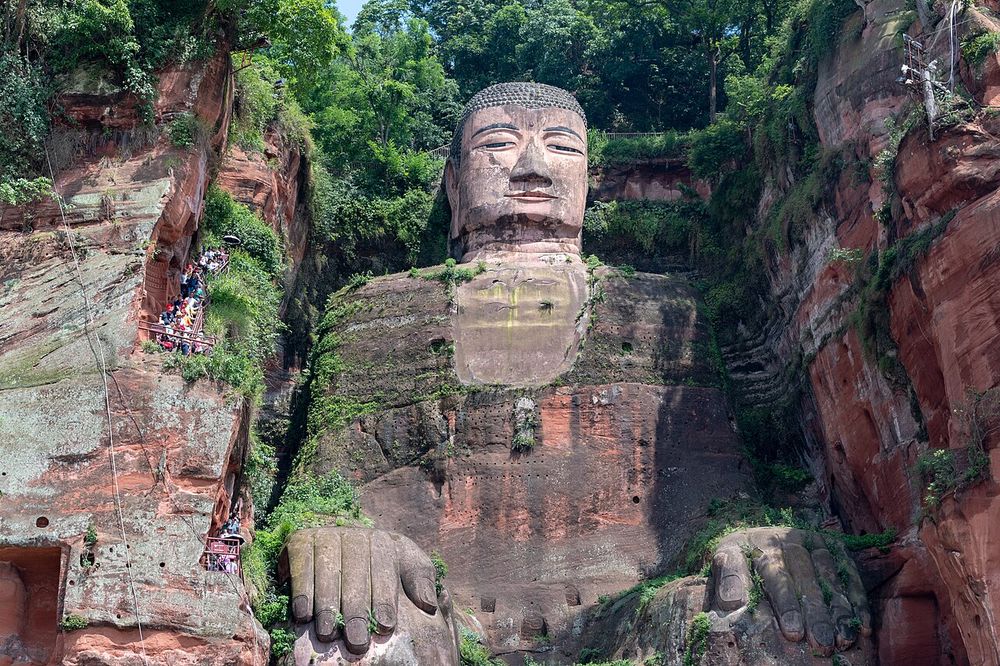
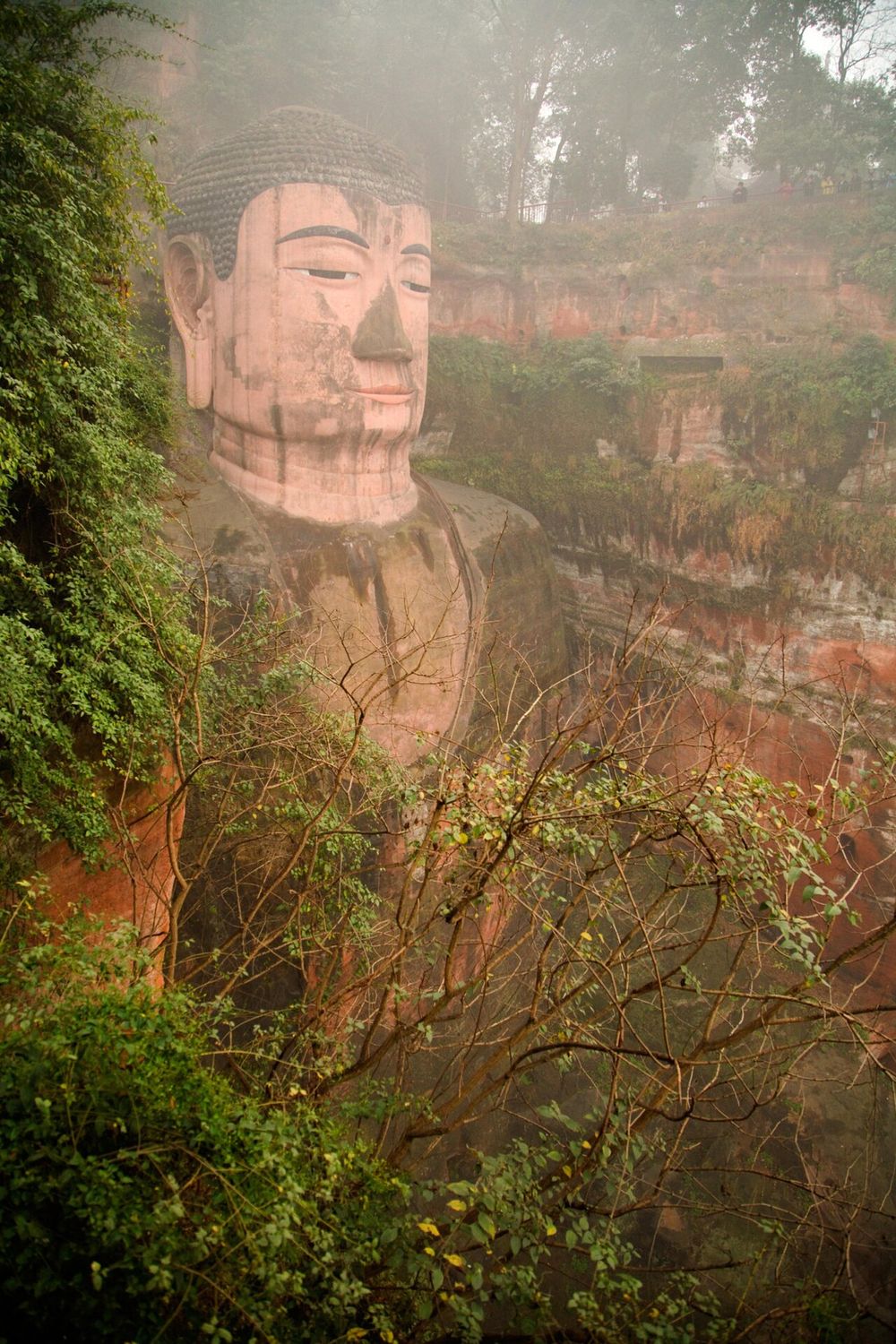
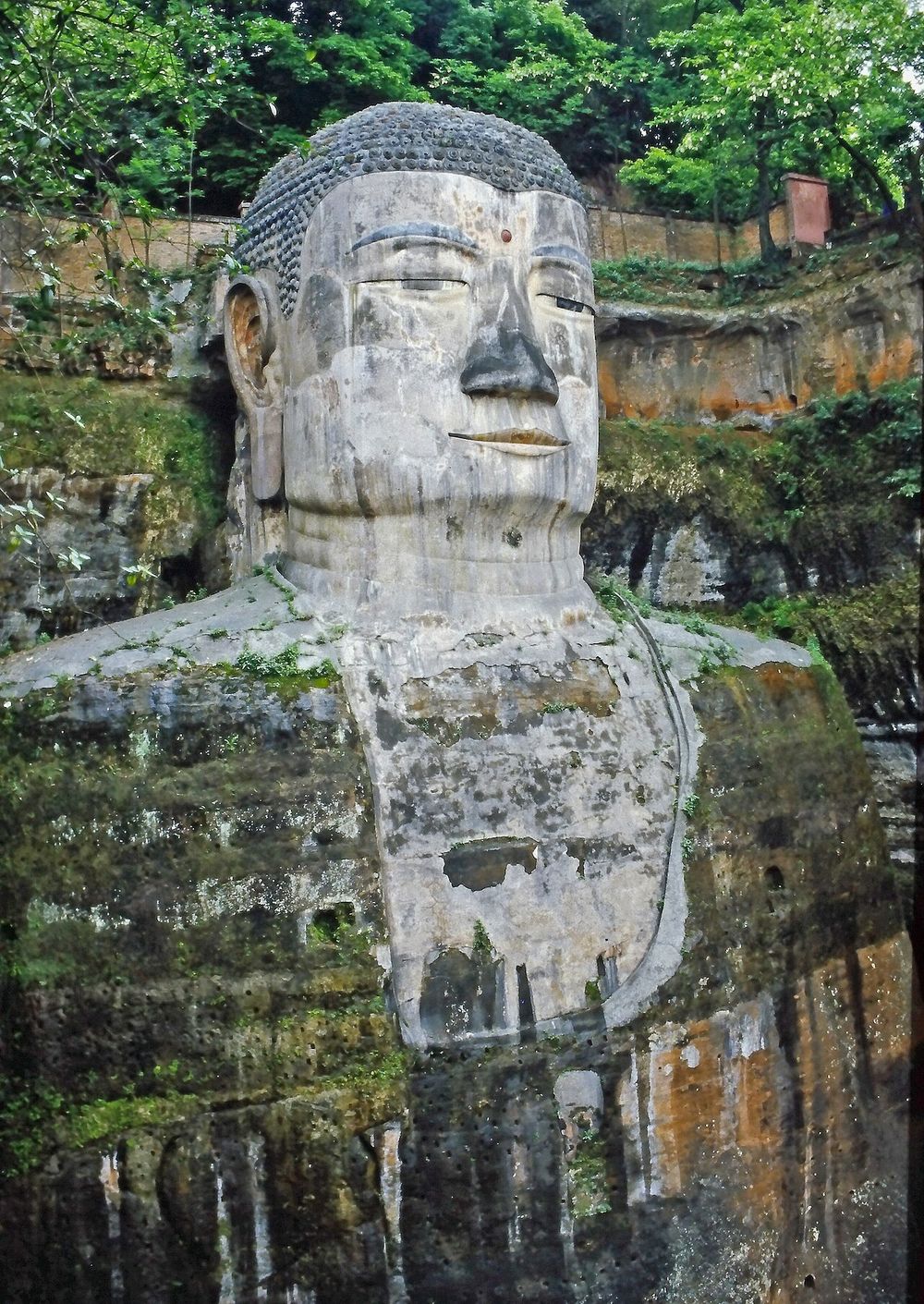
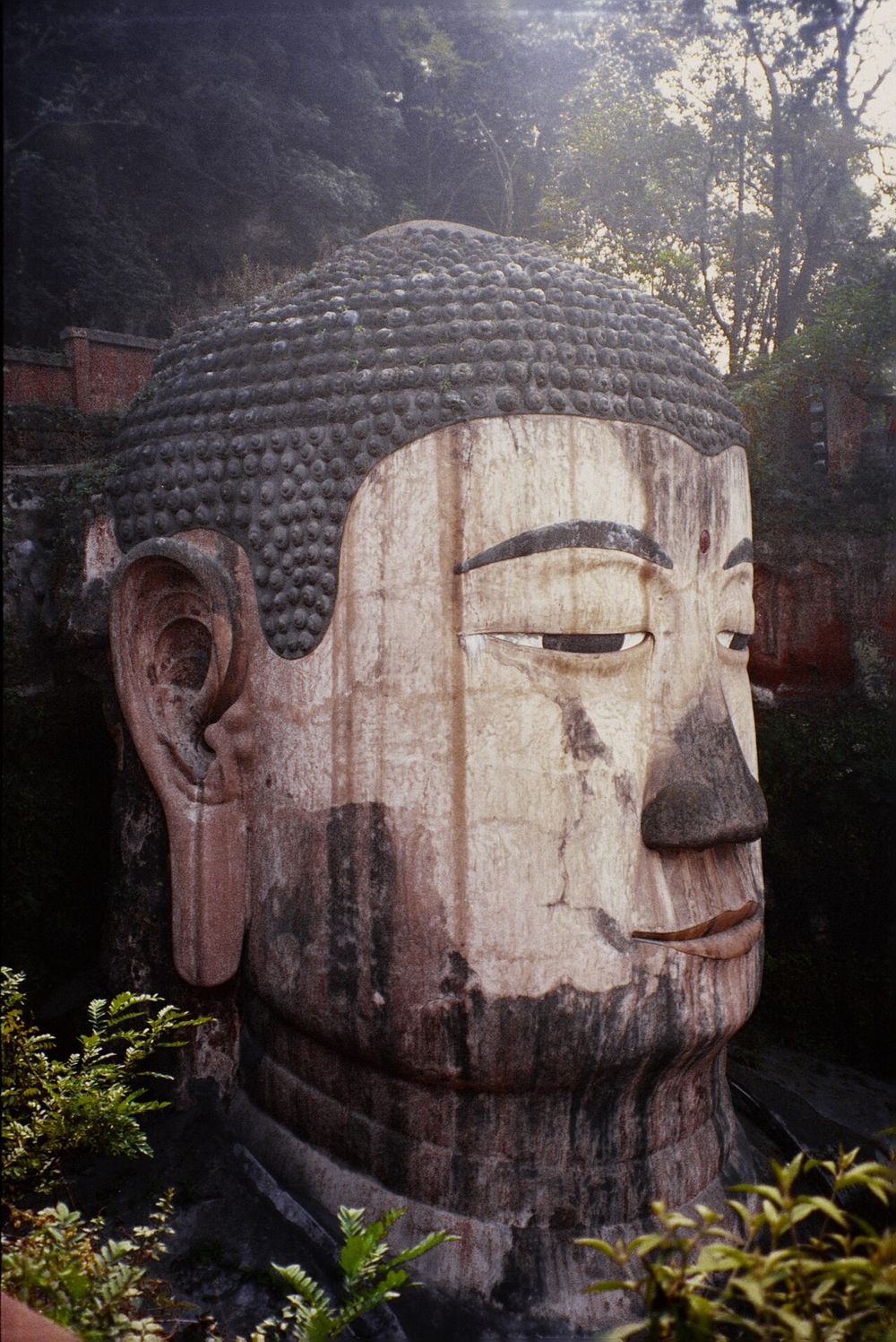
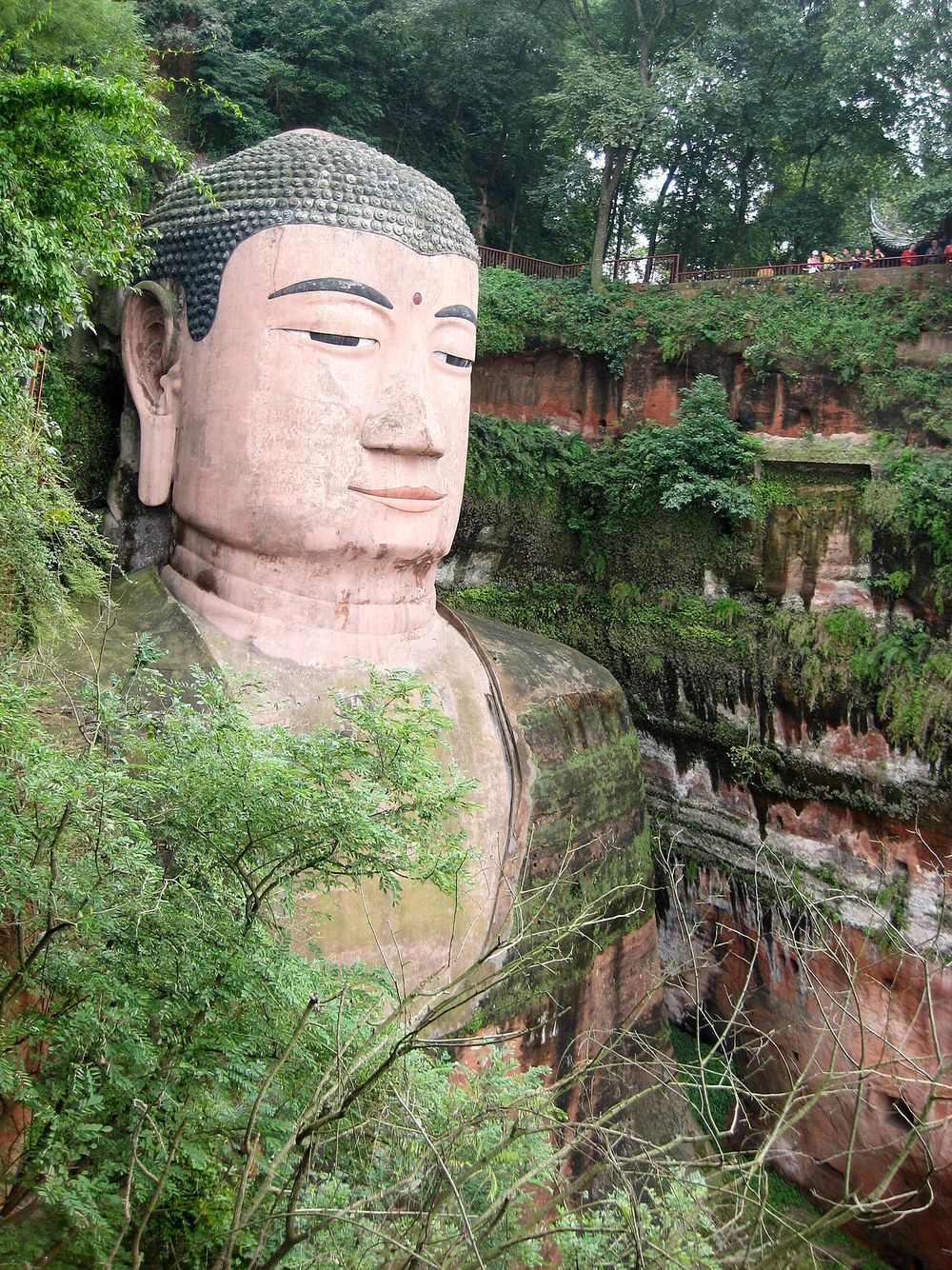
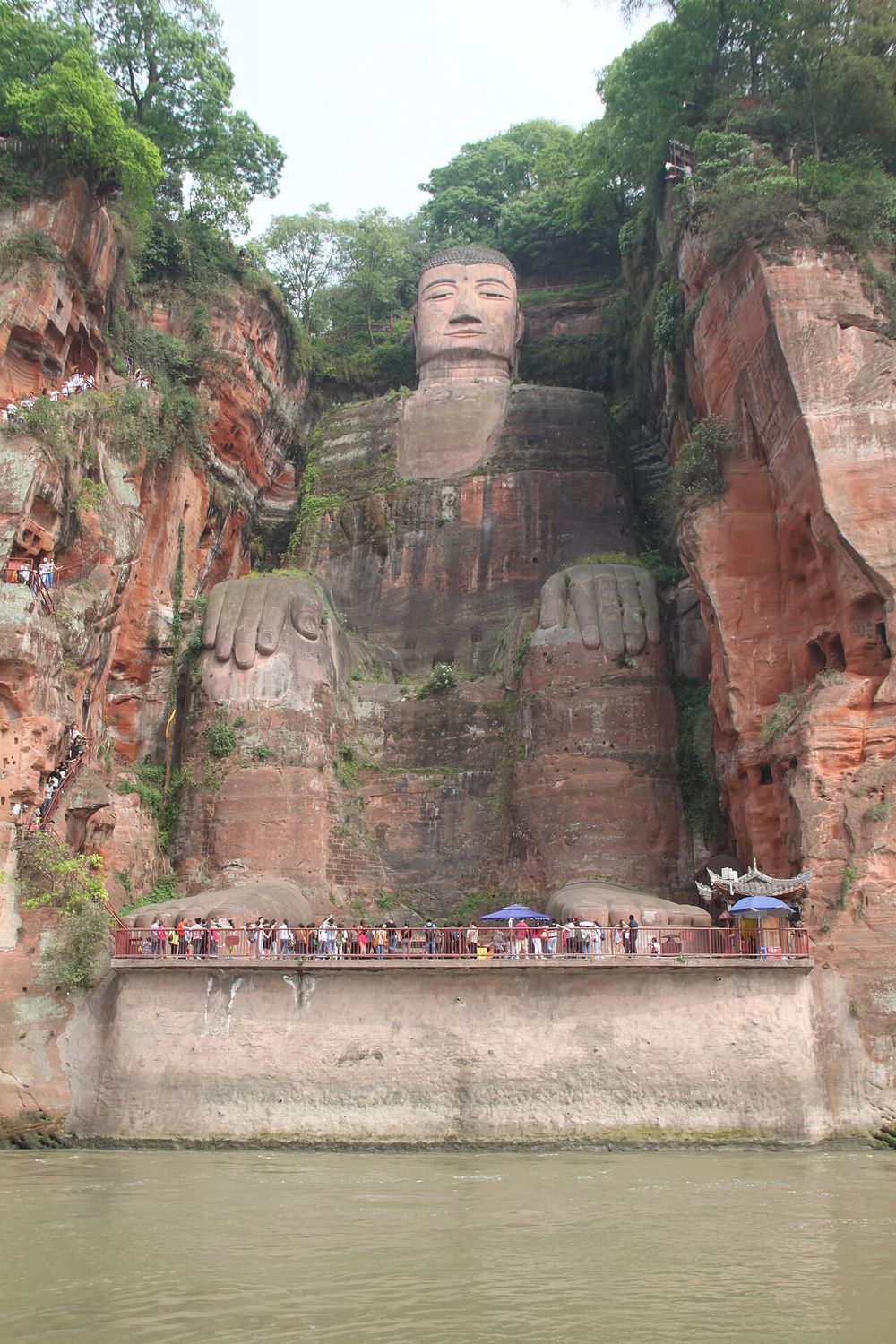
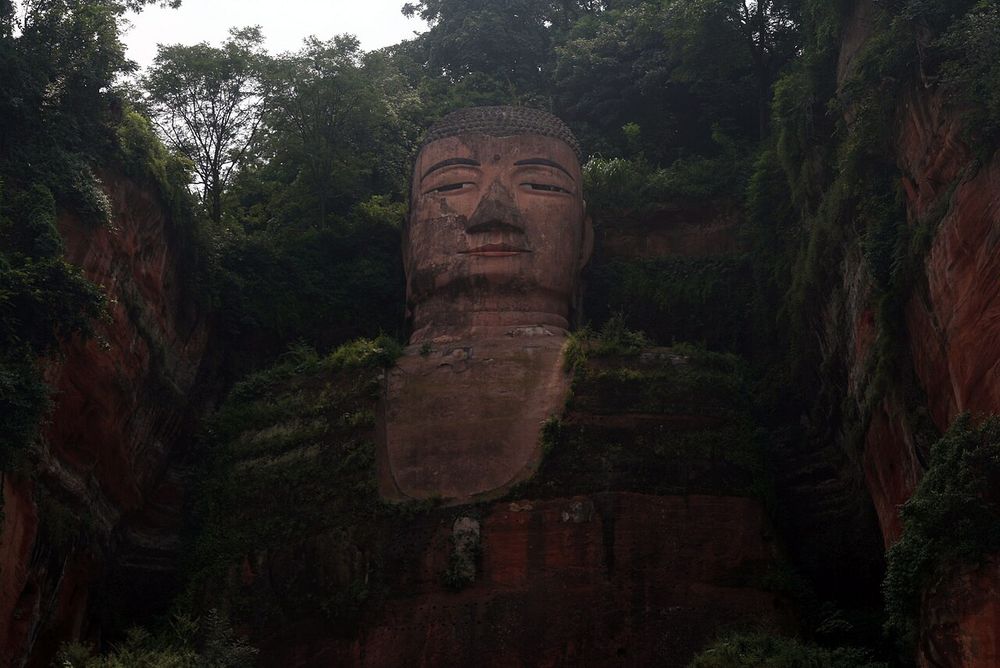
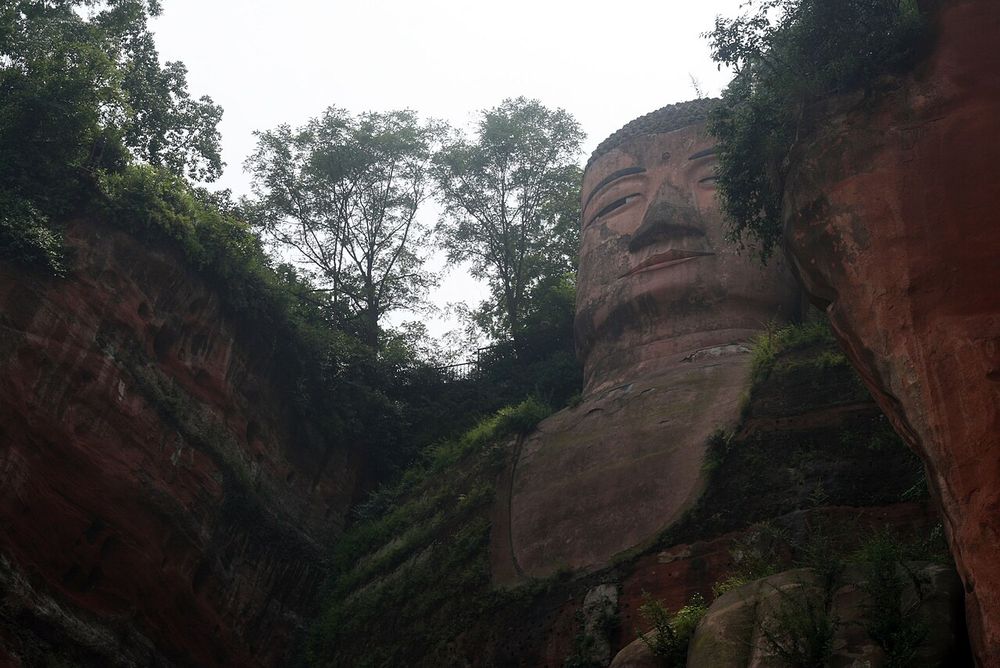
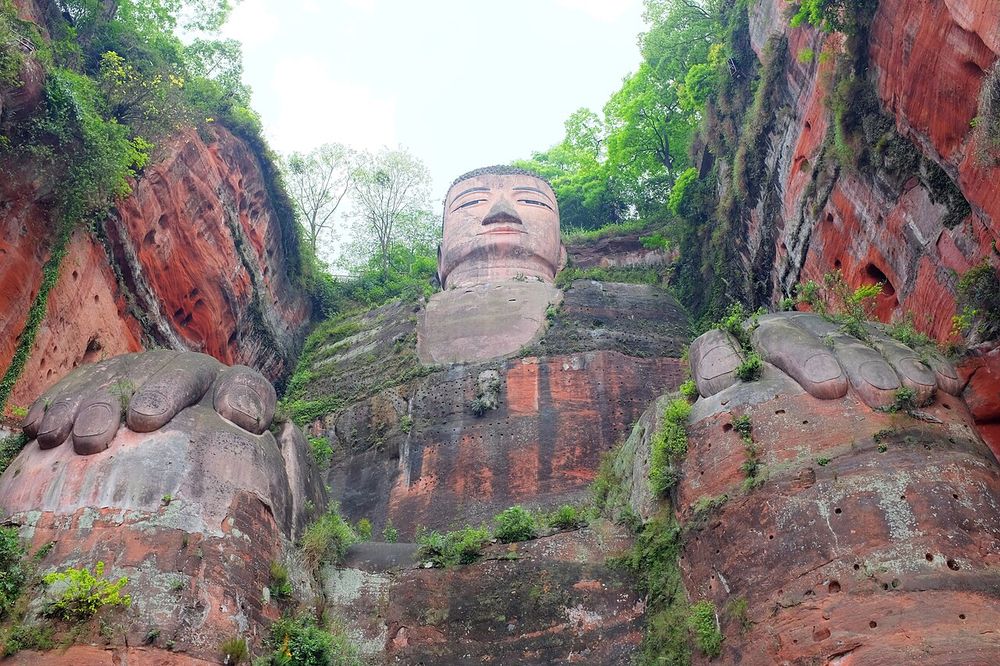
A seated Buddha 71 metres high, cut into a red sandstone cliff where three rivers meet. A monk began it in 713 to calm the deadly waters below, and it took ninety years to finish. It is still the largest stone Buddha in the world.
Photo: Yumeto, CC BY-SA 4.0, Wikimedia Commons
The story
Below Lingyun Mountain the Min, the Qingyi and the Dadu rivers meet, and in the Tang dynasty (618–907) boats were smashed here every flood season. In 713 a monk called Haitong began to carve a Buddha into the cliff, hoping its presence would tame the waters. He raised the money by begging along the rivers. He died long before it was done; two governors of Sichuan carried on, and the Buddha was finished in 803, ninety years after the first cut.
The Buddha is Maitreya, the Buddha of the future, seated with hands on knees and feet on the river bank. For centuries he sat under a thirteen-storey wooden hall, which burned at the end of the Ming (1368–1644). His builders hid gutters in his hair, behind his ears and in the folds of his robe to carry away rain, and they still work. Stone chipped from the cliff fell into the river and, it is said, really did slow the current.
What is here
One ticket covers the mountain: the head, the stair to the feet, Lingyun Temple, the Lingbao Pagoda and Wuyou Temple. The river boat is a separate ticket.
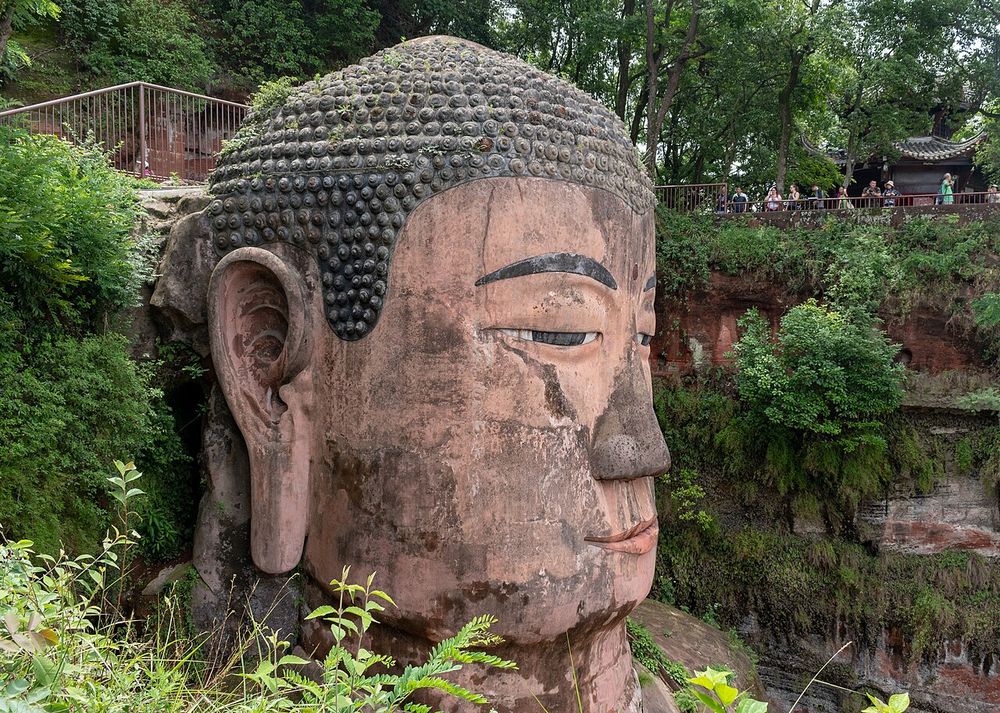
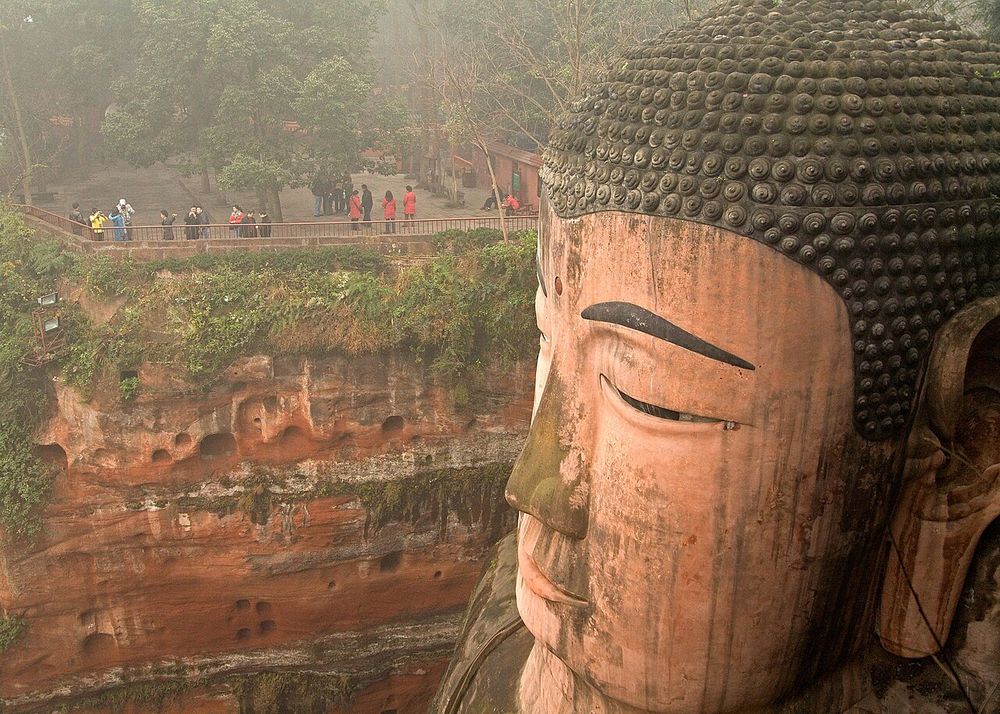
The head from beside it, 2018xiquinhosilva, CC BY 2.0
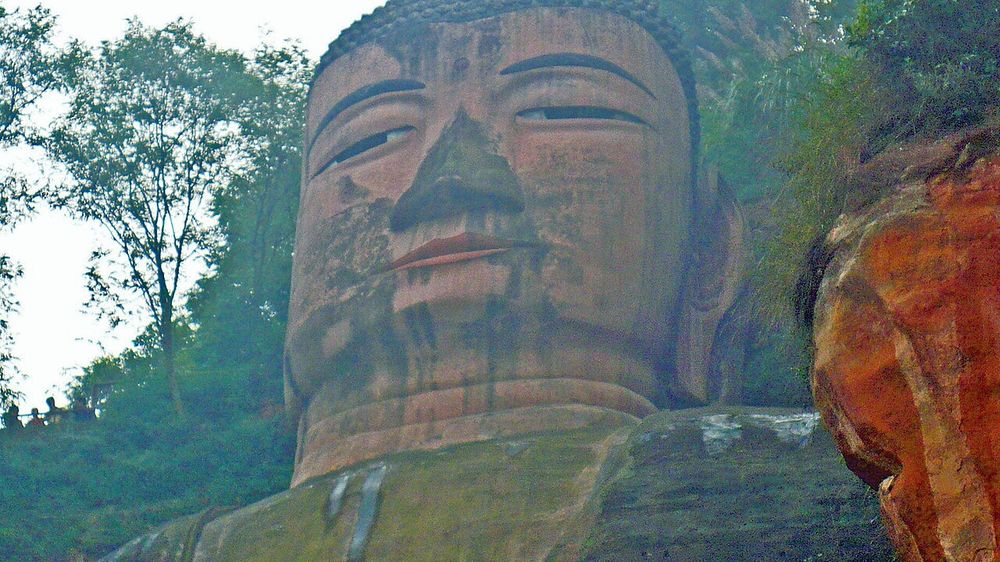
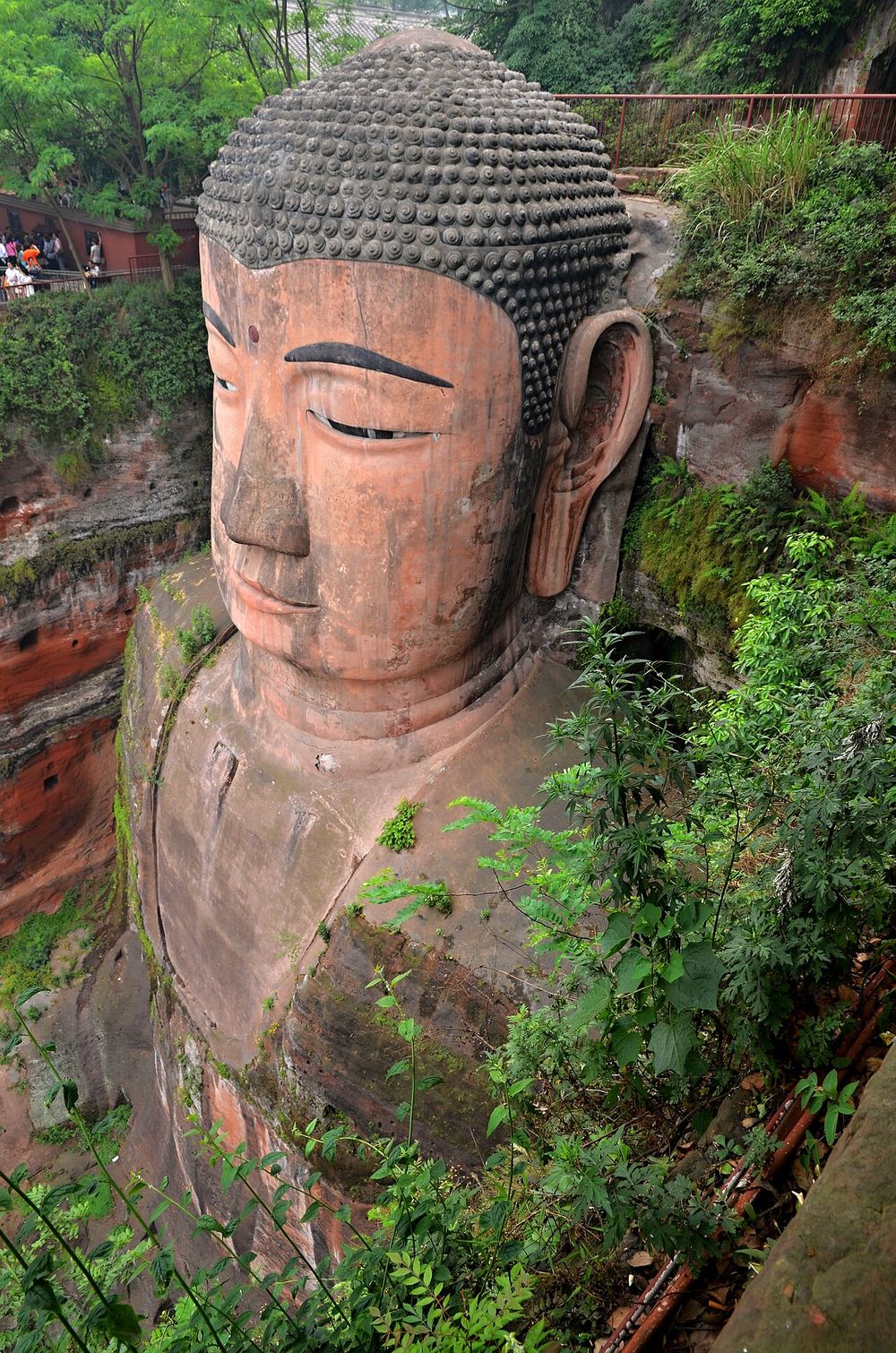
You are level with his eyes. The head alone is about fifteen metres tall, and the coils of his hair are separate stones set into the scalp, more than a thousand of them. Look at his ears: each is about seven metres long and made of wood covered with plaster.
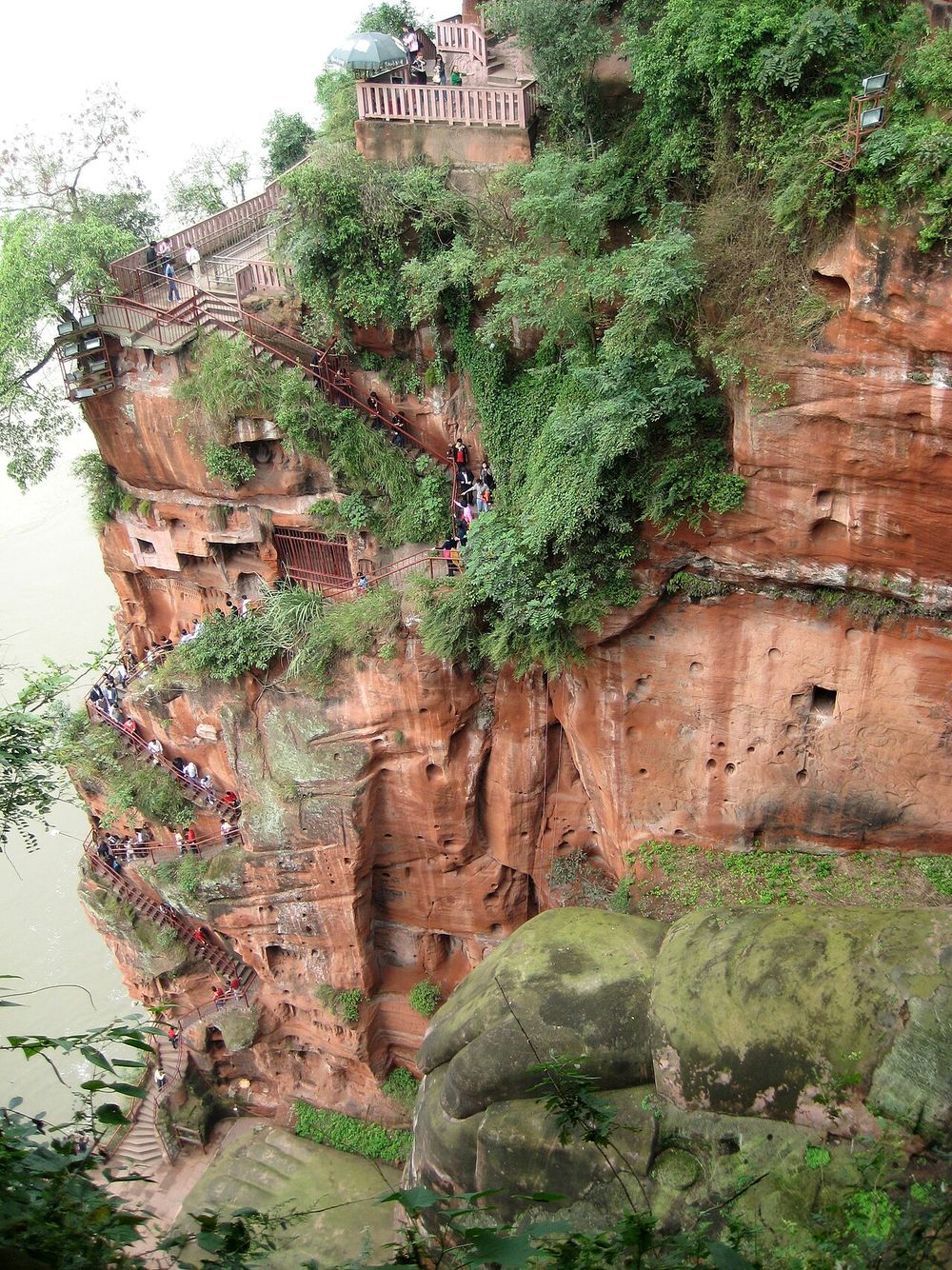
Then look down the cliff. A steep stair, the Nine-Bend Plank Way, zigzags down the rock beside him to his feet. Each of his toes is big enough for a group of people to stand on the nail.
The stair down to the feet, 2008rduta, CC BY 2.0
Things people often get wrong
"It is the Buddha who founded Buddhism." It is Maitreya, the Buddha to come, often shown seated like this in the Tang.
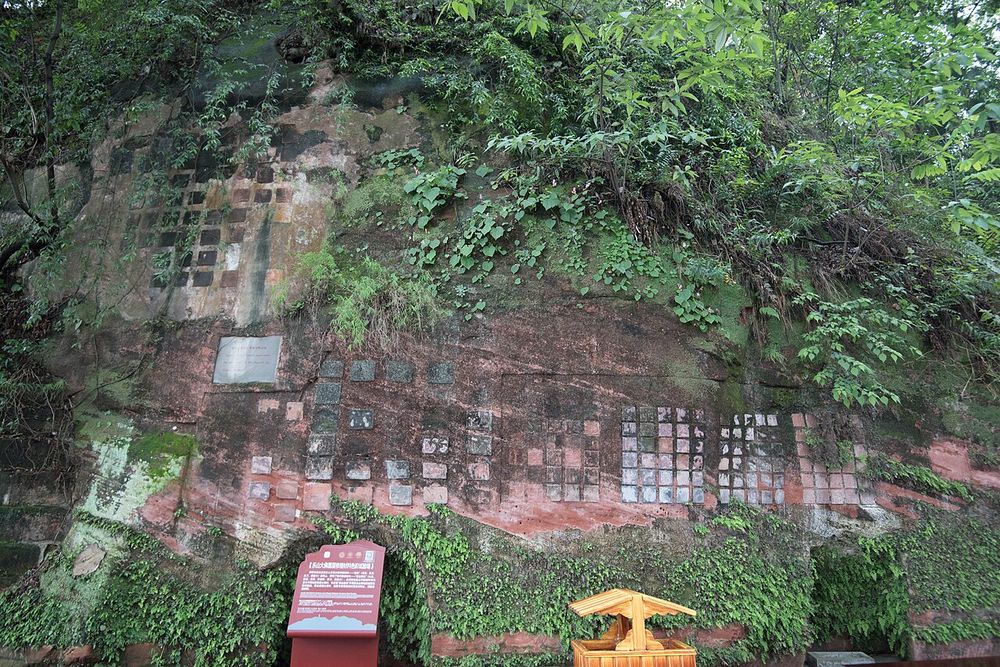
"It is made of one solid stone and nothing else." The ears and parts of the nose were made of wood and plaster, and the surface has been repaired many times; patches of recent repair can be seen on the cliff.
People who stood here
We searched Chinese sources first for this list, then English ones.
Haitong (monk, 8th century)He began the Buddha in 713 and spent his life raising money for it. His cave beside the head, the Haishi Cave, is still there.
Wei Gao (governor of Sichuan, 745–805)He saw the Buddha finished in 803 and wrote the inscription that tells its story.
Su Shi (poet, 1037–1101)The great Song poet, from nearby Meishan, wrote that he wished he could be governor here and "come with wine to roam on Lingyun". A hall on the mountain is named after him.
Lu You (poet, 1125–1210)He served as acting prefect of Jiazhou, today's Leshan, in 1173 and wrote poems on the great image.
Go deeper: five stops from the head to the feet and out on the river6 stops · about 1 min to read
The walk takes two to three hours on the mountain; the boat, half an hour on the river. Do both if you can: the head from above, the whole figure from the water.
1. The head and Lingyun Temple
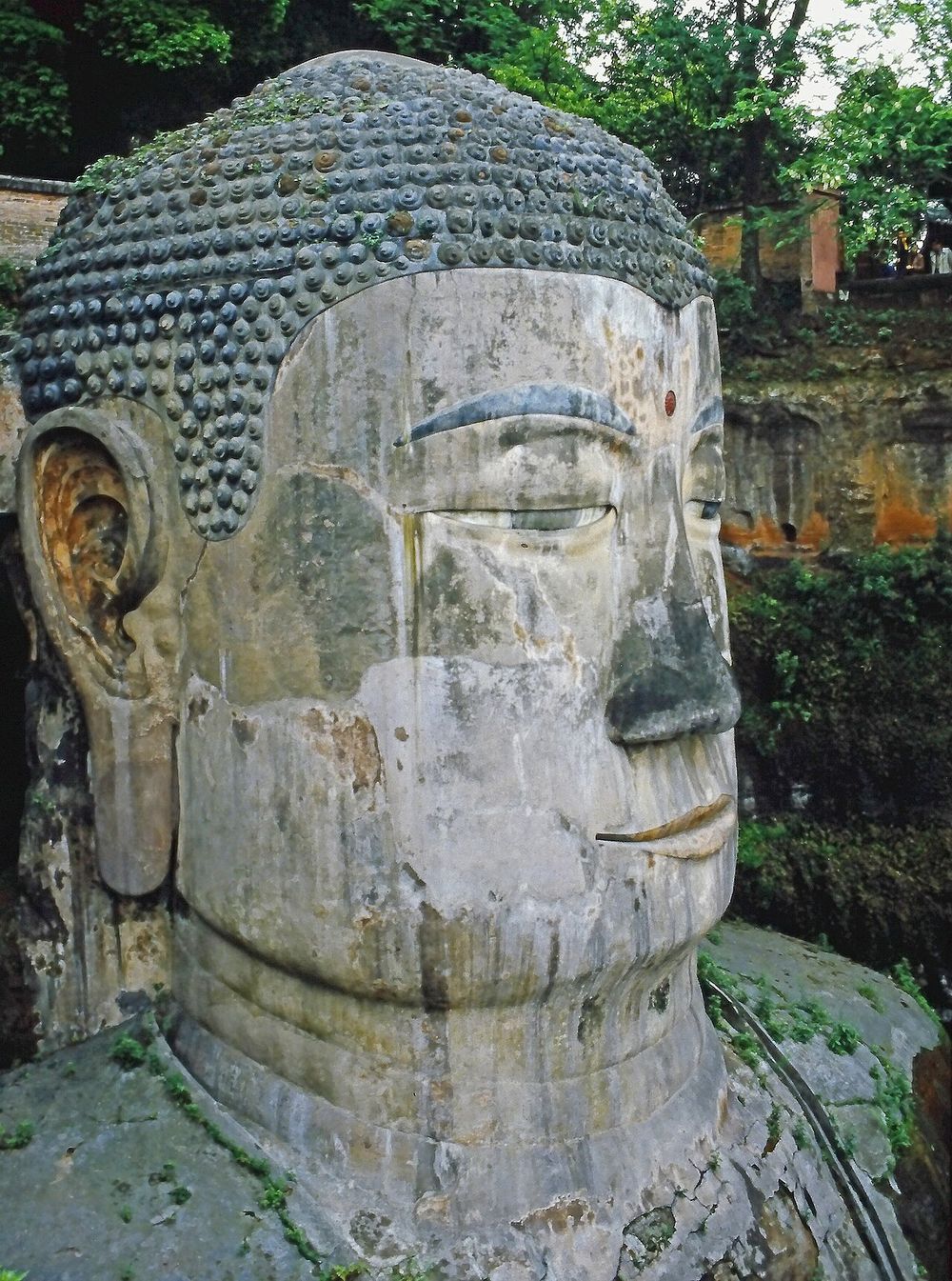
The head in 1988Jan Kranendonk (https://www.jankranendonk.nl), CC0
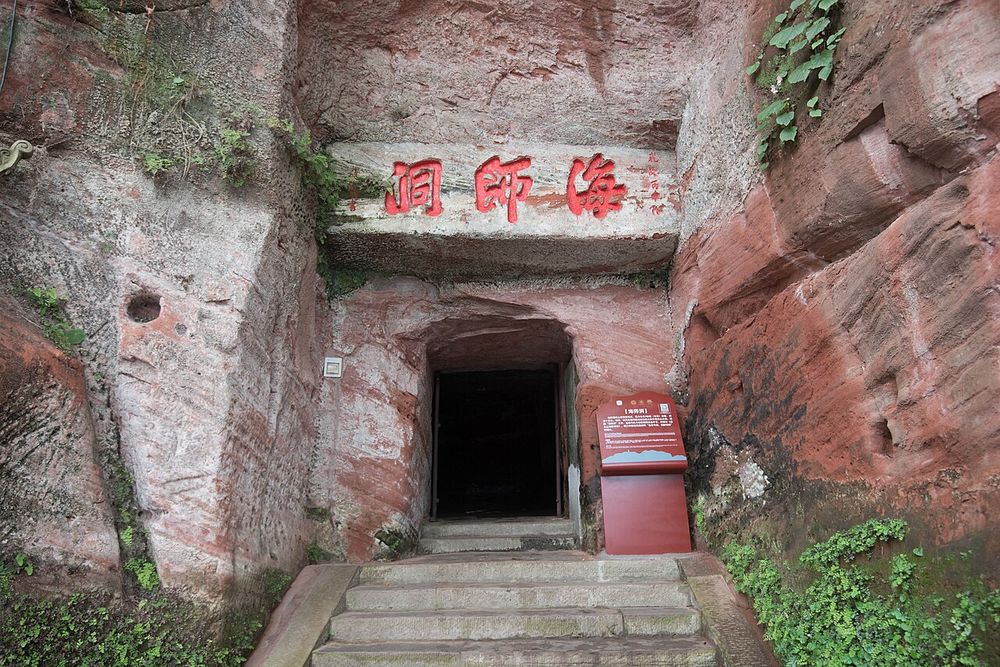
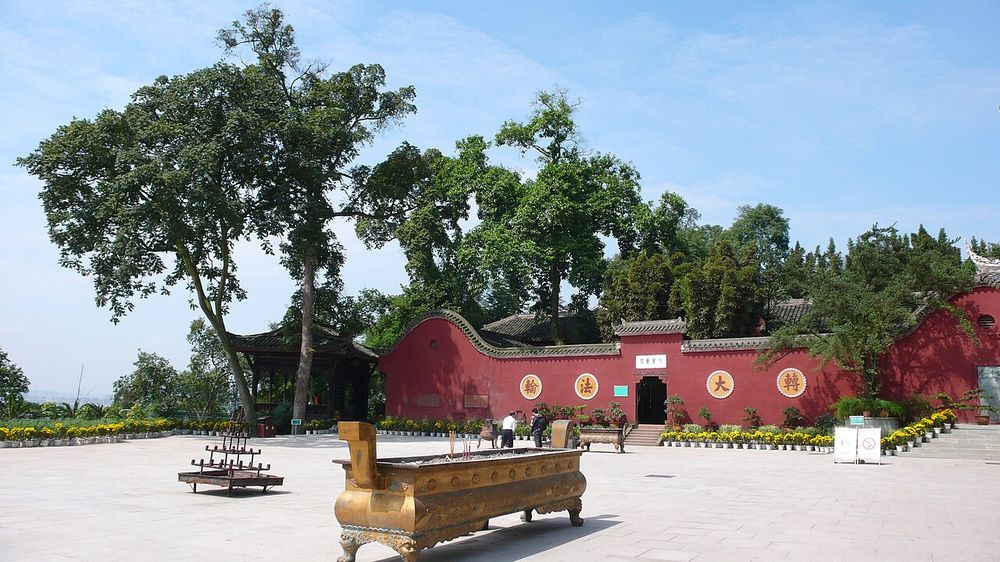
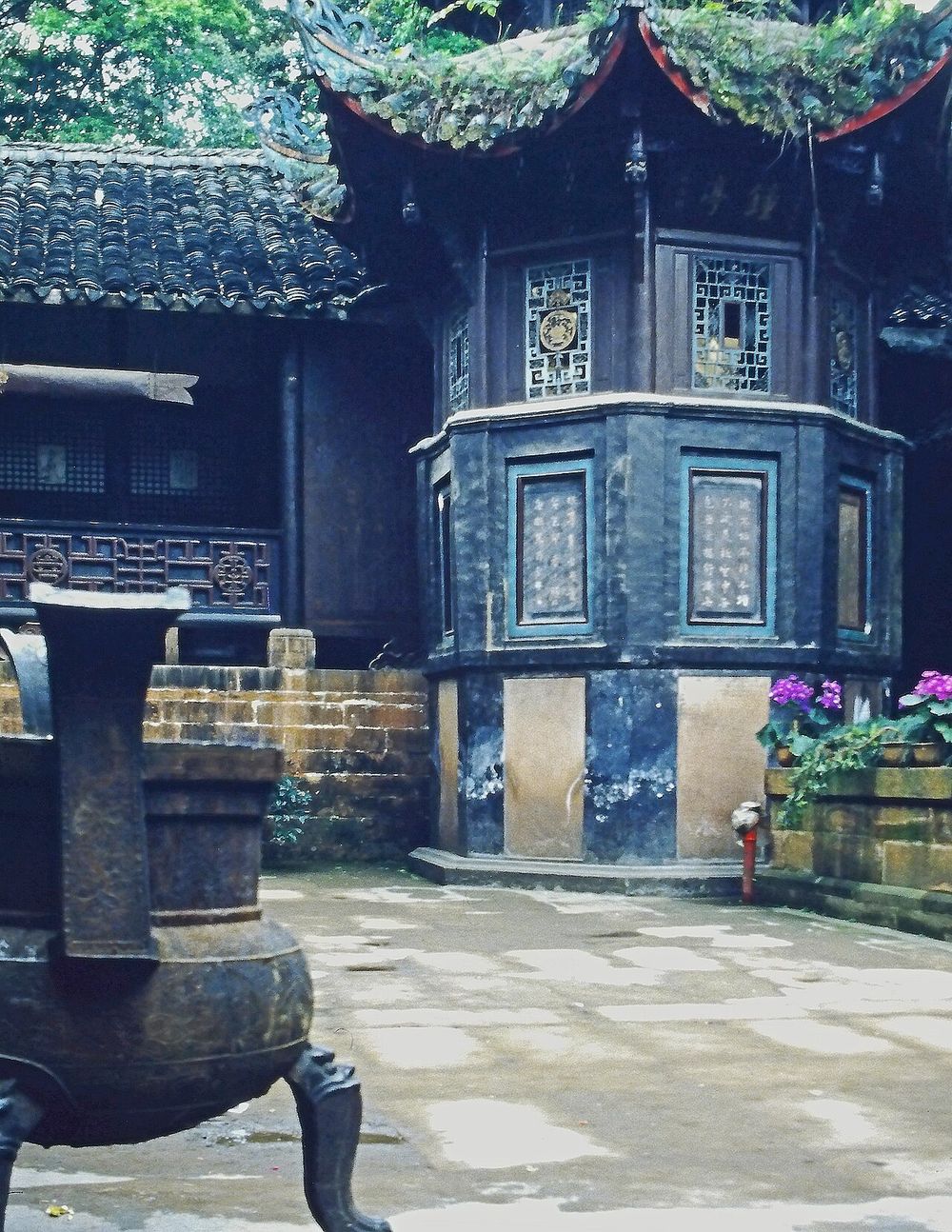
Behind the head stands Lingyun Temple, the monastery that grew up with the Buddha. The Haishi Cave, where Haitong lived, is cut into the cliff close by.
The Haishi Cave, where Haitong lived, 2017Siyuwj, CC BY-SA 4.0
2. Down the Nine-Bend Plank Way
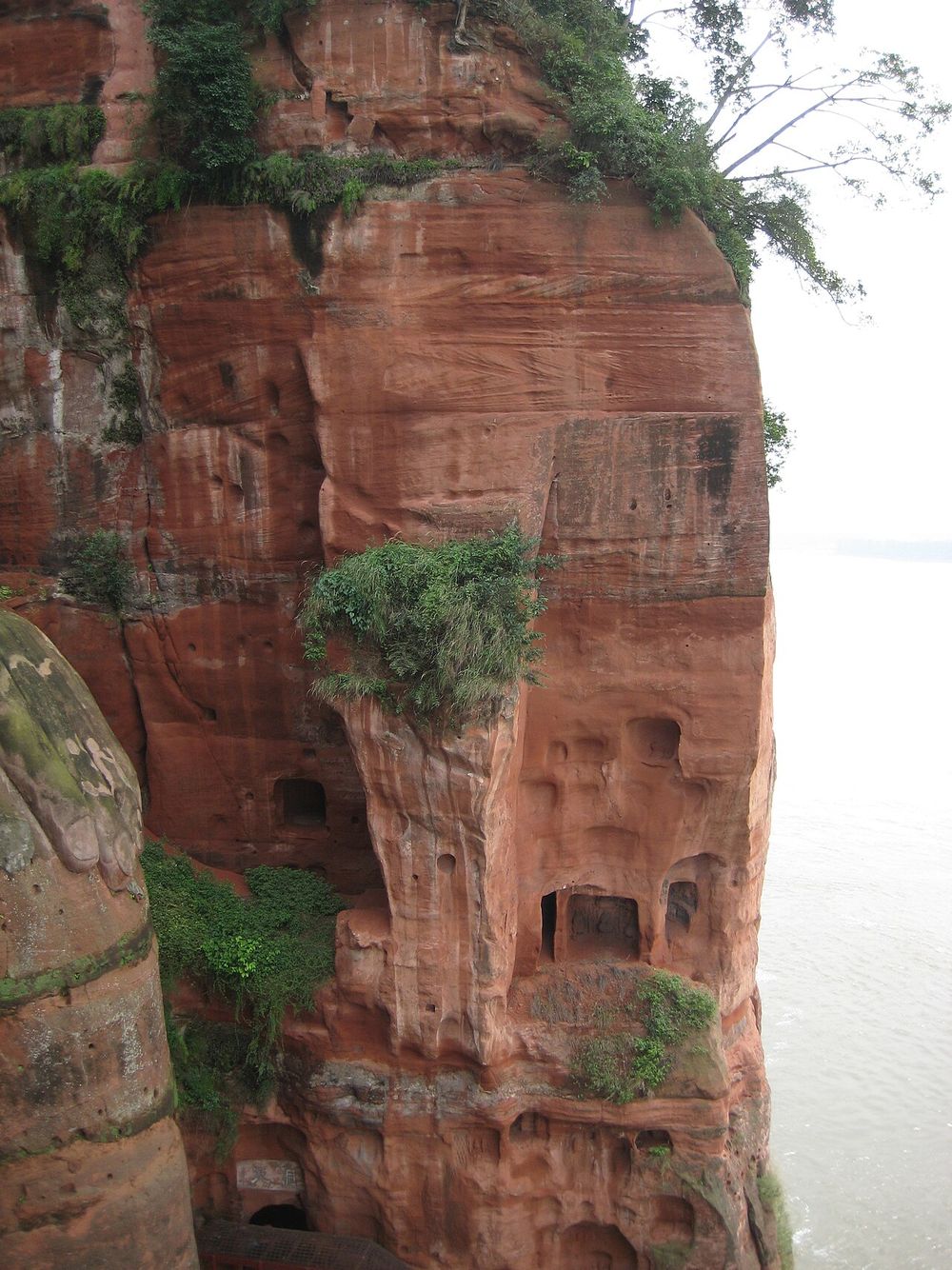
The cliff beside the Buddha, 2008rduta, CC BY 2.0
The stair is one-way and narrow, with up to two or three hours of queue on busy days. As you go down, the Buddha's body passes beside you like a wall; look for the old niches and small carved figures in the cliff.
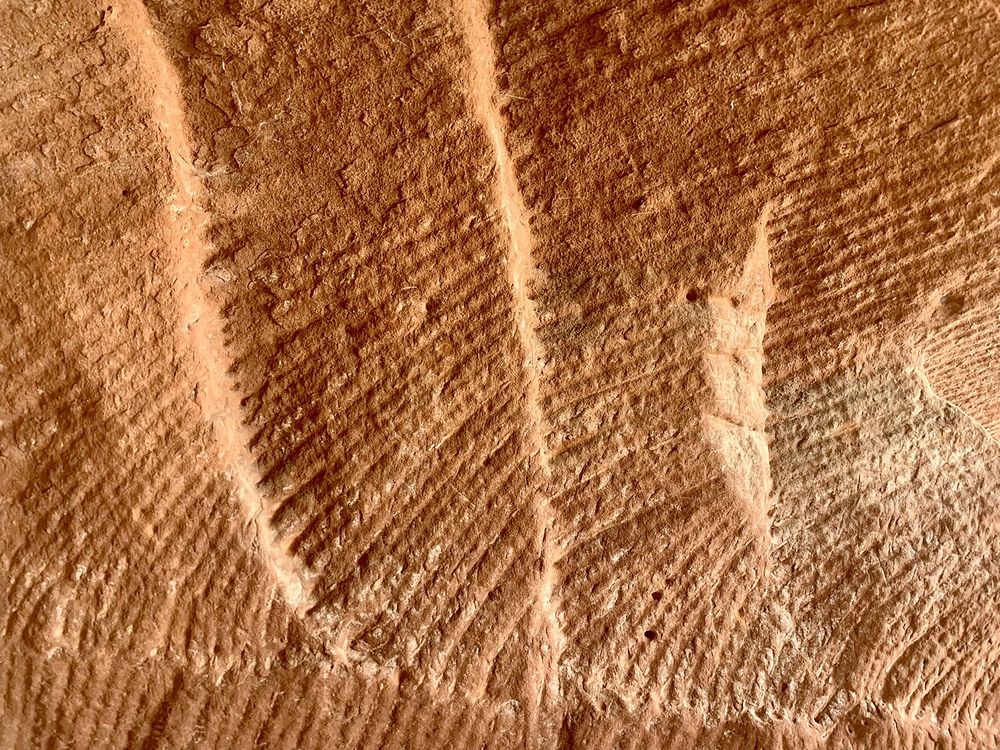
Tool marks in the sandstone beside the Buddha, 2025Dudva, CC0
3. At his feet
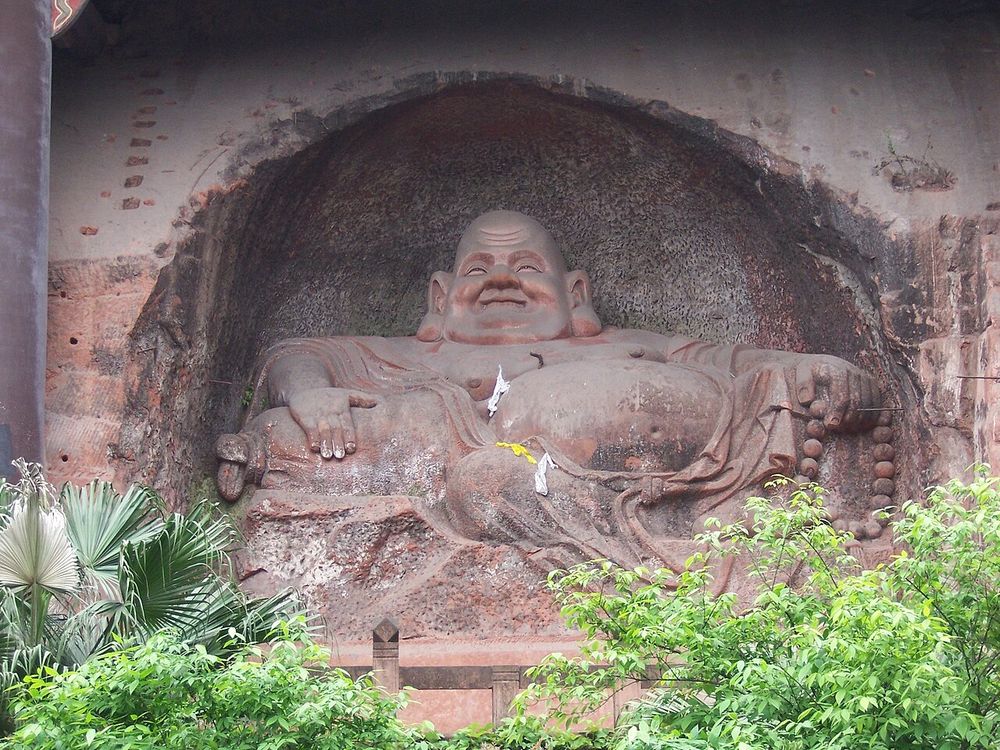
A seated Buddha in a niche on the cliff, 2006McKay Savage from London, UK, CC BY 2.0
The platform at his feet is just above the river. Look up: from here you understand the scale, and why it took ninety years.
4. Lingbao Pagoda and Wuyou Temple
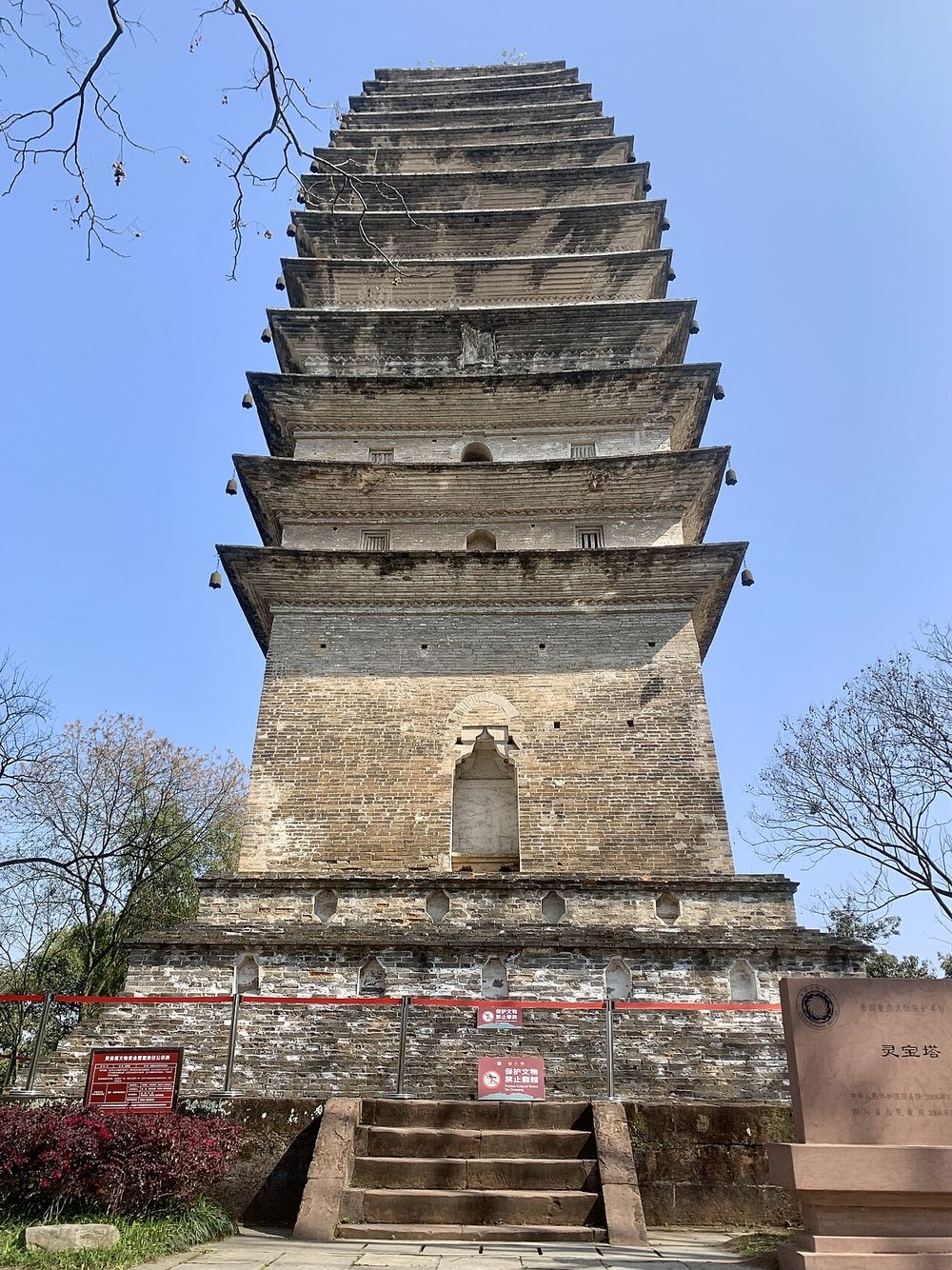
The Lingbao Pagoda, 2025Dudva, CC0
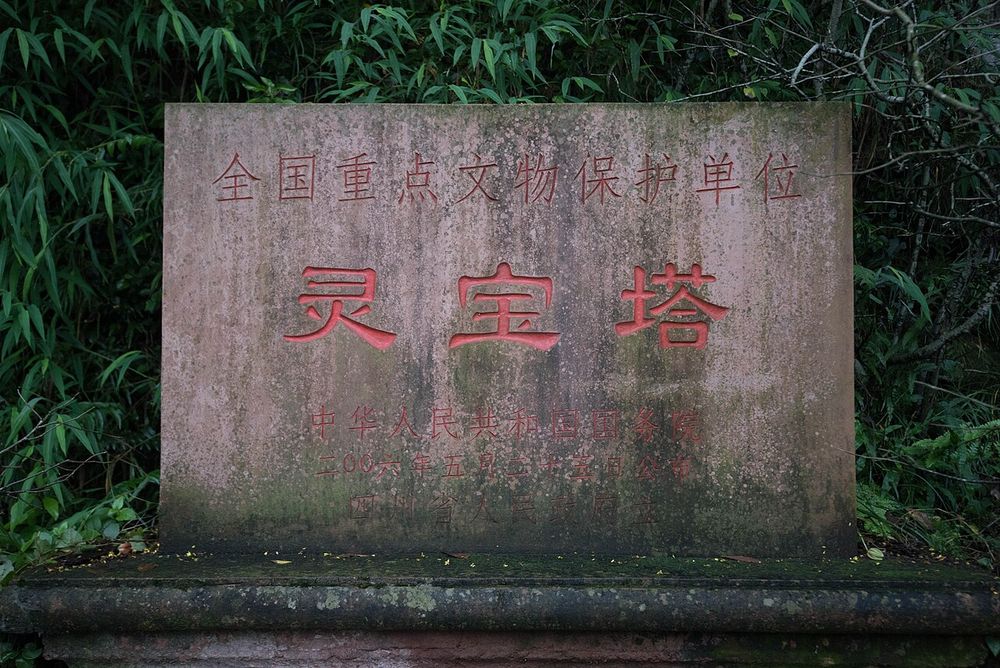
On the hill above stands the brick Lingbao Pagoda, about 38 metres high, a landmark for boats since the Tang or Song. Across a small channel, on its own hill, Wuyou Temple has a hall of five hundred arhats.
Inside Wuyou Temple, 2011Urga, CC BY-SA 3.0
5. From the river
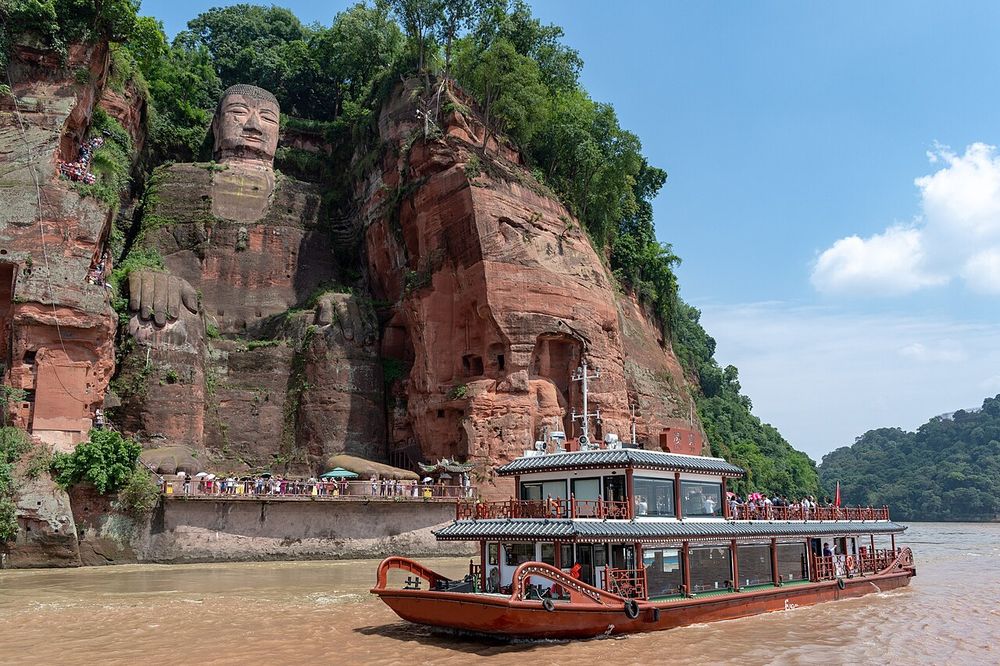
A boat in front of the Buddha, 2018xiquinhosilva, CC BY 2.0
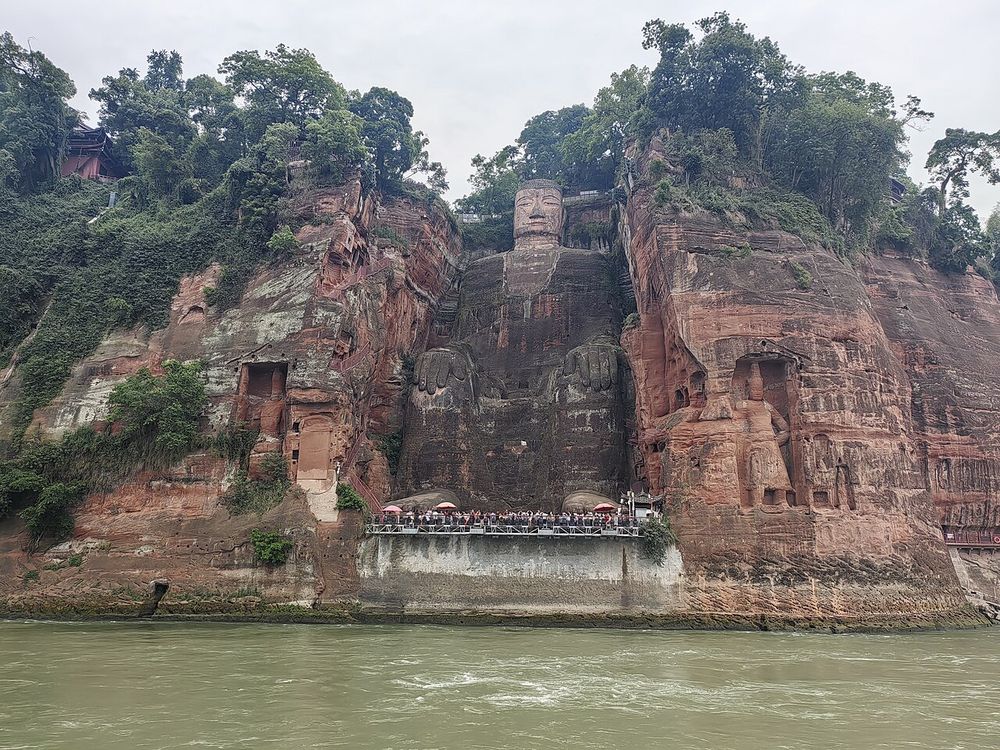
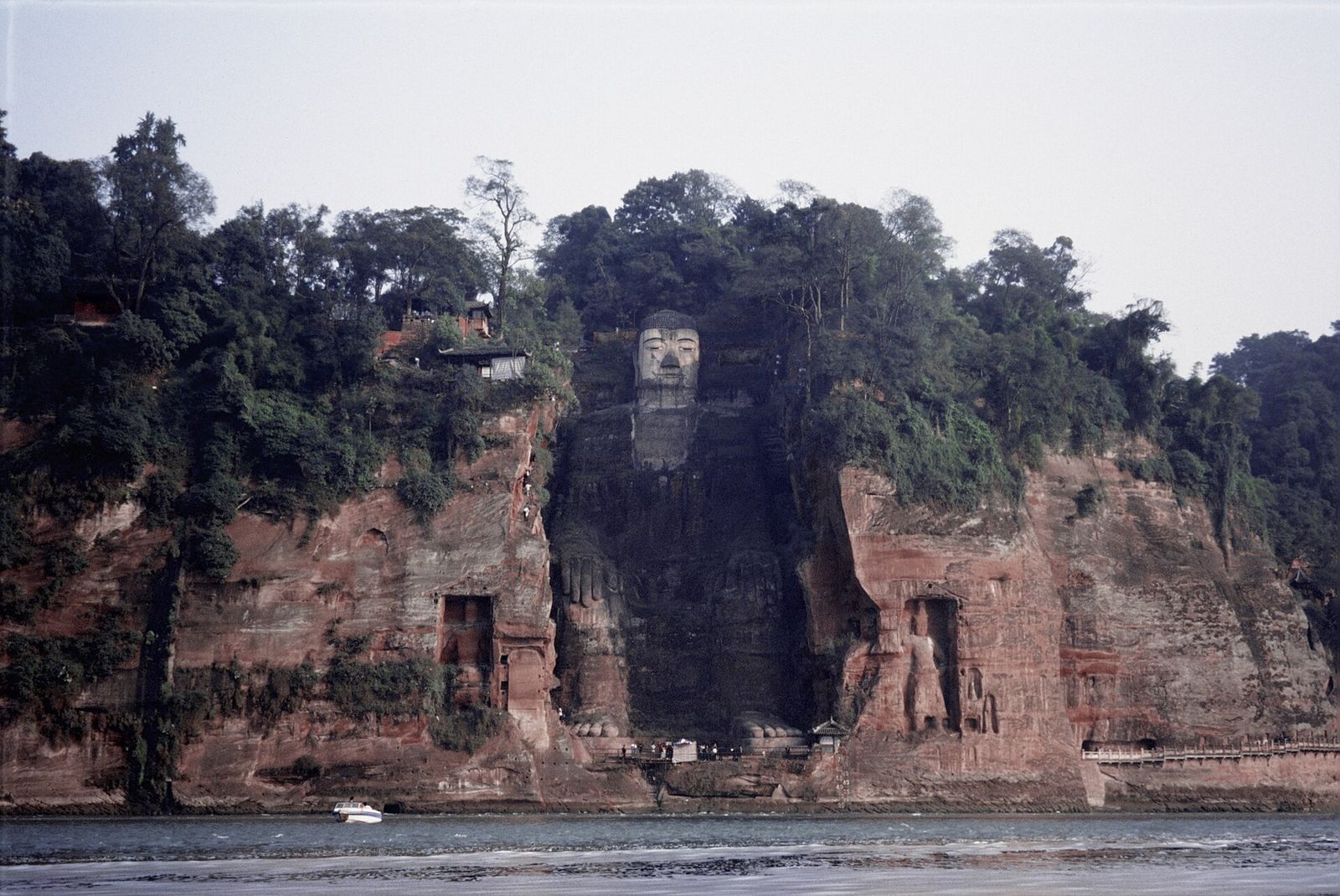
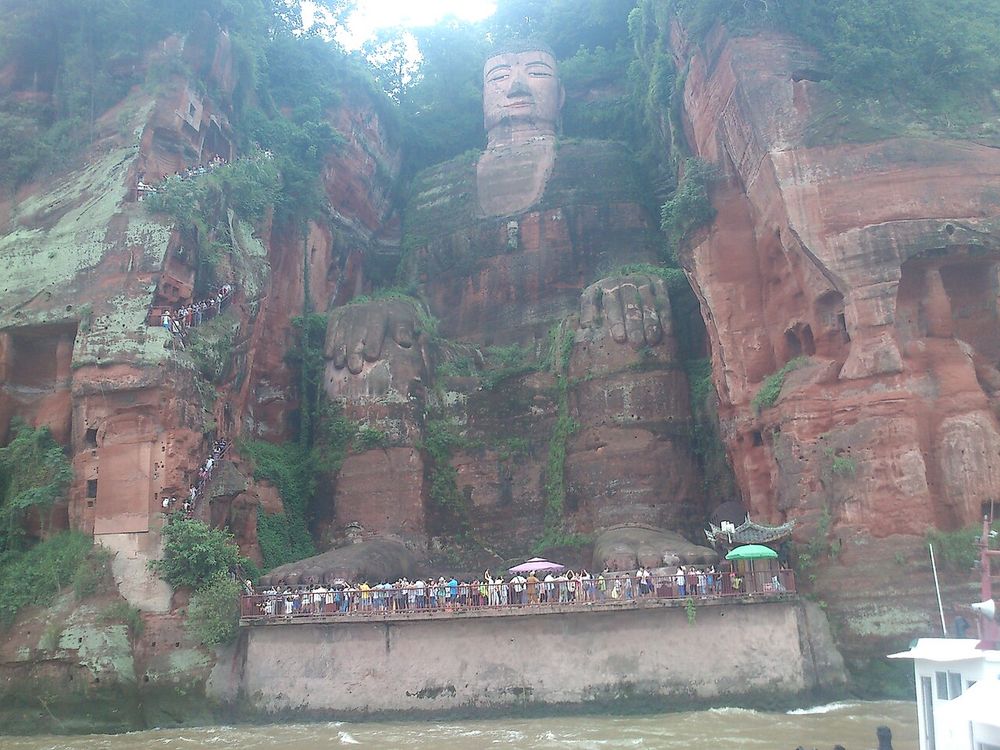
Only from a boat can you see the whole Buddha at once, with the two guardian kings carved in niches on either side. The boats stop for a few minutes in front of him.
The Buddha and the same years elsewhere
The first stones were cut in 713. Two years earlier, Arab and Berber armies had crossed into Spain.
Meanwhile in the world
Year
Here
Elsewhere
713
Haitong begins the Buddha
Arab armies have just entered Spain
803
The Buddha is finished
Charlemagne rules the Franks as emperor
1996
With Mount Emei, the Buddha becomes a World Heritage Site
The sheep Dolly is cloned
One line to remember: a monk's prayer to calm a river, ninety years in the cutting.
Then and now
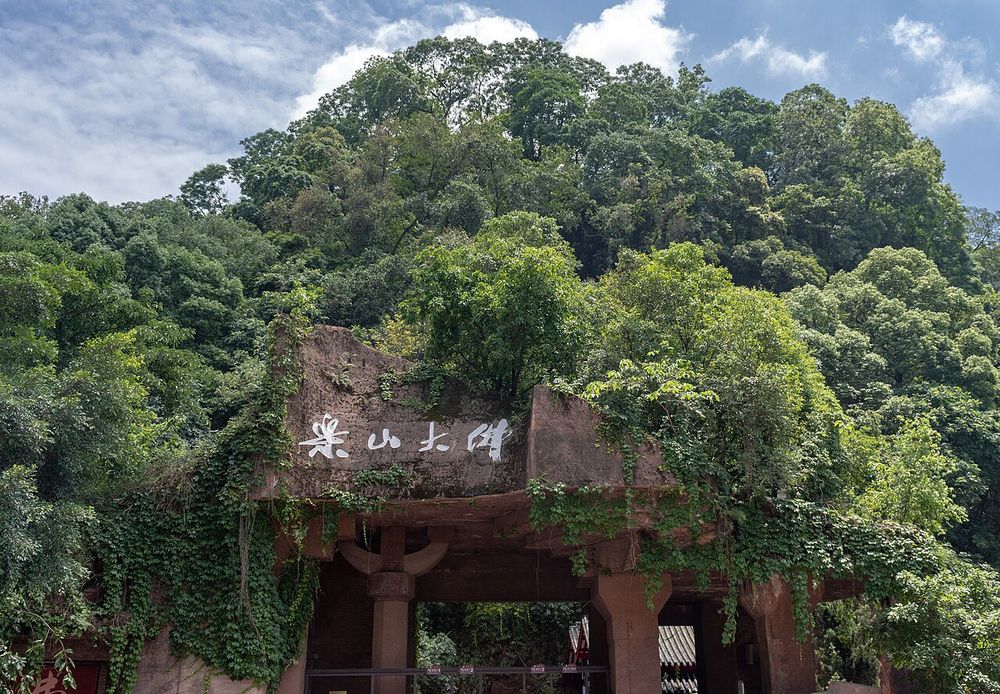
The Buddha from the river, May 2025Yumeto, CC BY-SA 4.0, Wikimedia CommonsThe cliff and the Buddha from the water, 1997Giorgioglobe, CC BY-SA 4.0, Wikimedia CommonsA boat in front of the Buddha, 2018xiquinhosilva, CC BY 2.0, Wikimedia CommonsThe whole figure, 2018xiquinhosilva, CC BY 2.0, Wikimedia CommonsThe head from beside it, 2018xiquinhosilva, CC BY 2.0, Wikimedia CommonsThe gate of Lingyun Mountain, 2018xiquinhosilva, CC BY 2.0, Wikimedia CommonsThe face in mistChi King, CC BY 3.0, Wikimedia CommonsThe Buddha in a green hazeChi King, CC BY 3.0, Wikimedia CommonsLooking down on the Buddha in mistChi King, CC BY 3.0, Wikimedia CommonsThe head in 1988Jan Kranendonk (https://www.jankranendonk.nl), CC0, Wikimedia CommonsHead and torso, 1988Jan Kranendonk (https://www.jankranendonk.nl), CC0, Wikimedia CommonsThe face, 1997Giorgioglobe, CC BY-SA 4.0, Wikimedia CommonsThe upper body, 2008rduta, CC BY 2.0, Wikimedia CommonsThe cliff beside the Buddha, 2008rduta, CC BY 2.0, Wikimedia CommonsThe stair down to the feet, 2008rduta, CC BY 2.0, Wikimedia CommonsThe Buddha above the river, 2014Gary Todd from Xinzheng, China, CC0, Wikimedia CommonsBetween the cliffs, 2013Joe Hart from Southampton, United Kingdom, CC BY 2.0, Wikimedia CommonsThe Buddha from the side, 2013Joe Hart from Southampton, United Kingdom, CC BY 2.0, Wikimedia CommonsThe Buddha and the red rock, 2015Min Zhou, CC BY 2.0, Wikimedia CommonsThe face close upColin W, CC BY-SA 3.0, Wikimedia CommonsThe platform at the feetBlackNose, CC BY 3.0, Wikimedia CommonsThe Buddha among green leavesPavel Špindler, CC BY 3.0, Wikimedia CommonsA seated Buddha in a niche on the cliff, 2006McKay Savage from London, UK, CC BY 2.0, Wikimedia CommonsThe river below the mountain, 2006McKay Savage from London, UK, CC BY 2.0, Wikimedia CommonsTool marks in the sandstone beside the Buddha, 2025Dudva, CC0, Wikimedia CommonsTrial repair patches on the cliff, 2017Siyuwj, CC BY-SA 4.0, Wikimedia CommonsThe Haishi Cave, where Haitong lived, 2017Siyuwj, CC BY-SA 4.0, Wikimedia CommonsThe Lingbao Pagoda, 2025Dudva, CC0, Wikimedia CommonsThe stone tablet of the Lingbao Pagoda, 2017Siyuwj, CC BY-SA 4.0, Wikimedia CommonsInside Wuyou Temple, 2011Urga, CC BY-SA 3.0, Wikimedia CommonsA hall of Wuyou Temple, 1988Jan Kranendonk (https://www.jankranendonk.nl), CC0, Wikimedia CommonsThe gate of the scenic area at nightShadi Alkasim, CC BY-SA 3.0, Wikimedia Commons
Local legends
These are stories people tell about this place. They are legends, not history, and each one says where it comes from.
LegendHaitong's eyes
When officials came to take the money he had collected for the Buddha, Haitong is said to have told them they could have his eyes but not the Buddha's money, and gouged out his own eyes. The officials fled in shame.
Source: Told in Wei Gao's inscription of 803 and retold ever since
Later, people who live here will be able to add the stories they grew up with, and say which of these they have heard.
Not certain, and where accounts conflict
How many coils of hair?
Guides give 1,021 or 1,051. Counts differ because some coils are damaged or hidden by plants.
Did Su Shi study here?
A building on the mountain is called Dongpo's study, after a tradition that he read books here as a young man. His poem shows he admired the place; no record confirms that he studied here.
Visiting
Tickets and hours
Mountain ticket 80 yuan. River boats from about 70 yuan, more for larger boats.
Open about 7:30 to 18:30; on some evenings a night visit runs from 19:30 to 22:30.
Last checked 2026-11-12. Ticket, boat and hours from 2026 press guides and Trip.com listings; the scenic area's own notices are on its WeChat account.
Booking without WeChat
Official page in English Tickets are booked on the scenic area's WeChat account, 乐山大佛景区, up to seven days ahead, in timed slots, with a passport number.
International booking platform Trip.com and similar sites sell the ticket and the river boat with a passport.
Ticket window on site On holidays tickets sell out within hours of release; the boat usually has places when the mountain does not.
Note Book a week ahead for holidays and weekends.
Checked 2026-11-12
Where to start
High-speed trains from Chengdu East reach Leshan in under an hour; buses and taxis go on to the scenic area.
Arrive at opening time and go straight to the stair before the tour groups.
Before you go
The stair is steep, wet in rain and single file; wear shoes with grip and leave large bags behind.
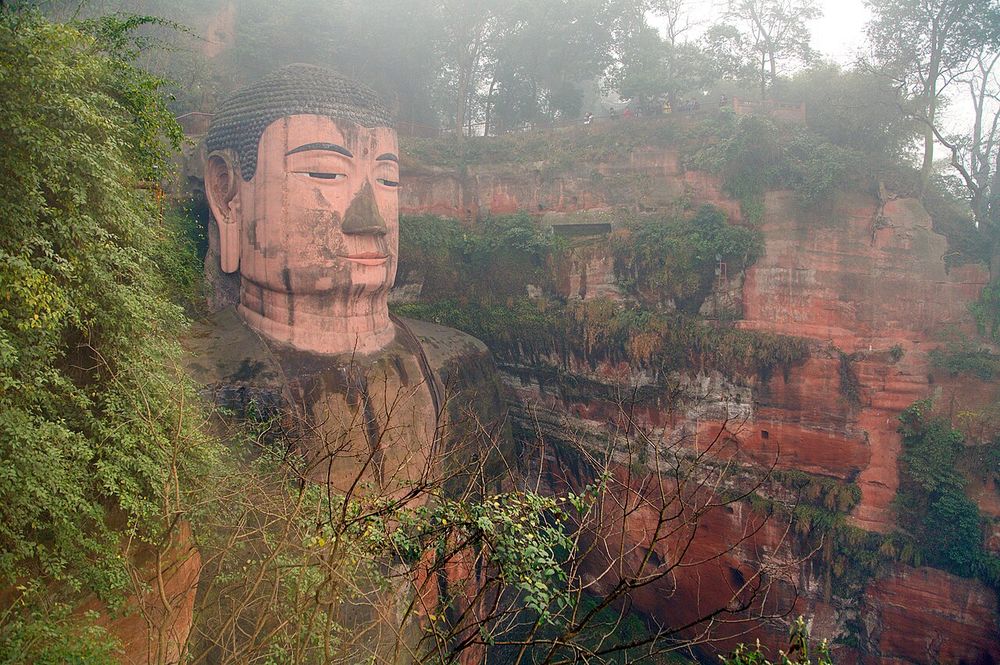
Mist is common in the morning in spring and summer; the face may be clearer after ten.
Customs and manners
Lingyun and Wuyou are working temples. Dress modestly and do not touch offerings.
Do not climb on the Buddha's feet or carve names on the rock.
Opening hours are given in the local time of the place. Prices are in the local currency. The figure after ≈ is approximate, at exchange rates checked on 9 November 2026, in .
Look for these
Find a gutter hidden in the folds of the robe.
Find the two guardian kings on either side, from the boat.
Find Haitong's cave beside the head.
I am here
Stand at the site, sign in, press the button, and collect its stamp. Your browser will ask to use your location. It is sent to us once to confirm that you are at the site; we keep how far you were from it, not the spot where you stood.
Your stamps are saved to your account, so they follow you to any device. Checking from a browser cannot rule out every false location; stricter checks arrive with the app.
Messages
Share your photos
Photos here show the place, not people. Each one is credited to the visitor who took it and appears after our team has looked at it. A photo with you in it belongs under “I am here”.