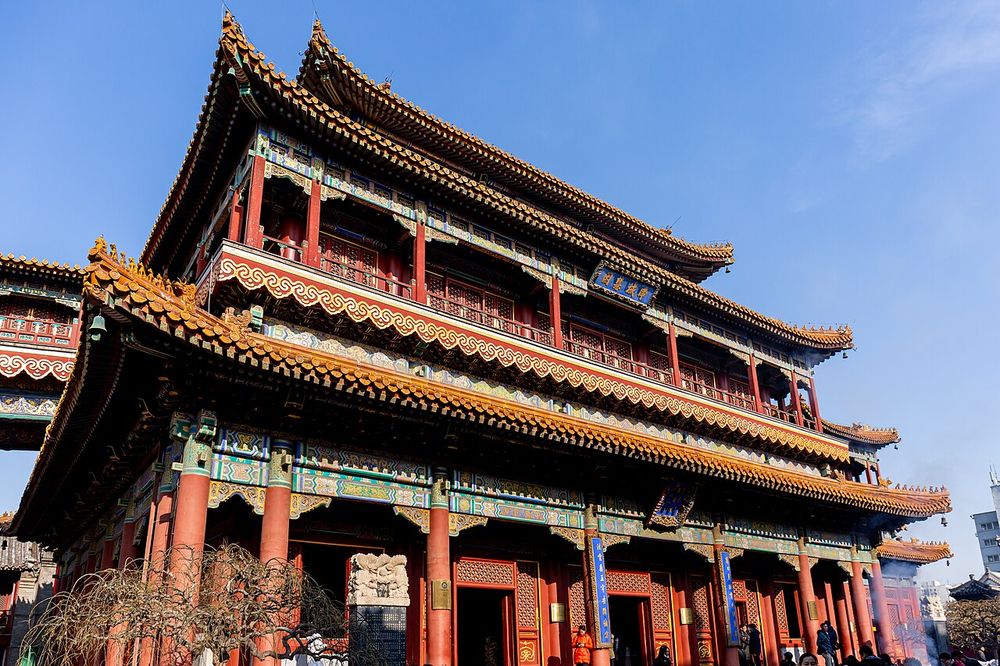
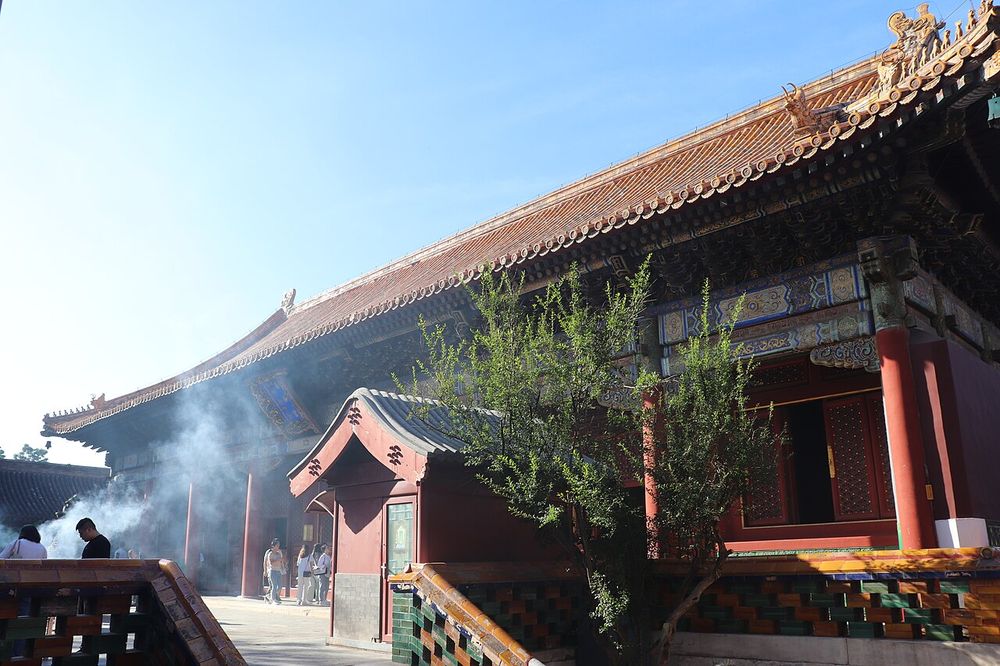
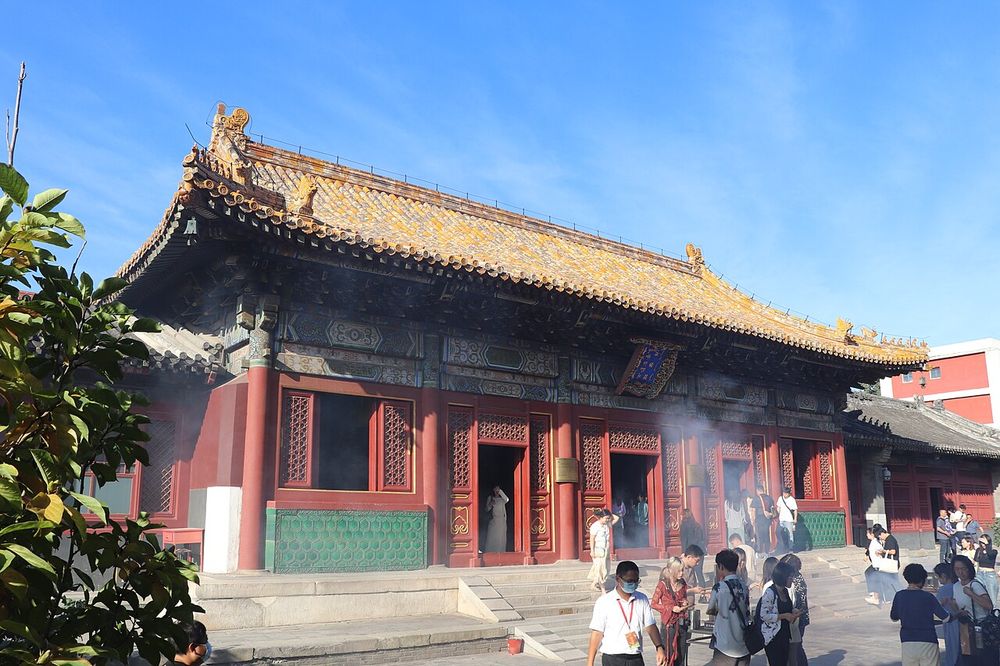
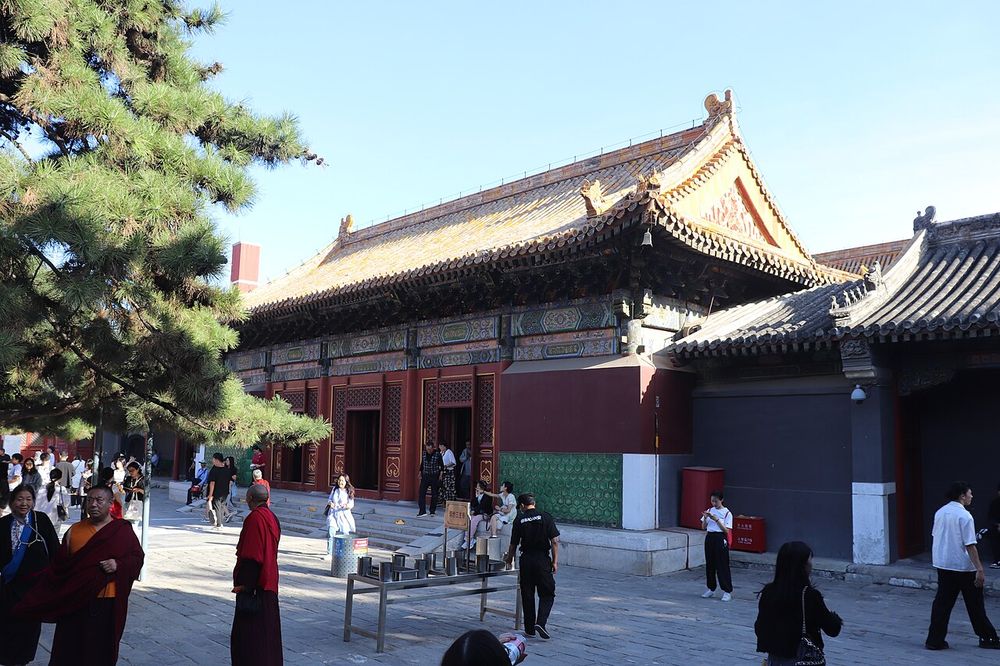
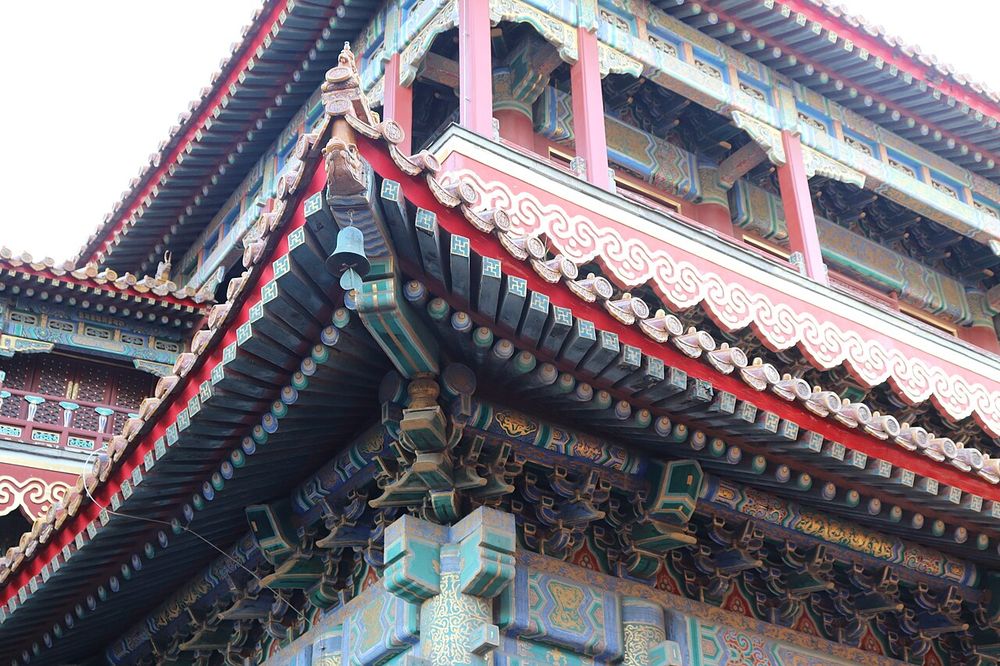
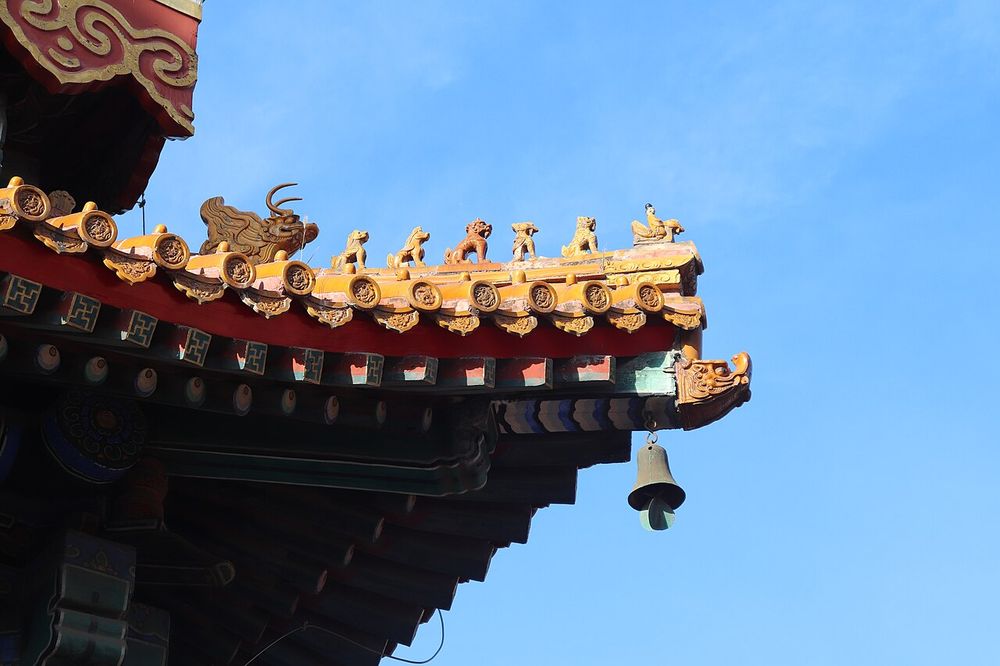
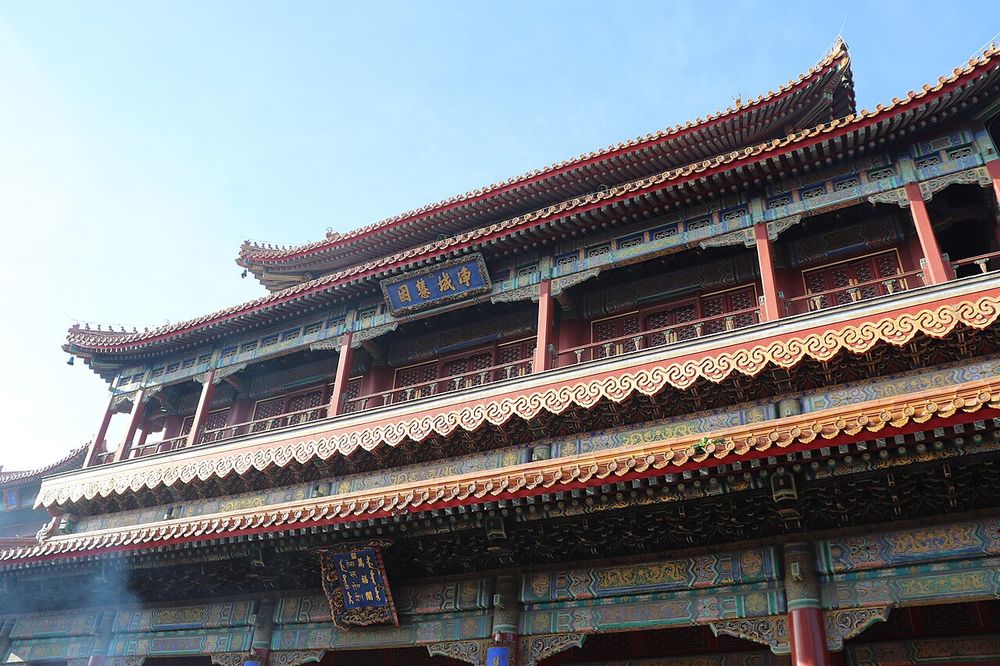
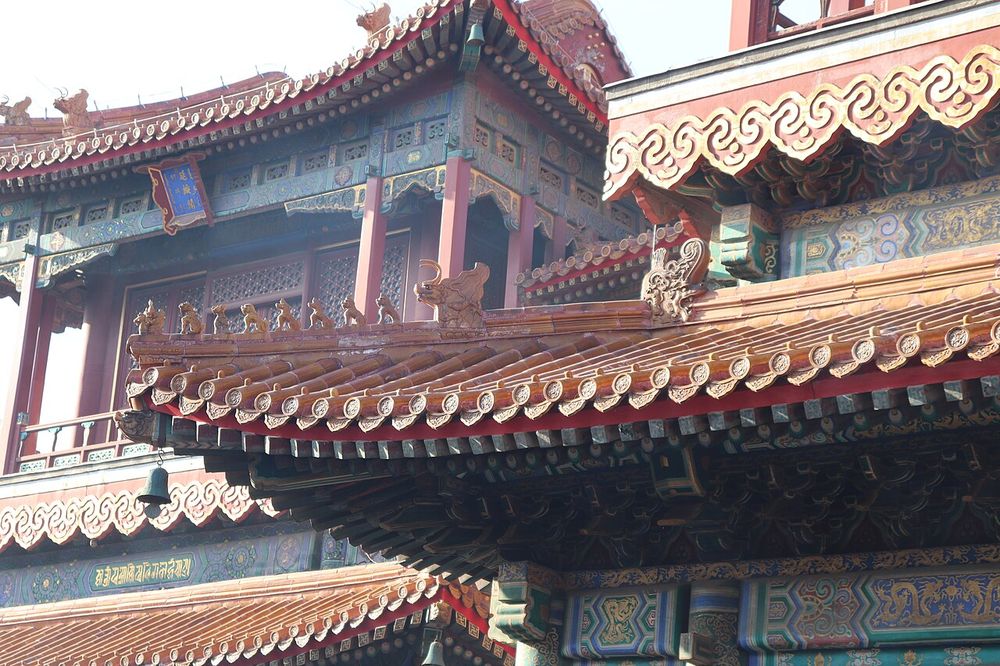
A prince's mansion that became an emperor's palace and then, in 1744, the most important Tibetan Buddhist monastery in Beijing. Behind its yellow roofs stands a Buddha 18 metres tall carved from a single sandalwood tree, and monks still chant here every day.
Photo: Balon Greyjoy, CC0, Wikimedia Commons
The story
In 1694 the Kangxi emperor gave this ground to his fourth son, Yinzhen, Prince Yong, for a mansion. When the prince became the Yongzheng emperor in 1722, the house of a man who had become emperor could no longer be an ordinary home; it was raised to a palace, Yonghe Gong, the Palace of Harmony. His son, the Qianlong emperor, grew up here.
In 1744 Qianlong turned the palace into a monastery of the Gelug school of Tibetan Buddhism, staffed with monks from Mongolia and Tibet. It became the court's centre for managing Tibetan Buddhism: in 1792 the golden urn used to choose the reincarnations of great lamas was placed here. That is why the roofs are yellow, the colour of the emperor, over a temple full of Tibetan images.
What is here
One ticket covers all the halls and both exhibition buildings, the Panchen Hall and the Ordination Hall, which show treasures sent from Tibet.
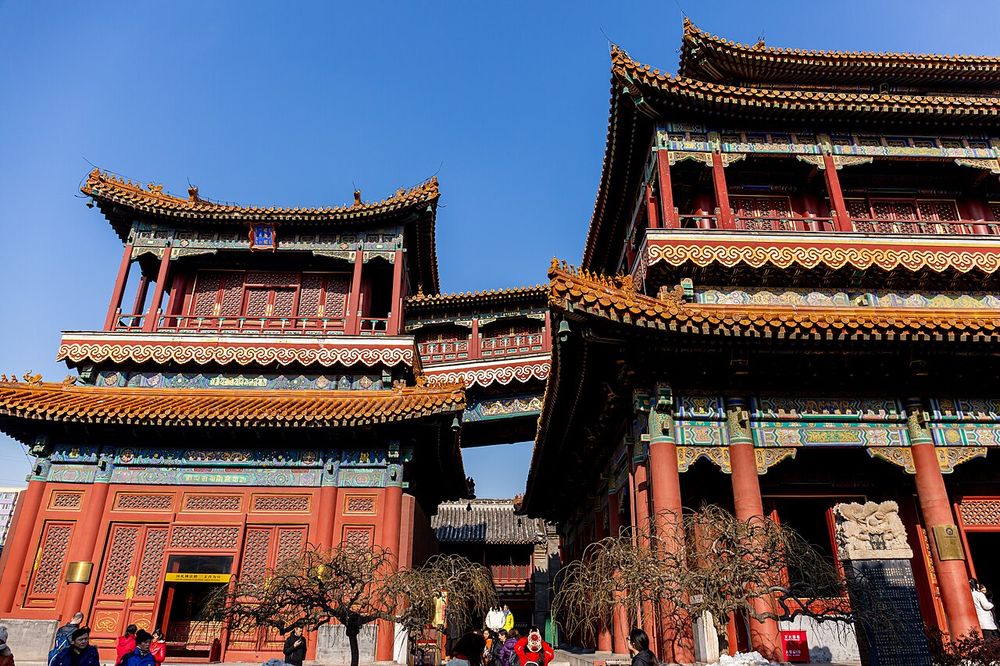
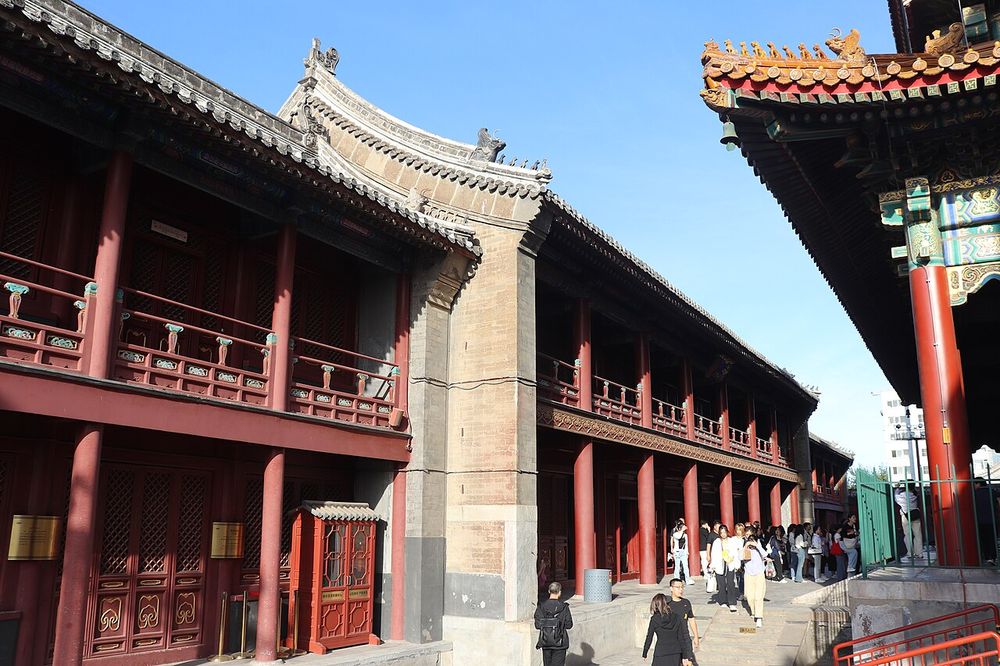
The flying bridges between the pavilions, 2020Balon Greyjoy, CC0
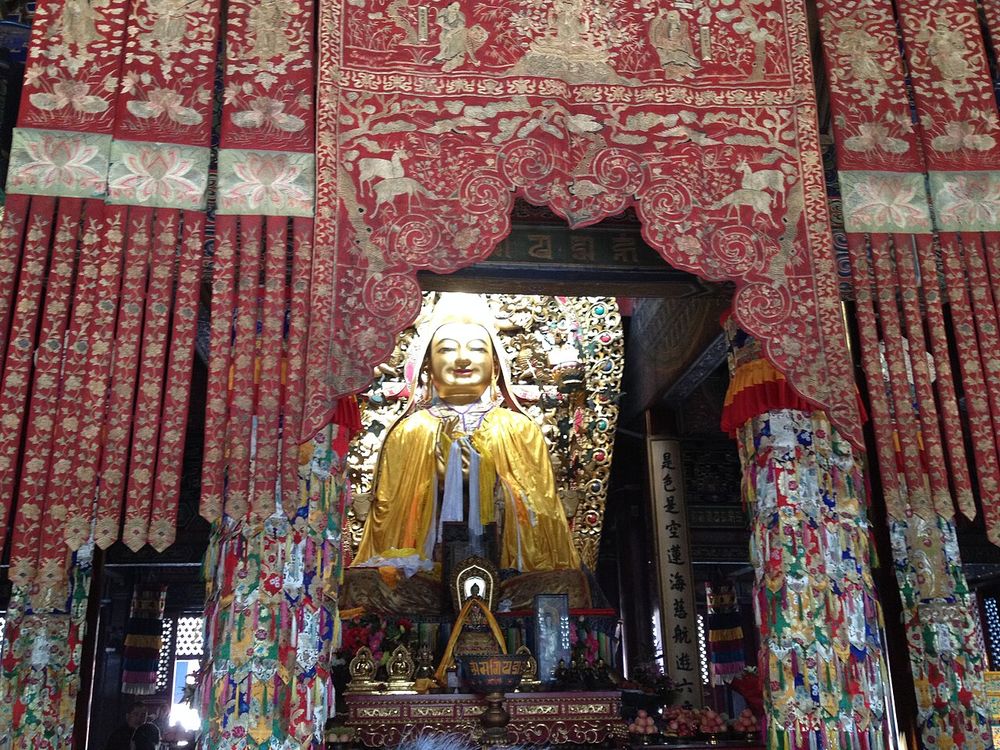
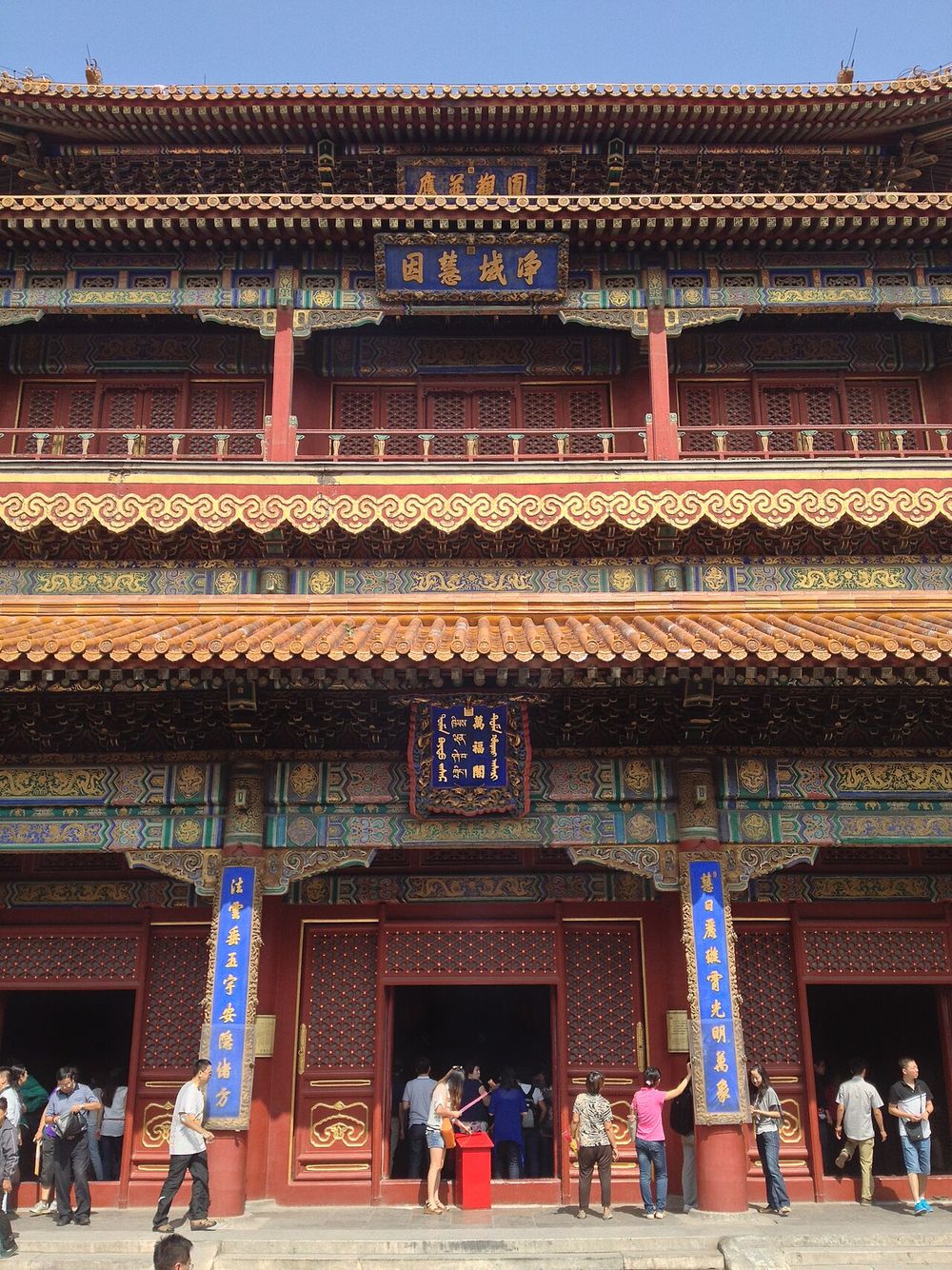
The three-storey pavilion at the back of the temple, about 25 metres high, was built around one statue. Inside stands Maitreya, the Buddha of the future, 18 metres above the floor and 8 more below it, carved from the trunk of a single white sandalwood tree that the seventh Dalai Lama sent to Qianlong from Nepal. The pavilion was raised around him after he was in place.
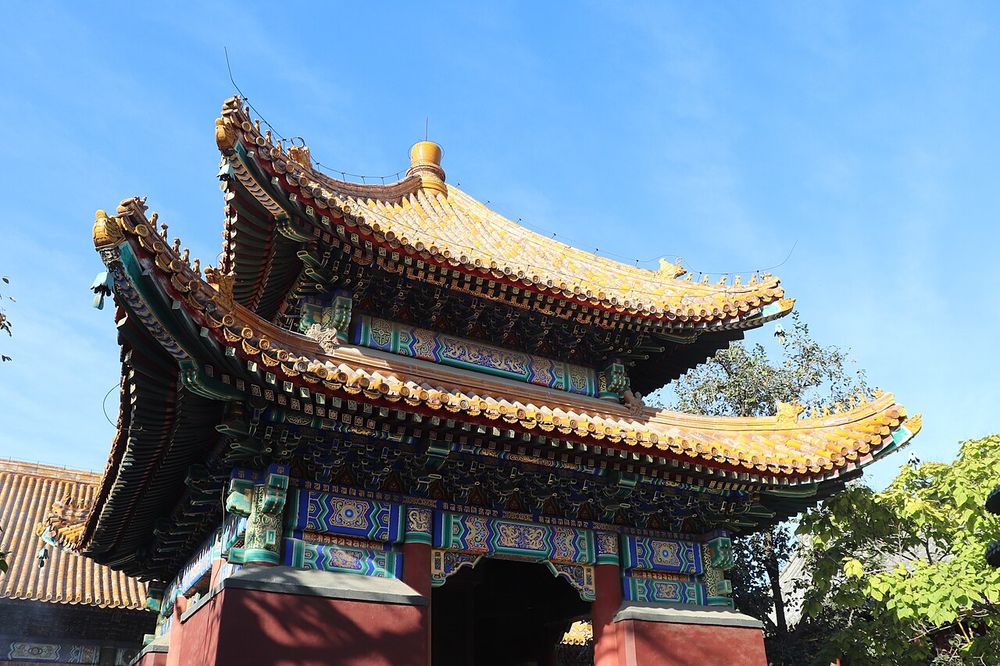
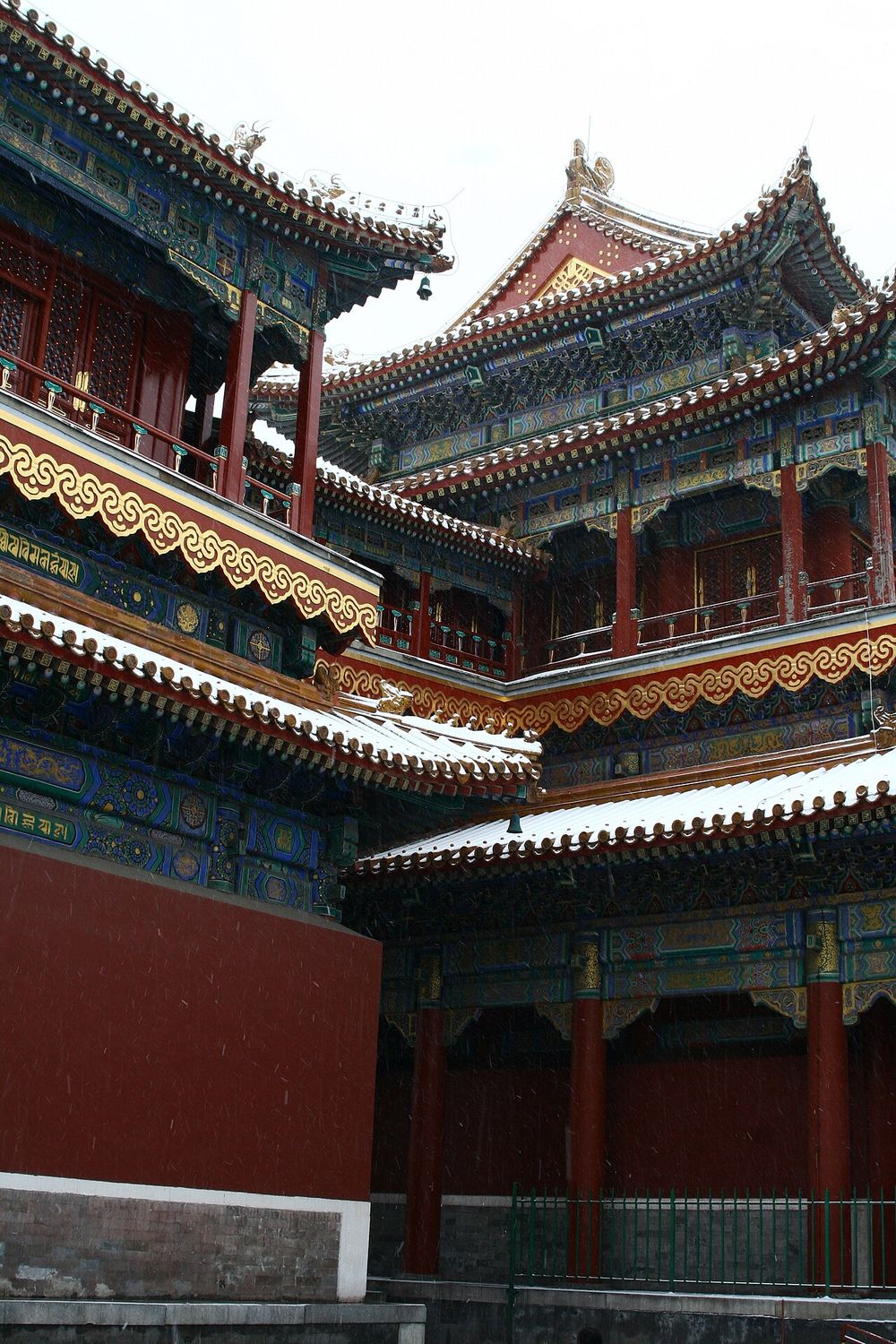
Look at the two smaller pavilions on either side, joined to the middle one by flying bridges at the upper floor, a rare design in Beijing.
Things people often get wrong
"It is a museum." It is a working monastery, with resident monks and daily rituals; people come to pray as well as to look.
"Lama means any monk." In Tibetan, a lama is a teacher; the Chinese name "lama temple" simply means a Tibetan Buddhist temple.
People who stood here
We searched Chinese sources first for this list, then English and Tibetan-studies sources.
The Yongzheng emperor (1678–1735)As Prince Yong he lived here for nearly thirty years before he took the throne; the "fourth prince" of many Chinese television dramas.
The Qianlong emperor (1711–1799)He grew up here, turned it into a monastery in 1744, and wrote the inscription in four languages that explains why.
Go deeper: five courtyards from the gate to the great Buddha6 stops · about 1 min to read
The temple runs north for nearly 500 metres through five courtyards. Walk straight up the axis and look into the side halls on the way.
1. The gateways and the avenue
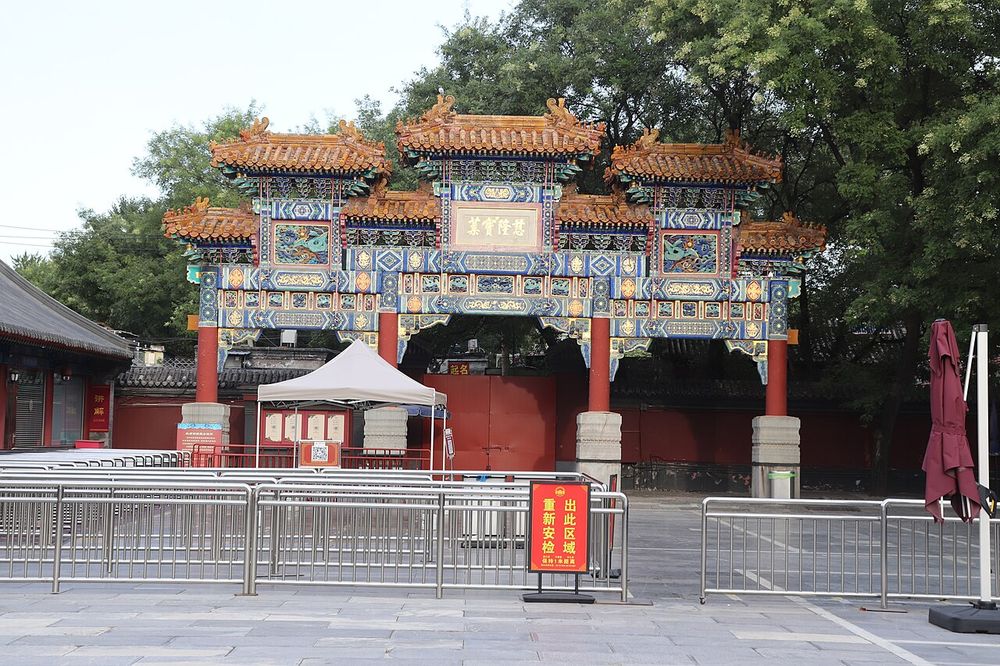
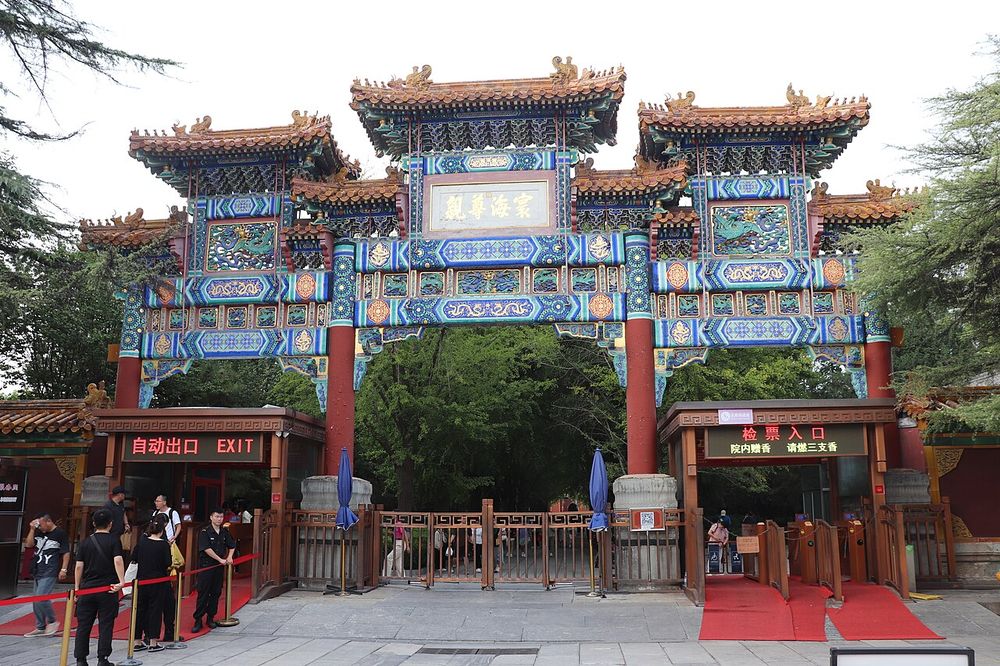
The painted pailou gateway, 2023Andrzej Otrębski, CC BY-SA 4.0
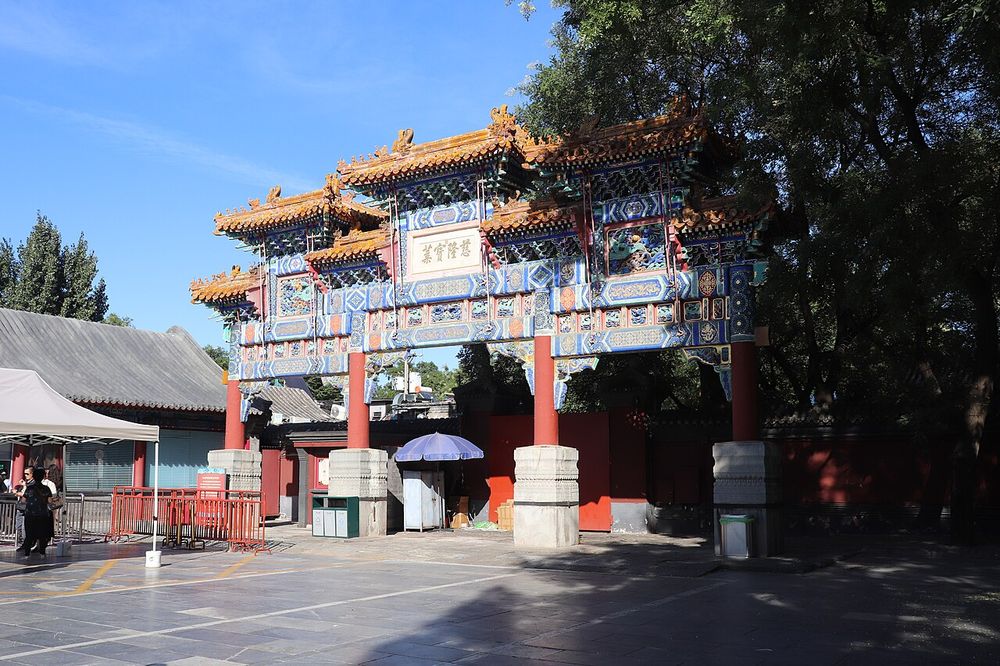
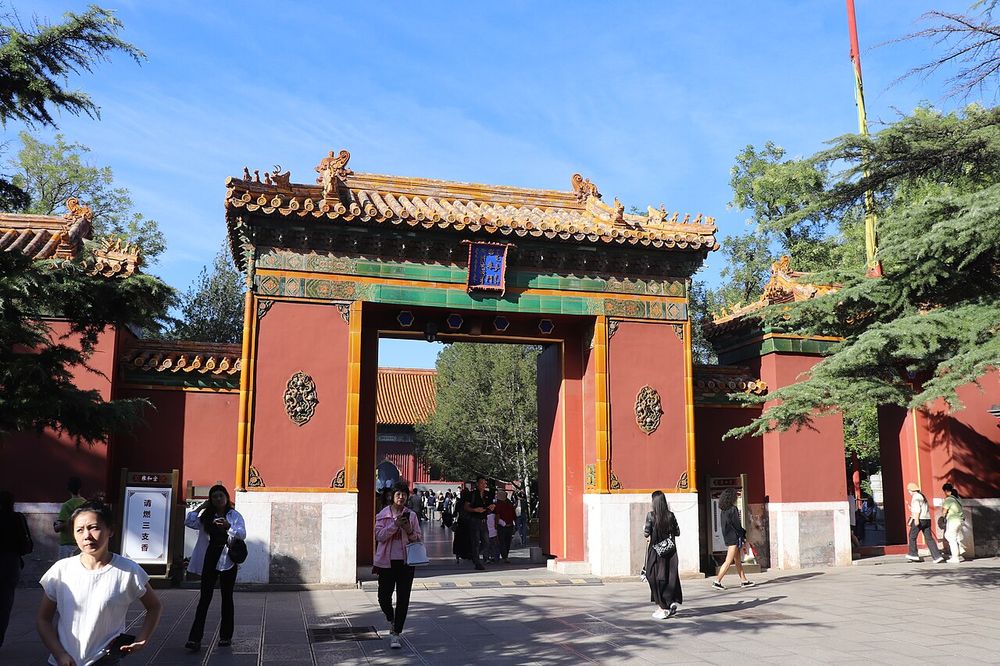
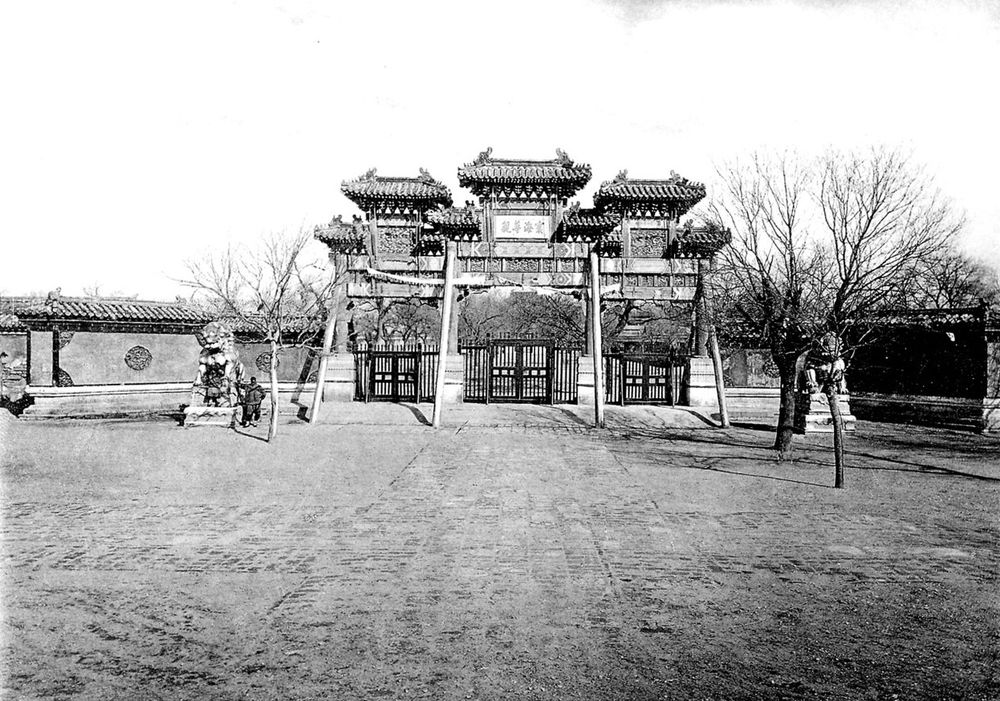
Three painted pailou gateways stand at the south end; beyond them a long avenue of ginkgo and pine leads to the gate. At the ticket gate you are given free incense: three sticks are enough.
2. The Hall of the Heavenly Kings and the bronze stand
Gateway and trees, 2023Andrzej Otrębski, CC BY-SA 4.0
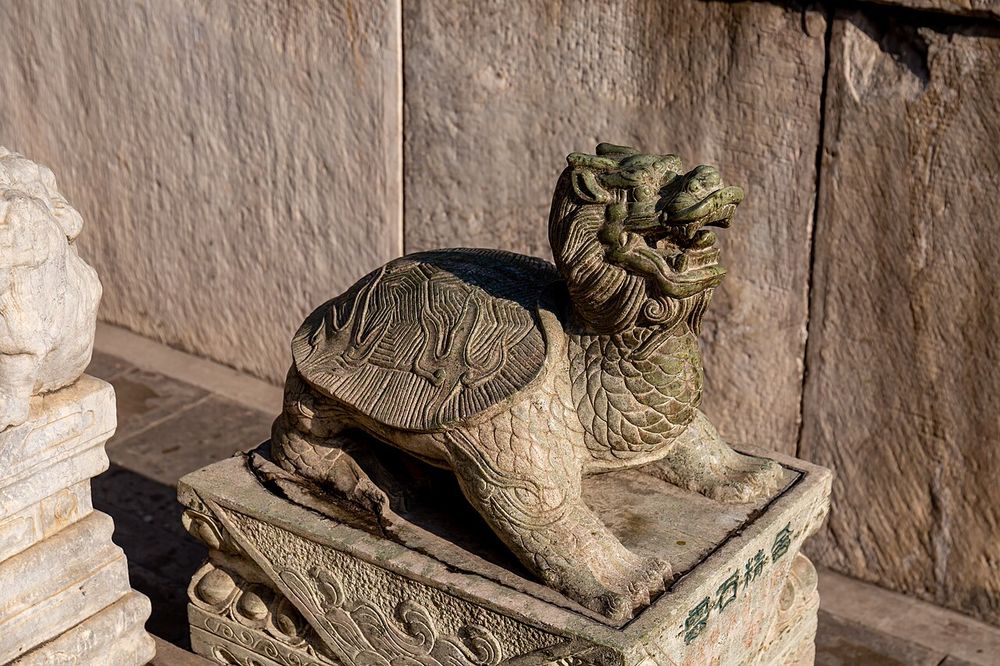
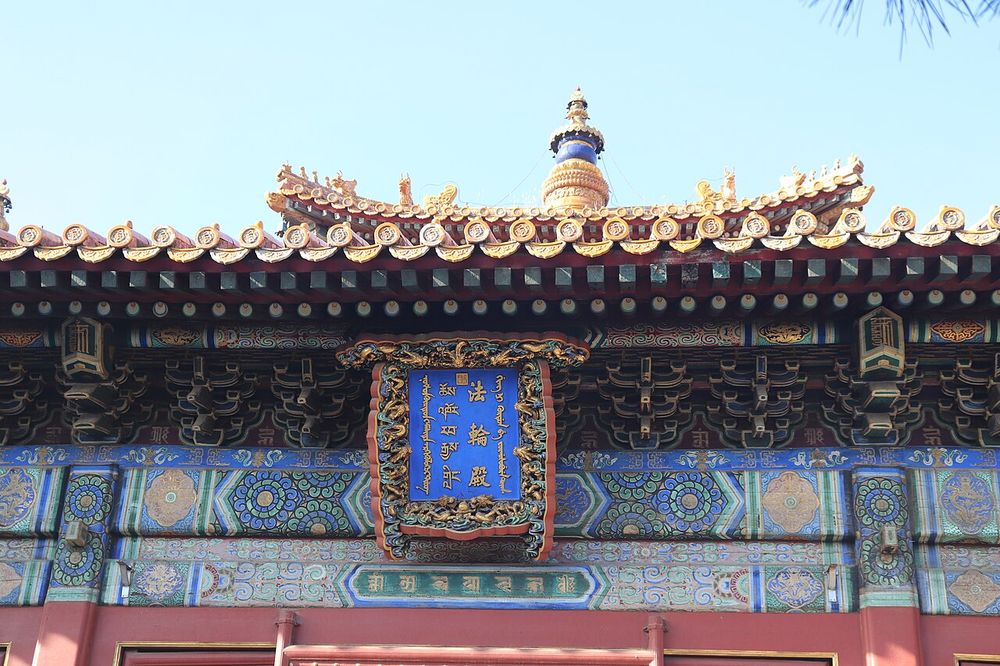
Maitreya in his Chinese form, the laughing fat Buddha, greets you, with the four kings of the directions. In the courtyard stands a huge bronze incense burner and a stele in four scripts: Chinese, Manchu, Mongolian and Tibetan, the languages of Qianlong's empire.
A bronze turtle, January 2020Balon Greyjoy, CC0
3. The Hall of Harmony
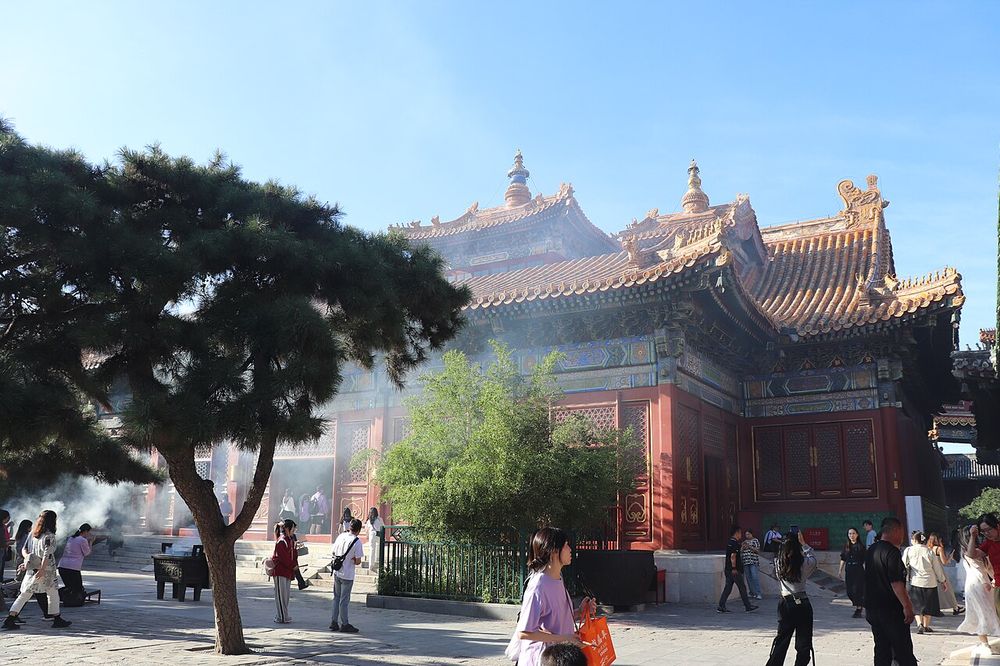
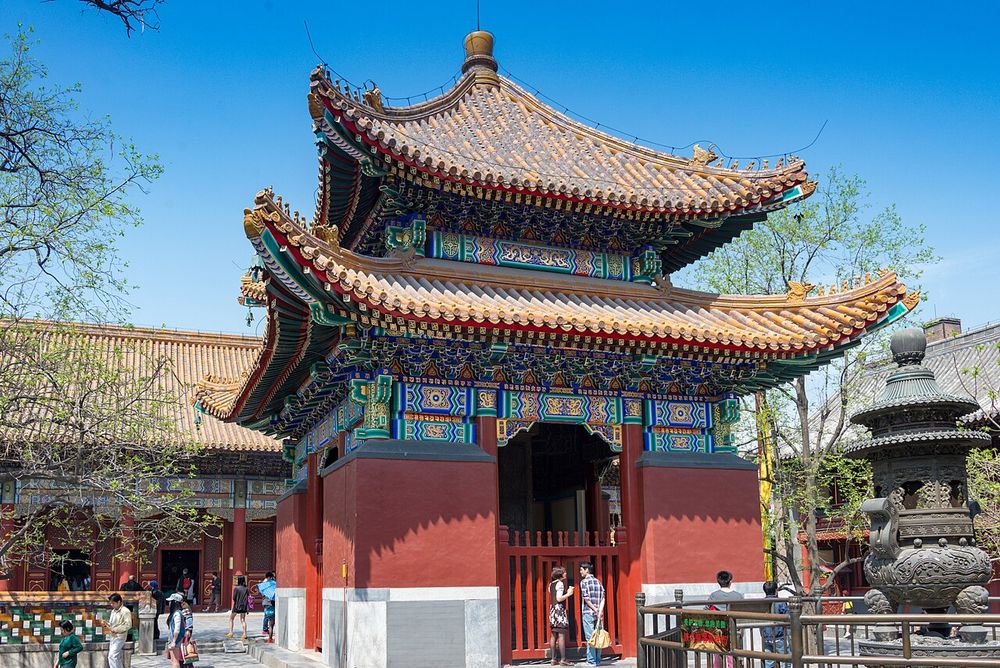
A pavilion with double eaves, 2023Andrzej Otrębski, CC BY-SA 4.0
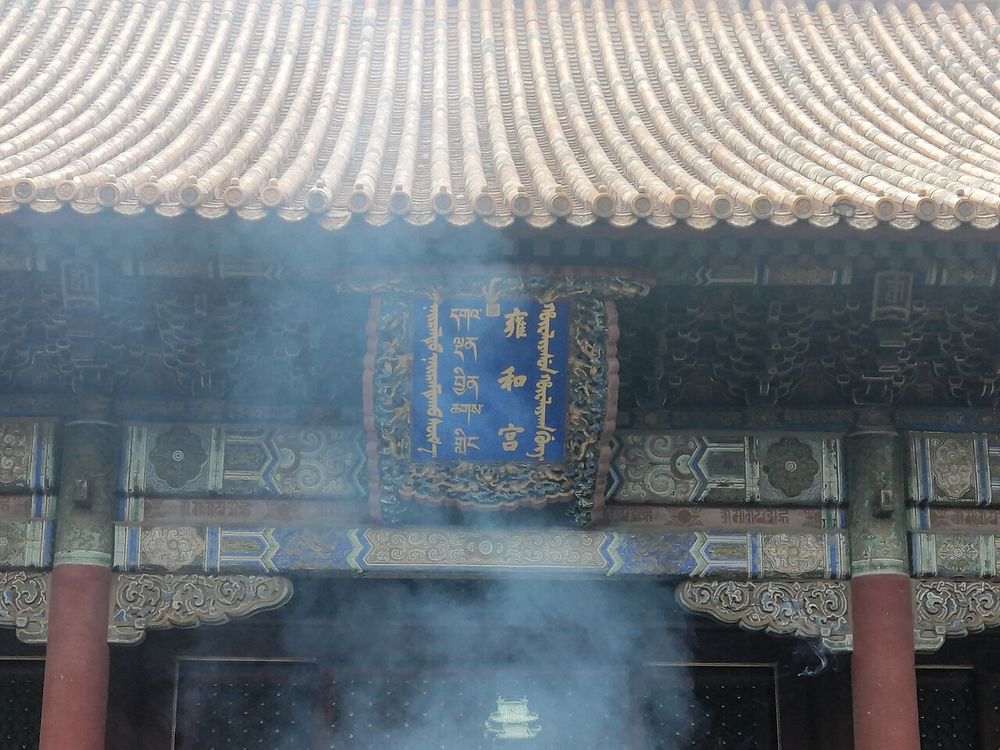
The main hall of the old mansion, now holding the Buddhas of the past, present and future. Its name gave the whole temple its name.
4. The Hall of the Wheel of Dharma
The statue of Tsongkhapa, 2013Rewindat(Pan Xuan), CC BY-SA 3.0
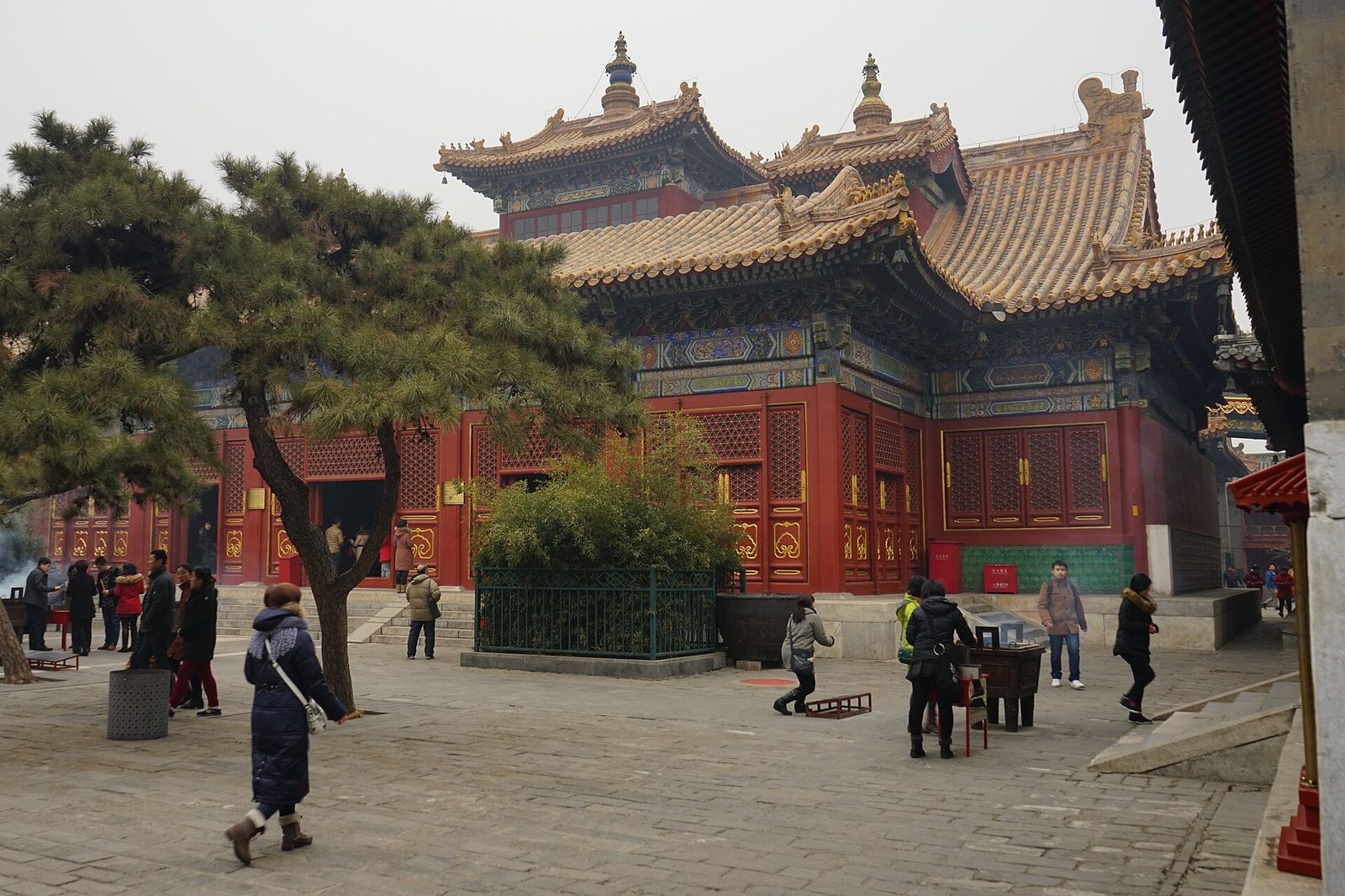
The largest hall, with small Tibetan-style pavilions on its roof, is where the monks chant. At its centre sits a bronze Tsongkhapa, founder of the Gelug school, about 6 metres high; behind him is a mountain of five hundred arhats carved in red sandalwood, with the little figures in gold, silver and copper.
5. The Wanfu Pavilion and the Buddha
The Wanfu Pavilion, 2013Rewindat(Pan Xuan), CC BY-SA 3.0
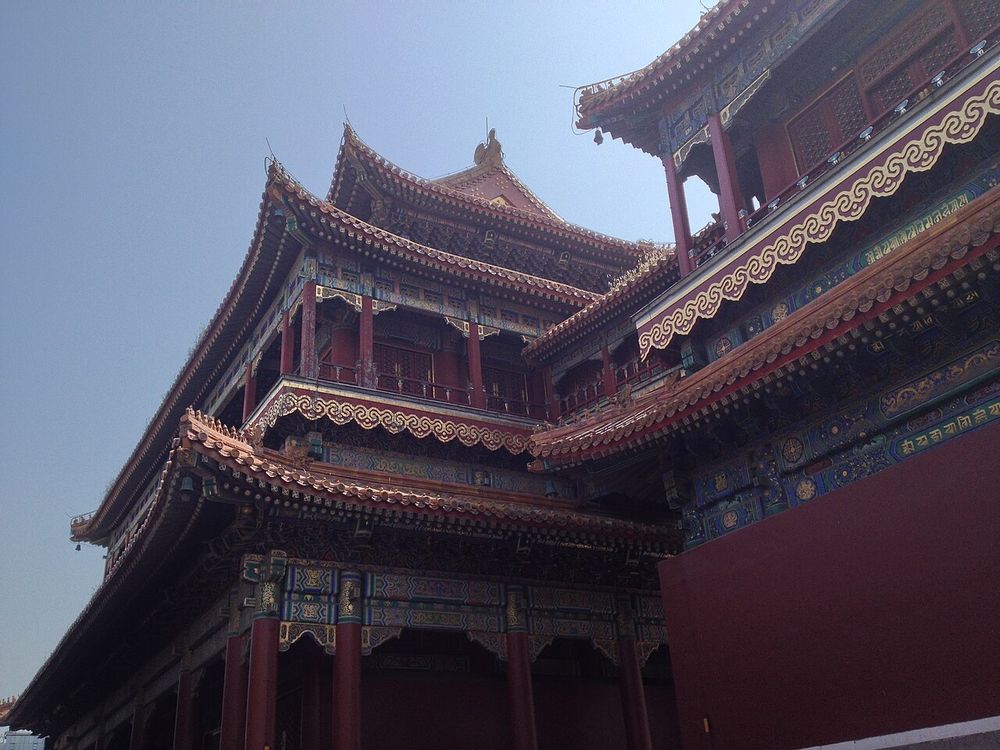
Step inside and look up. The Buddha's face is far above the second floor. With the arhat mountain and a Buddha niche carved from golden nanmu wood, the Buddha is one of the temple's "three wonders of wood carving".
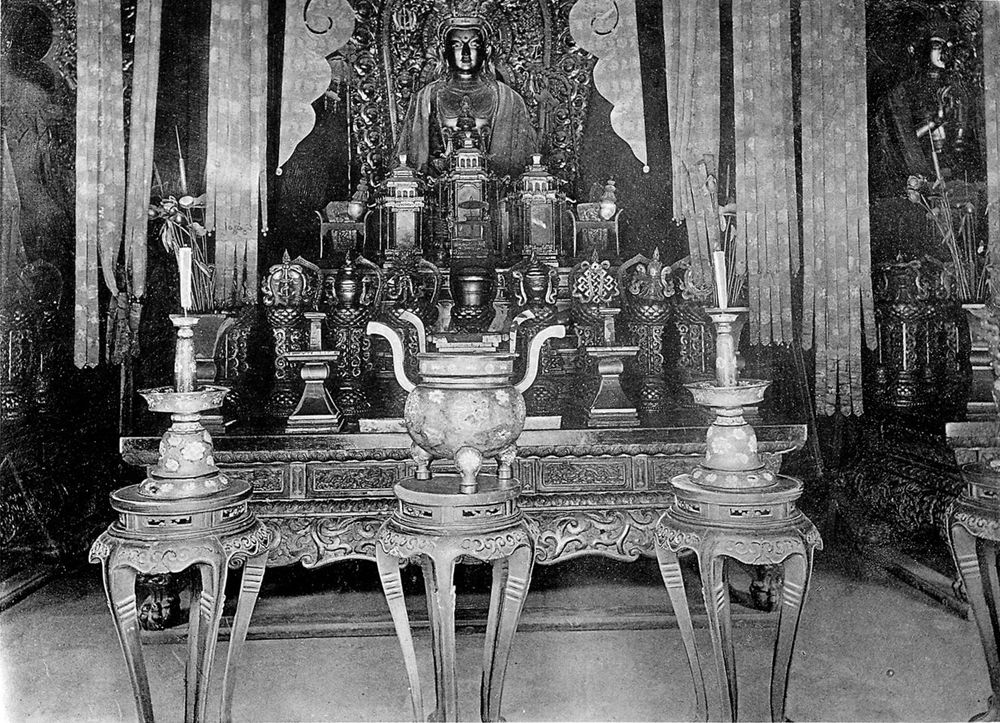
An altar in the temple, before 1902Alfons von Mumm, Public domain
The temple and the same years elsewhere
The palace became a monastery in 1744. In the same years in Germany, Johann Sebastian Bach was finishing "The Art of Fugue".
Meanwhile in the world
Year
Here
Elsewhere
1694
The mansion of Prince Yong is built
The Bank of England is founded
1744
The palace becomes a monastery
The War of the Austrian Succession is raging in Europe
1792
The golden urn is placed here
France declares itself a republic
One line to remember: an emperor's old home, given to the Buddha.
Then and now
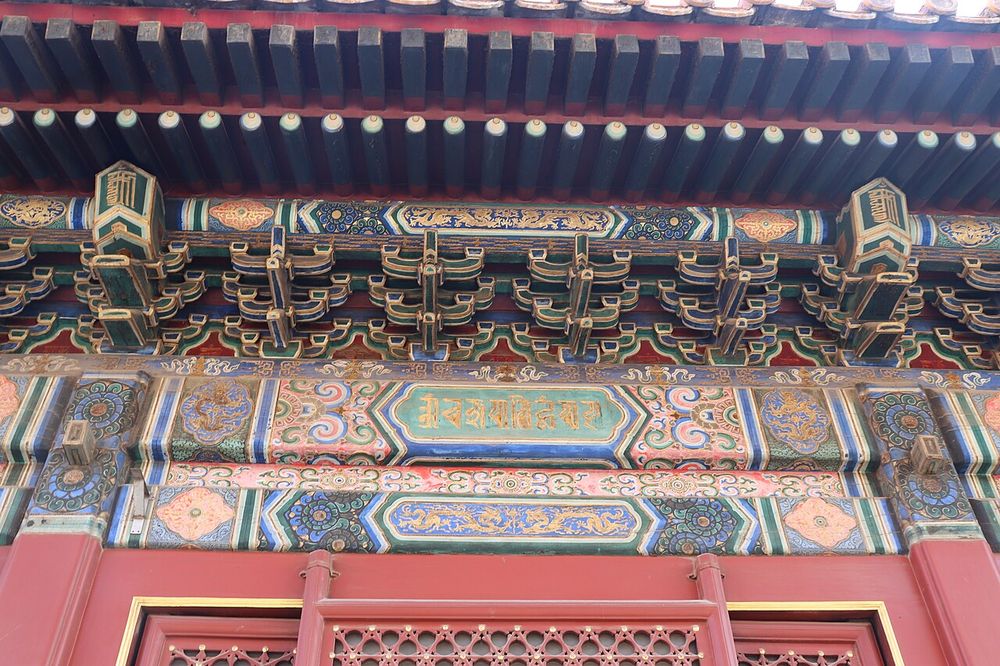
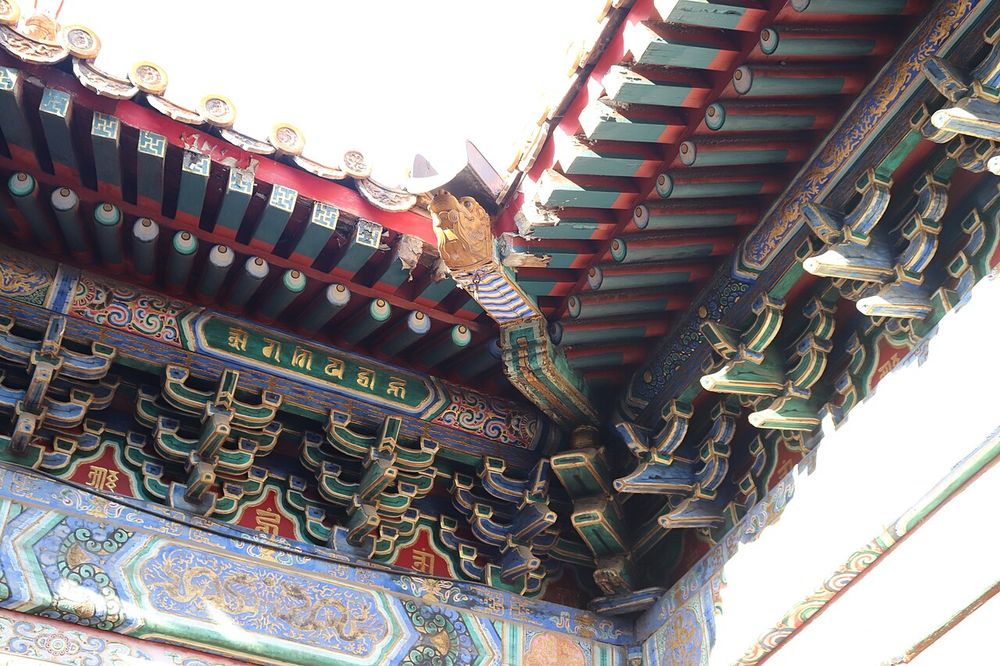
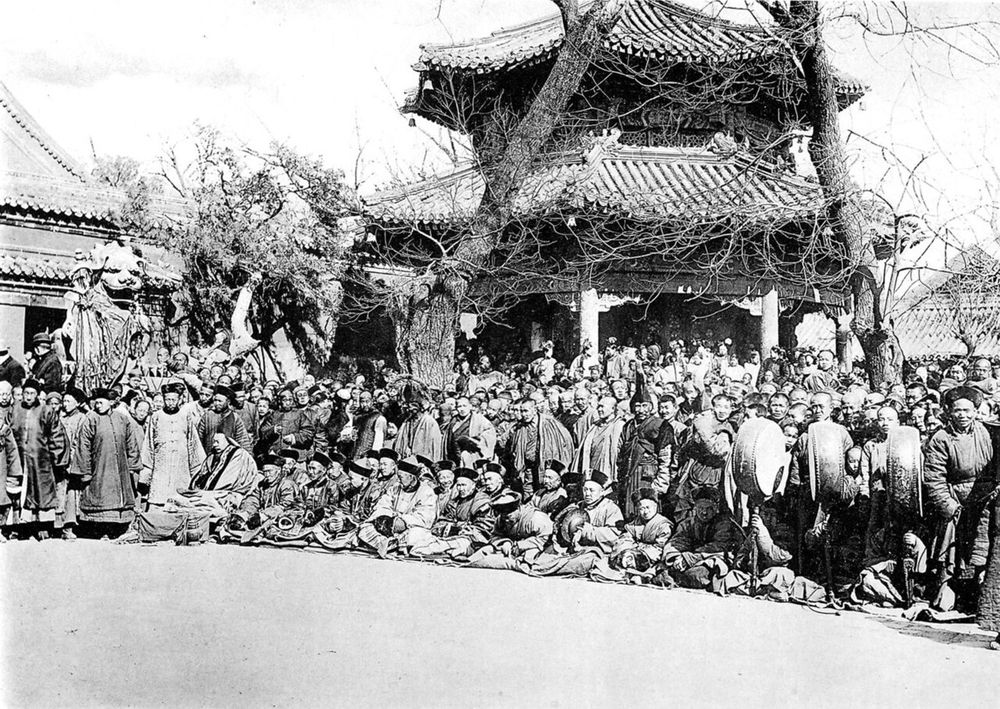
The Wanfu Pavilion and its side pavilions, January 2020Balon Greyjoy, CC0, Wikimedia CommonsThe flying bridges between the pavilions, 2020Balon Greyjoy, CC0, Wikimedia CommonsA hall in winter sun, January 2015Jan Bockaert, CC BY-SA 2.0, Wikimedia CommonsThe painted pailou gateway, 2023Andrzej Otrębski, CC BY-SA 4.0, Wikimedia CommonsAnother gateway at the entrance, 2023Andrzej Otrębski, CC BY-SA 4.0, Wikimedia CommonsGateway and trees, 2023Andrzej Otrębski, CC BY-SA 4.0, Wikimedia CommonsThe Zhaotai Gate, 2023Andrzej Otrębski, CC BY-SA 4.0, Wikimedia CommonsA hall with incense smoke, 2023Andrzej Otrębski, CC BY-SA 4.0, Wikimedia CommonsA pavilion with double eaves, 2023Andrzej Otrębski, CC BY-SA 4.0, Wikimedia CommonsA hall in the morning, 2023Andrzej Otrębski, CC BY-SA 4.0, Wikimedia CommonsA side hall, 2023Andrzej Otrębski, CC BY-SA 4.0, Wikimedia CommonsA hall behind pines, 2023Andrzej Otrębski, CC BY-SA 4.0, Wikimedia CommonsA long side hall, 2023Andrzej Otrębski, CC BY-SA 4.0, Wikimedia CommonsPainted beams and a gilt board, 2023Andrzej Otrębski, CC BY-SA 4.0, Wikimedia CommonsPainted brackets under the eaves, 2023Andrzej Otrębski, CC BY-SA 4.0, Wikimedia CommonsGalleries along a courtyard, 2023Andrzej Otrębski, CC BY-SA 4.0, Wikimedia CommonsEaves of a pavilion, 2023Andrzej Otrębski, CC BY-SA 4.0, Wikimedia CommonsA bell hanging from a roof corner, 2023Andrzej Otrębski, CC BY-SA 4.0, Wikimedia CommonsThe Wanfu Pavilion from the side, 2023Andrzej Otrębski, CC BY-SA 4.0, Wikimedia CommonsRoofs above roofs, 2023Andrzej Otrębski, CC BY-SA 4.0, Wikimedia CommonsA painted roof corner, 2023Andrzej Otrębski, CC BY-SA 4.0, Wikimedia CommonsA hall with Tibetan-style windows, 2013xiquinhosilva, CC BY 2.0, Wikimedia CommonsIncense smoke before the Hall of Harmony, 2021Yumeto, CC BY-SA 4.0, Wikimedia CommonsLooking up at the Wanfu Pavilion, 2013Rewindat(Pan Xuan), CC BY-SA 3.0, Wikimedia CommonsThe Wanfu Pavilion, 2013Rewindat(Pan Xuan), CC BY-SA 3.0, Wikimedia CommonsThe statue of Tsongkhapa, 2013Rewindat(Pan Xuan), CC BY-SA 3.0, Wikimedia CommonsA bronze lion, January 2020Balon Greyjoy, CC0, Wikimedia CommonsA bronze turtle, January 2020Balon Greyjoy, CC0, Wikimedia CommonsSnow on the roofs, February 2017Xin wood, CC BY-SA 4.0, Wikimedia CommonsThe temple in snow, November 2015Xin wood, CC BY-SA 4.0, Wikimedia CommonsThe entrance of the temple, before 1902Alfons von Mumm, Public domain, Wikimedia CommonsAn altar in the temple, before 1902Alfons von Mumm, Public domain, Wikimedia CommonsMonks assembled for the New Year exorcism dance, early 20th centuryAlfons von Mumm, Public domain, Wikimedia Commons
Local legends
These are stories people tell about this place. They are legends, not history, and each one says where it comes from.
LegendThe dragon's lucky ground
Because two emperors lived here, Beijing people say the site is a "dragon's lucky ground", and that a prayer here brings rising fortune; on the first days of the lunar new year the queue for incense runs round the block.
Source: Beijing popular belief, reported every Spring Festival in the city press
Later, people who live here will be able to add the stories they grew up with, and say which of these they have heard.
Not certain, and where accounts conflict
Was Qianlong born here?
The court record says he was born in the mansion of Prince Yong; a story repeated since the 19th century says he was born at the summer resort of Chengde. Most historians accept the court record.
Visiting
Tickets and hours
25 yuan. Children under 6 or under 1.2 metres free.
April to October 9:00 to 17:00, last tickets 16:30; November to March 9:00 to 16:30, last tickets 16:00. Longer hours on some festival days.
Last checked 2026-11-12. Hours and price from 2026 guides and the temple's 2026 Spring Festival notice (Beijing Daily); timed booking as reported in 2026 guides.
Booking without WeChat
Official page in English Entry is by timed booking on the temple's official WeChat mini-program, up to seven days ahead, with a passport.
International booking platform The temple warns that it has authorised no other platform to sell its religious goods; buy tickets only through official channels.
Ticket window on site Guides in 2026 report that same-day tickets are no longer sold at the gate; foreigners who cannot use WeChat should ask their hotel to book.
Note Book early for the first and fifteenth days of the lunar month and for New Year.
Checked 2026-11-12
Where to start
Metro Lines 2 and 5 to Yonghegong Lama Temple station; the gate is a few minutes' walk south of the station.
Combine it with the Temple of Confucius and the Imperial Academy across the street.
Before you go
Photography is not allowed inside the halls.
Ceremonies are held on the mornings of the 1st, 10th, 15th and 30th of each lunar month; the temple is crowded then.
Customs and manners
Walk round halls and stupas clockwise; do not point your feet at images or step on thresholds.
Use the free incense given at the gate; do not buy incense from street sellers outside.
Opening hours are given in the local time of the place. Prices are in the local currency. The figure after ≈ is approximate, at exchange rates checked on 9 November 2026, in .
Look for these
Find the stele in four scripts and tell them apart.
Find the flying bridges between the pavilions at the back.
On the arhat mountain, find an arhat crossing water.
I am here
Stand at the site, sign in, press the button, and collect its stamp. Your browser will ask to use your location. It is sent to us once to confirm that you are at the site; we keep how far you were from it, not the spot where you stood.
Your stamps are saved to your account, so they follow you to any device. Checking from a browser cannot rule out every false location; stricter checks arrive with the app.
Messages
Share your photos
Photos here show the place, not people. Each one is credited to the visitor who took it and appears after our team has looked at it. A photo with you in it belongs under “I am here”.