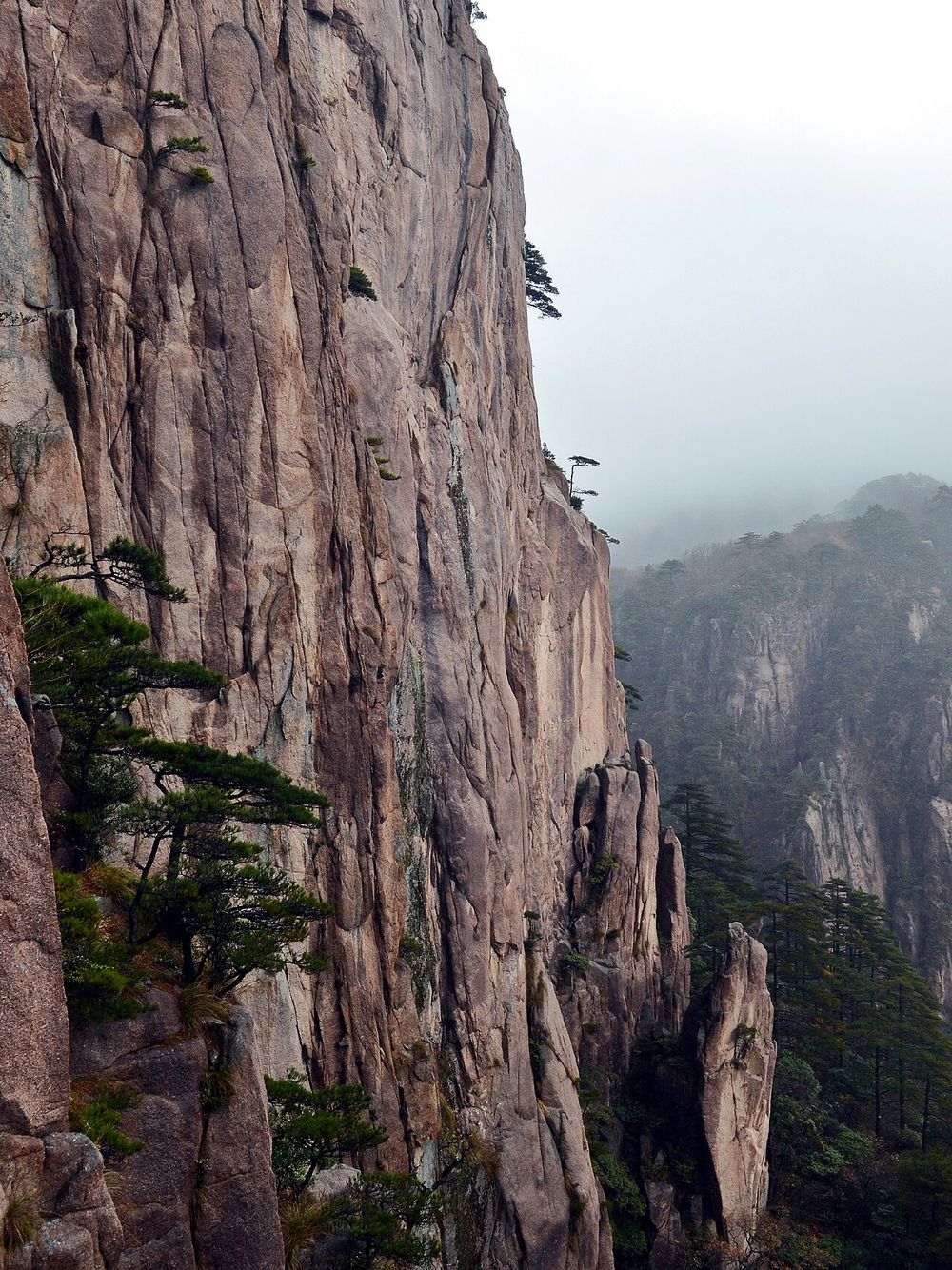
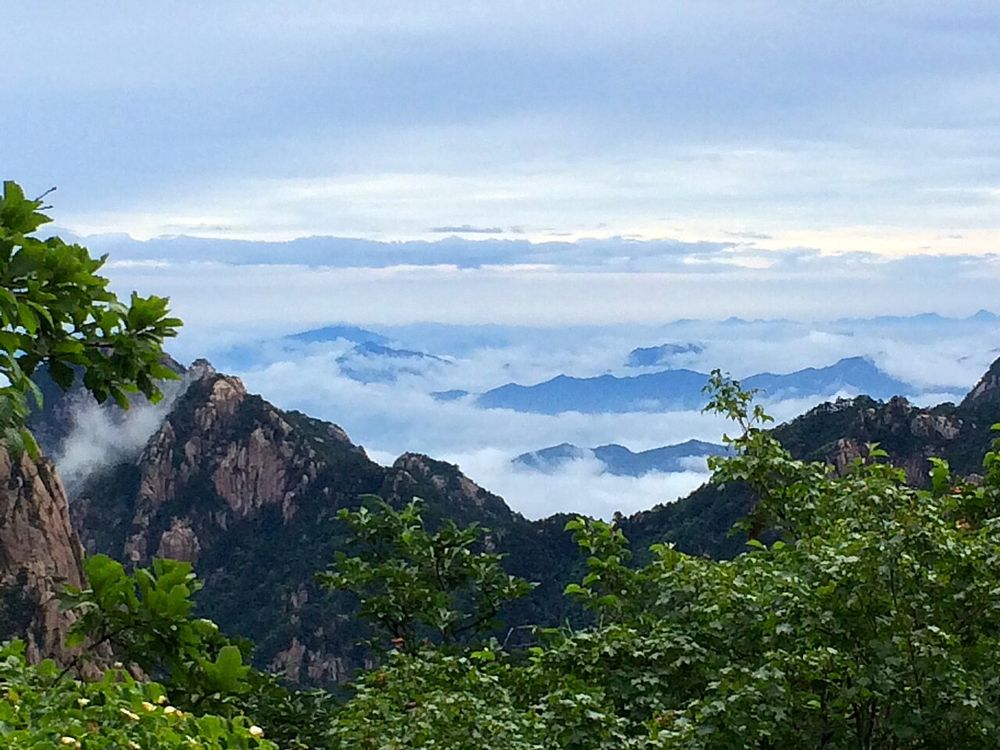
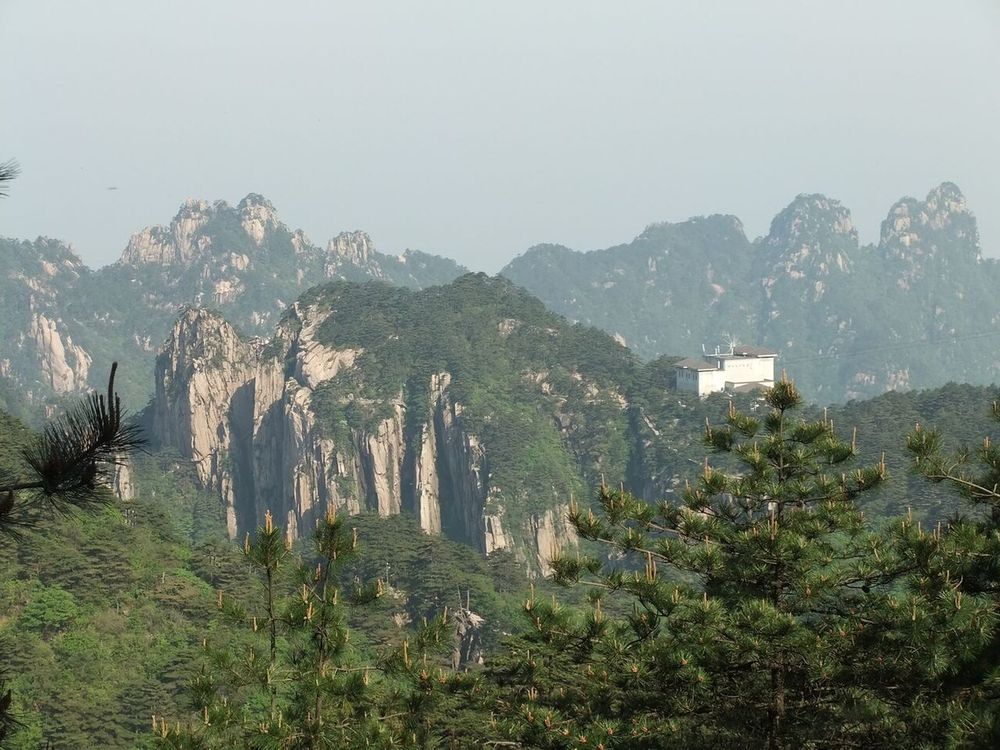
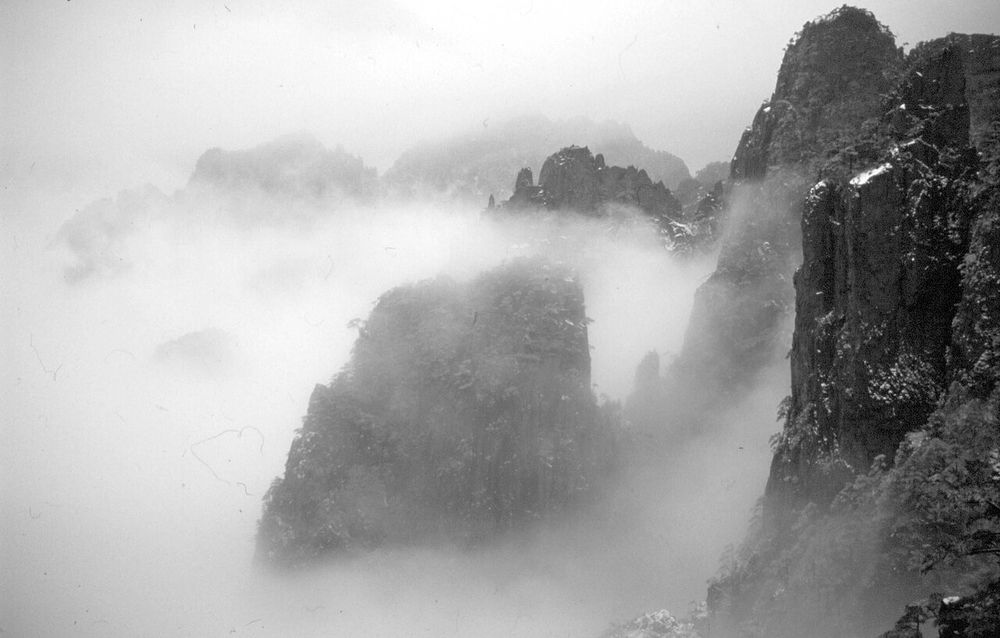
Granite peaks, wind-shaped pines and a sea of cloud: the mountain that taught China how to paint mountains. World Heritage since 1990.
Photo: eviltomthai, CC BY 2.0, Wikimedia Commons
The story
Huangshan used to be called Yishan, the Black Mountain, for its dark rock. In 747 a Tang (618–907) emperor renamed it Huangshan, the Yellow Mountain, after the Yellow Emperor.
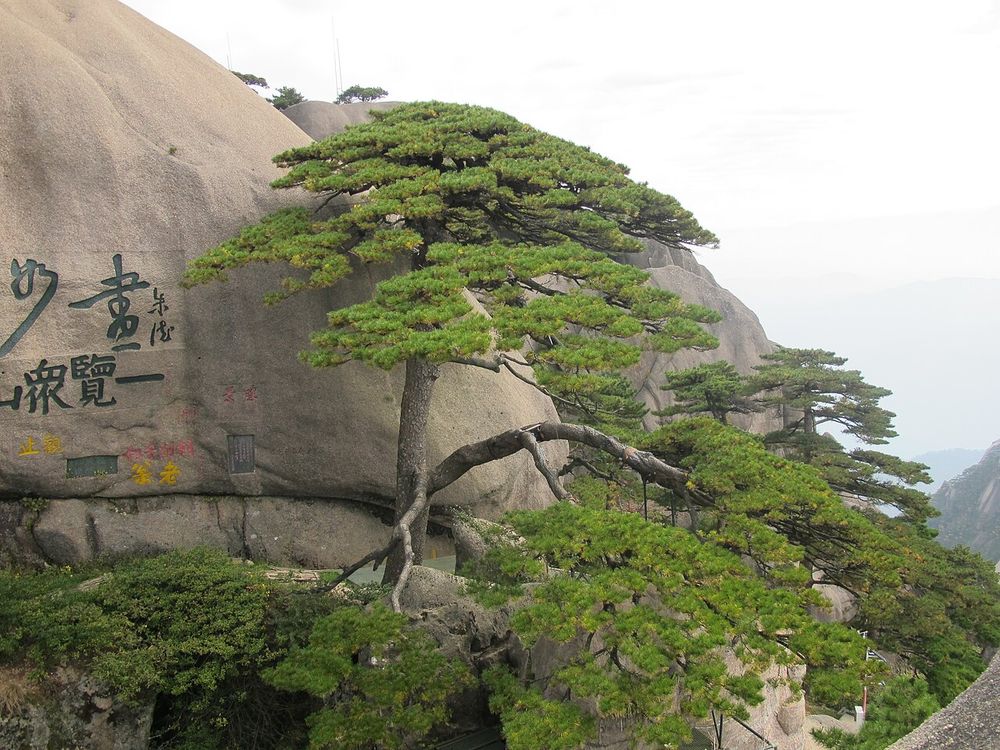
The pine in front of you grows out of a crack in the granite and holds one long branch out over the path like an arm raised in welcome. Since the 1980s it has had a full-time keeper. Few single trees anywhere are guarded like this one.
What is here
One ticket admits you to the whole mountain, and for three days. What it does not cover is the rides: the cable cars, the funicular in the West Sea canyon and the transfer bus from Tangkou up to the gates are all paid separately. Two peaks need more planning. Tiandu Peak needs a booking of its own, and Tiandu and Lotus take turns to close.
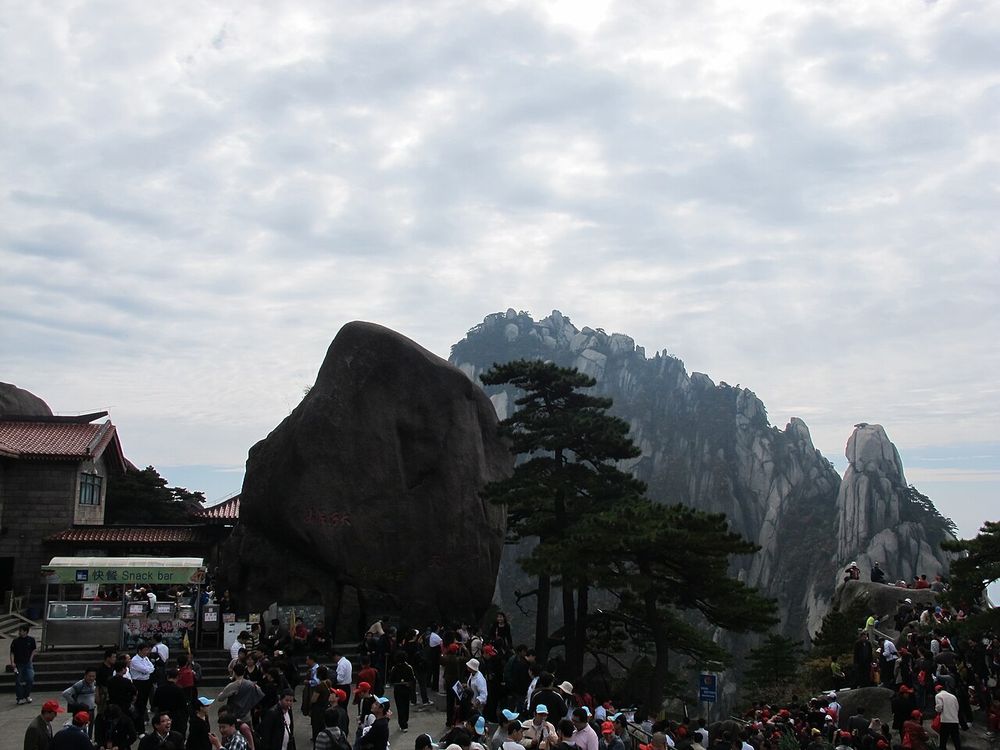
You are at about 1,670 metres, in front of Jade Screen Peak. The name "Guest-Greeting" is first found in a travel account of 1859. At that time the pine in front of the lion-shaped rock greeted guests, and another behind the old temple saw them off.
The whole country knows this tree because of a picture. When the Great Hall of the People in Beijing was finished in 1959, craftsmen from Wuhu in Anhui made the pine as an "iron painting", a picture hammered out of wrought iron, for the Anhui Room. It has stood behind handshakes in news photographs ever since.
The keeper checks the tree every two hours by day, looks for insects with a magnifying glass, shakes off snow in winter and watches an infrared alarm at night. The keepers' diary has been kept daily since 1995 and runs to more than a million characters.
Look under the long branch for its supports. In the winter of 1974 a blizzard split a limb, and the tree has had props ever since.
People who stood here
For a thousand years the people who climbed this mountain were poets, travellers and painters. Imagine them on the same stone, out of breath, looking at the same peaks.
Li Bai, Tang poet, 8th centuryChina's best-loved poet wrote of Huangshan's "thirty-two lotus peaks", and one of his poems says he had once climbed to the top. Perhaps he stood where you are, looking down on these pines.
Xu Xiake, Ming traveller, 1616 and 1618China's great travel writer of the Ming dynasty (1368–1644) first came up through deep snow, then returned to climb Tiandu and Lotus peaks. The way to both passes this ledge. Late in life he said that after Huangshan there was no other mountain worth seeing.
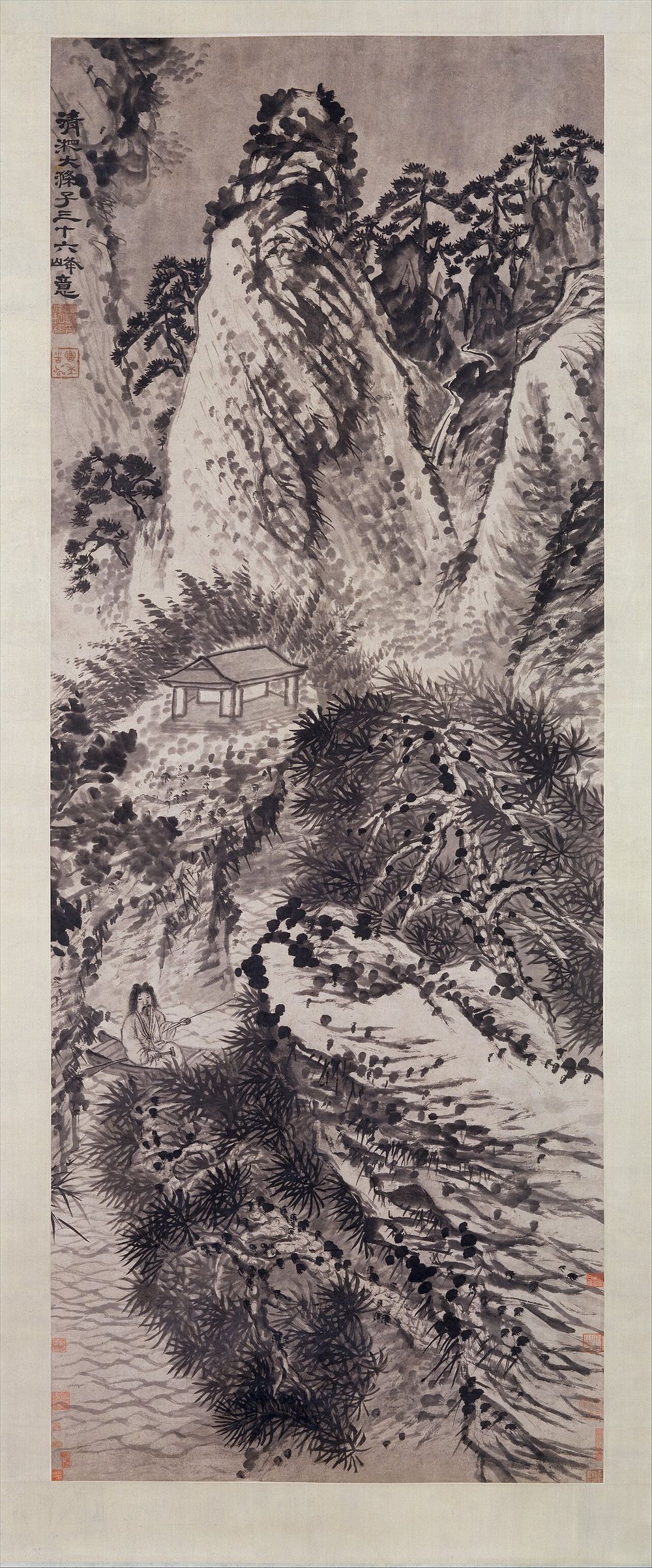
Shitao, Qing painter, 17th centuryOne of China's most original painters walked these ridges with a sketchbook. His motto was to search out every strange peak and make it his draft.
Deng Xiaoping, July 1979The leader who opened China's economy climbed on foot at the age of 75 and stopped beside this pine. He had asked that the paths stay open to other visitors.
Go deeper: seven stops
1. Before you climb: one great block of granite
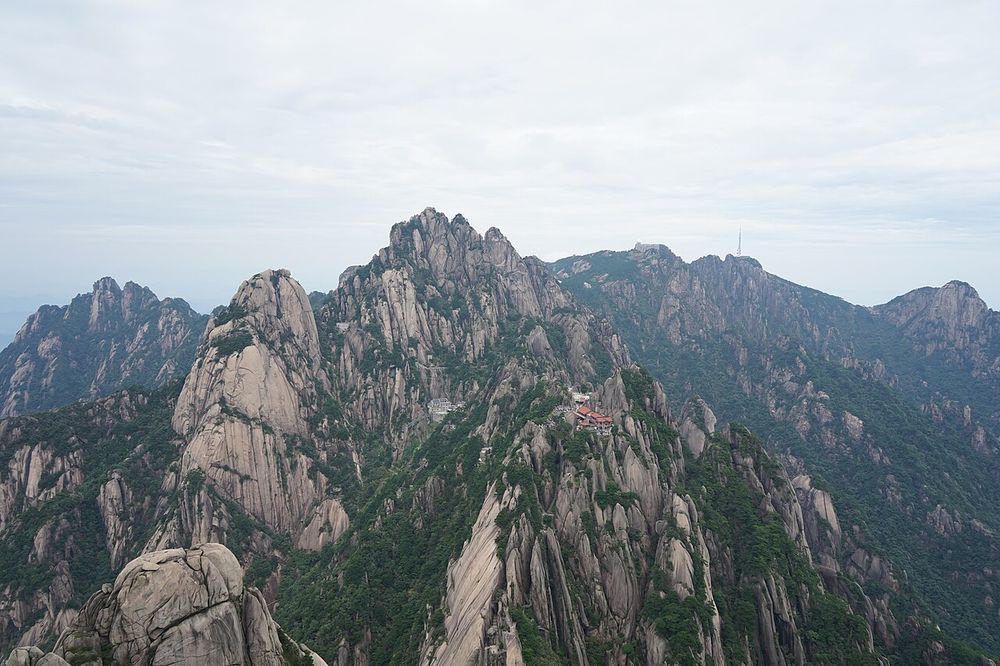
About 140 million years ago molten rock pushed up under this region and cooled slowly underground into granite. Later the crust rose in stages, the layers on top weathered away, and the granite was laid bare.
Granite is full of crossing cracks, called joints. Rain and frost work their way in and open the rock a little at a time, until what is left is a forest of pillars and odd-shaped boulders.
Of the 154 square kilometres of the core area, 107 are granite, and 77 peaks rise above 1,000 metres. About 2,400 mm of rain falls in a year, more than three times Beijing's, which is why there is so much cloud. The mountain is also a watershed: streams on the north side run to the Yangtze, those on the south to the Qiantang River.
2. Jade Screen: the pine and its kind
The Huangshan pine is a species that grows above 800 metres. A seed blown into a crack sprouts there and the root works down into the rock. The wind on the summits is so strong that many trees grow branches on one side only, with flat, table-like crowns.
Look beside the famous pine for the keeper's hut, less than ten square metres. When fire broke out on the mountain in the 1970s, the first thing Premier Zhou Enlai asked on the telephone was whether the pine was safe.
3. Tiandu and Lotus: the three great peaks
Lotus Peak and Jade Screen PeakDe-Shao Liu, CC BY-SA 4.0
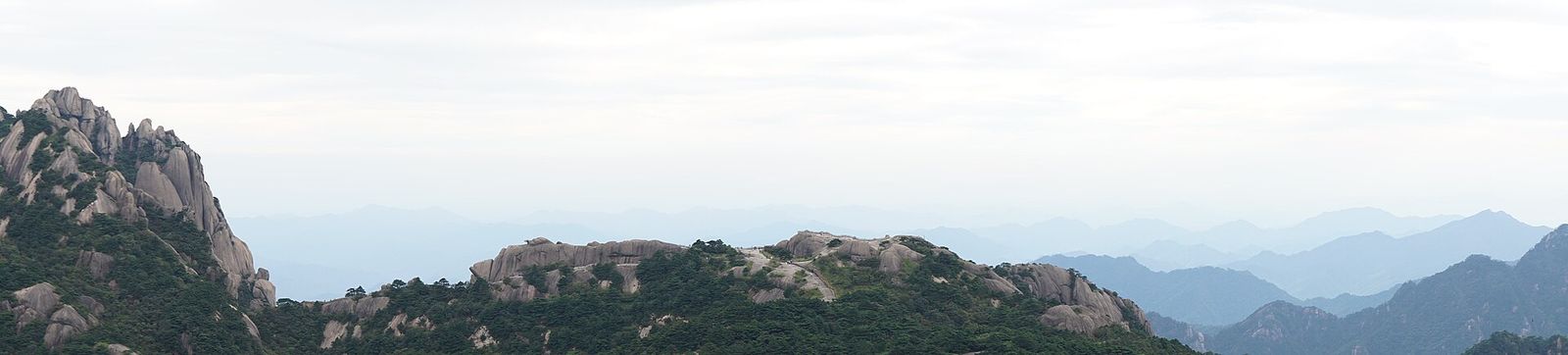
Three peaks stand above 1,800 metres. Lotus Peak is the highest at 1,864 m, Bright Summit second at 1,860 m and Tiandu, the Heavenly Capital, third at 1,810 m.
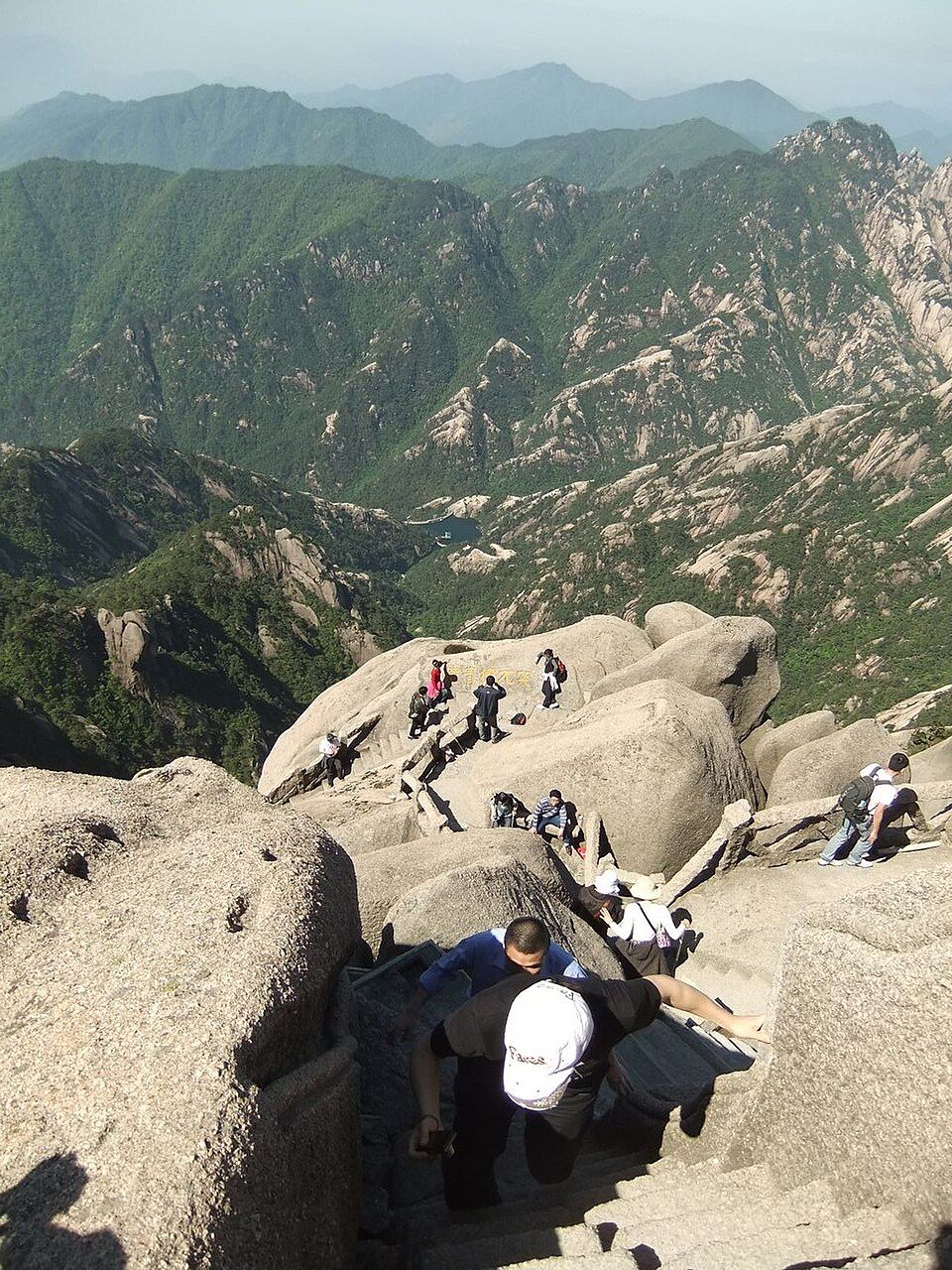
Tiandu is the steepest. The way up crosses the Carp's Back, a narrow spine of rock with a drop on both sides. Tiandu and Lotus are opened in turn so that each can rest, so check the notices before you set out.
Lotus Peak looks like a lotus just opening. Li Bai's line about lotus peaks between red cliffs and stone pillars has been called the earliest accurate description of this granite landscape.
4. Bright Summit: why is the top flat?
Looking out from Bright SummitDe-Shao Liu, CC BY-SA 4.0
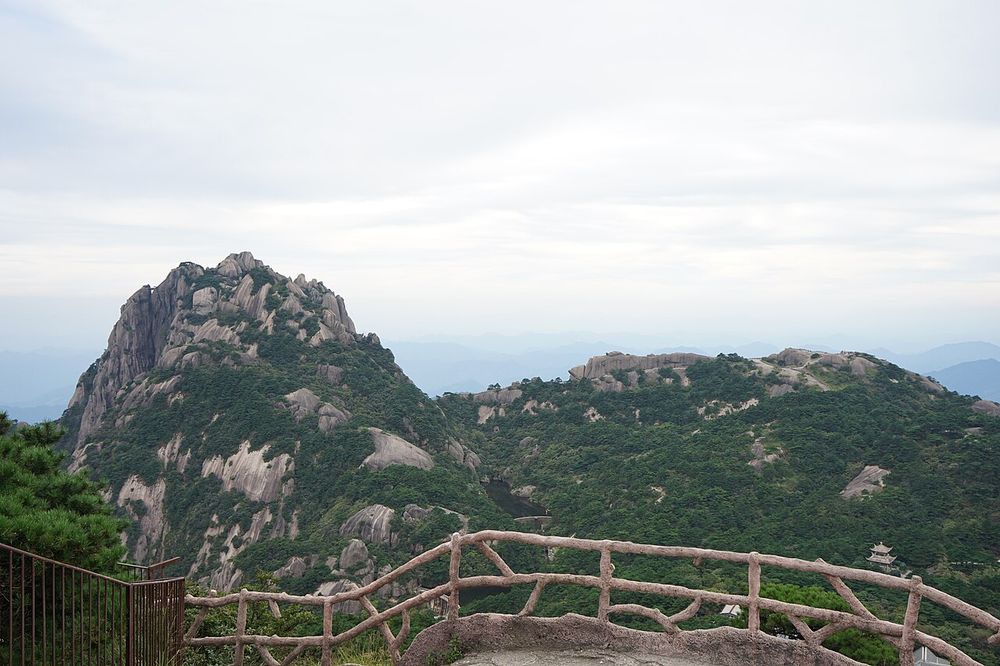
Bright Summit is broad and level, quite unlike the spires around it. Geologists read it as a remnant of an old erosion surface. Long ago the land here was worn down nearly flat. Then the whole block was lifted and the edges were cut into deep valleys, and only the middle kept its flat top.
The mountain's weather station stands here. It is a good place for sunrise and for the sea of cloud.
5. The Rock That Flew Here
The Rock That Flew Here above the cloud江上清风1961, CC BY 3.0
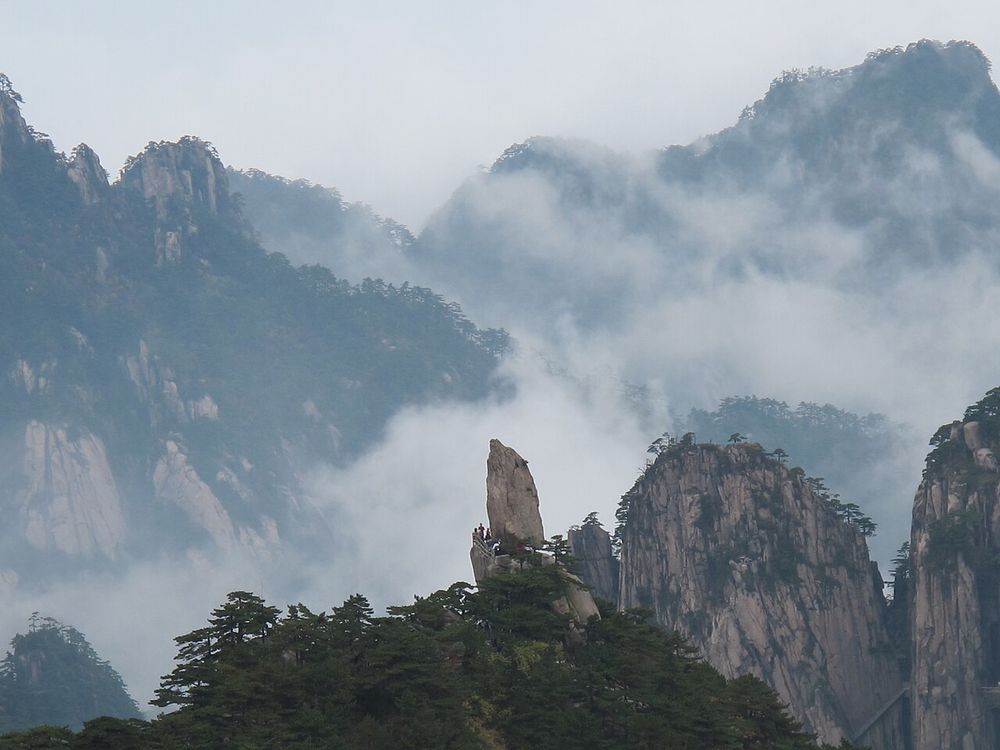
A tall slab stands upright on a platform and touches the rock beneath it over a very small area, as if it had dropped from the sky. It did not fly. The usual explanation is that the granite weathered along its joints and this block was left standing.
It is widely said that the stone in the opening titles of the 1987 television Dream of the Red Chamber, the rock left over when the goddess mended the sky, was filmed here. We have not found a first-hand source from the production.
6. West Sea canyon and North Sea: the "seas" are cloud
The West Sea Grand Canyon颐园居, CC BY-SA 4.0
Parts of the mountain are called seas: North Sea, West Sea, Heavenly Sea. The sea is cloud. When it lies low in the valleys, the peaks stand out of it like islands.
The West Sea Grand Canyon is deep and crowded with pillars, and has a small funicular. The North Sea is the place for cloud, sunrise and rocks named for what they look like, such as the Monkey Gazing at the Sea. Those names are fancy, not history.
7. On the way down: did Huangshan have glaciers?
In the 1930s the geologist Li Siguang argued that Huangshan shows clear marks of Ice Age glaciers, such as U-shaped valleys. From the 1960s other scientists disputed all of it and put the same landforms down to running water and frost. The argument has lasted more than half a century and is not settled. Read the signboards about glacial remains with that in mind.
A mountain and a school of painting
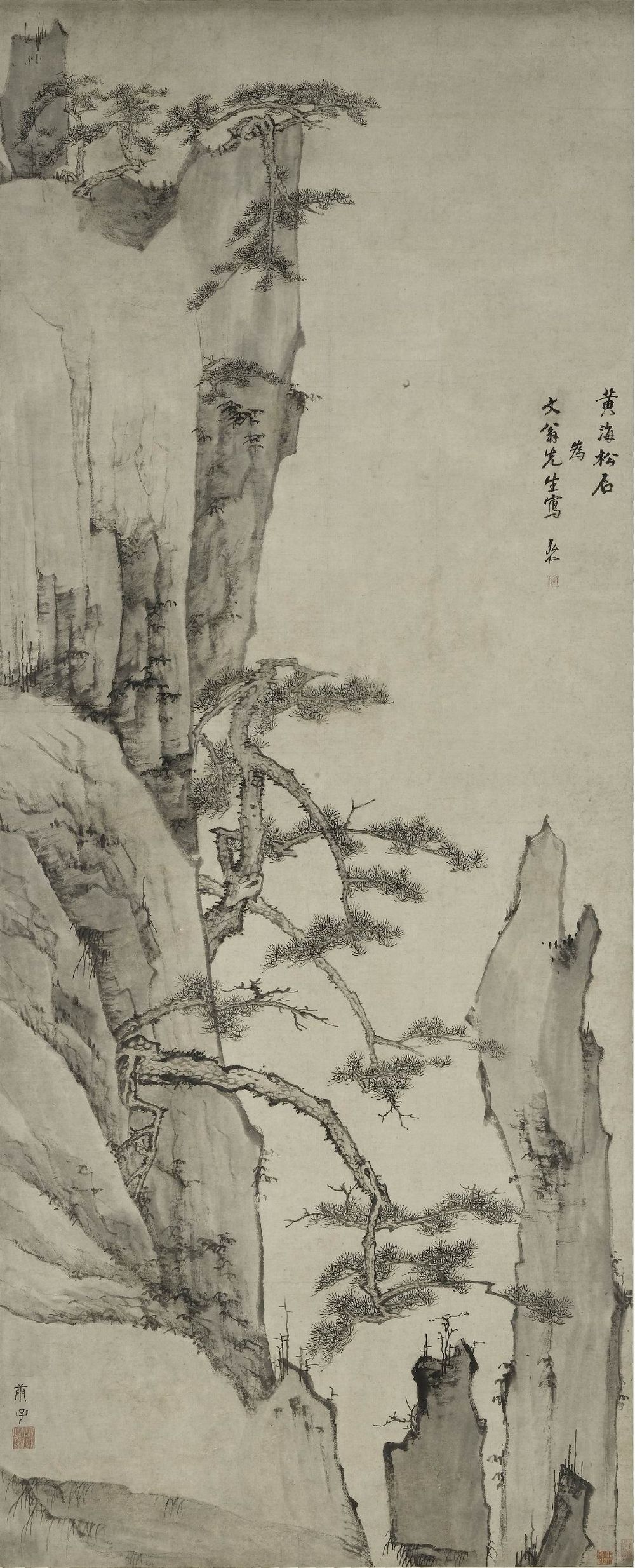
In the early Qing (1644–1912) a group of painters made this mountain their subject: Hongren, Mei Qing and Shitao. A later critic summed them up: Shitao caught its spirit, Mei Qing its shadow, Hongren its strangeness. Shitao's huge Huangshan of 1667, 3.5 metres high, is in the Liu Haisu Art Museum in Shanghai.
The modern painter Liu Haisu climbed Huangshan ten times. The tenth was in 1988, when he was 93.
A saying, a film and a sister park
"After the Five Sacred Mountains you need see no other mountain; after Huangshan you need not see the Five." Many people credit this to Xu Xiake. It is a later summary. What the record gives him is a different remark, quoted by a Qing writer.
Avatar (2009): at the film's Beijing press conference James Cameron said the floating Hallelujah Mountains were based on Huangshan. Geologists in Hunan and the Zhangjiajie park answered that they look far more like Zhangjiajie's sandstone pillars, and in 2010 Zhangjiajie renamed one of its pillars Hallelujah Mountain. One floating mountain, two Chinese mountains claiming it.
Yosemite in California is granite country too. Huangshan and Yosemite are sister parks, the first such pairing between China and the United States. Nearby, the old villages of Hongcun and Xidi are a World Heritage site of their own and fit well into the same trip.
Meanwhile in the world
Year
Here
Elsewhere
747
A Tang emperor renames the mountain Huangshan
Li Bai and Du Fu are in their prime; three years later the Abbasids take over the Arab empire
1616
Xu Xiake climbs Huangshan through deep snow
Shakespeare and Cervantes die in the same year
1618
Xu Xiake returns and climbs Tiandu and Lotus peaks
The Thirty Years' War breaks out in Europe
1667
Shitao paints his huge Huangshan
Milton publishes Paradise Lost
1859
The name "Guest-Greeting Pine" first appears in writing
Darwin publishes On the Origin of Species
1990
Inscribed as World Heritage for both culture and nature
It is China's second mixed site, after Mount Tai in 1987
One line to remember: the year Xu Xiake climbed Huangshan in the snow, Shakespeare died.
In pictures
The Guest-Greeting Pine江上清风1961, CC BY 3.0, Wikimedia CommonsThe pine and Tiandu Peak behind it江上清风1961, CC BY 3.0, Wikimedia CommonsAoyu Peak and Lotus Peak in one sweepDe-Shao Liu, CC BY-SA 4.0, Wikimedia CommonsLotus Peak and Jade Screen PeakDe-Shao Liu, CC BY-SA 4.0, Wikimedia CommonsOn the way up Lotus Peakrheins, CC BY 3.0, Wikimedia CommonsLooking out from Bright SummitDe-Shao Liu, CC BY-SA 4.0, Wikimedia CommonsThe Rock That Flew Here above the cloud江上清风1961, CC BY 3.0, Wikimedia CommonsThe sea of cloudJesseW900, CC BY-SA 4.0, Wikimedia CommonsThe West Sea Grand Canyon颐园居, CC BY-SA 4.0, Wikimedia CommonsPeaks of the North Sea arearheins, CC BY 3.0, Wikimedia CommonsHuangshan in winterDr. Hans-Günter Wagner, CC BY-SA 2.0, Wikimedia CommonsShitao, Thirty-six Peaks of Mount Huang Recollected, about 1705. The Metropolitan Museum of ArtShitao, CC0, Wikimedia CommonsHongren, Pines and Rocks of the Yellow Sea, 1660Hongren, Public domain, Wikimedia Commons
Local legends
These are stories people tell about this place. They are legends, not history, and each one says where it comes from.
LegendThe name of the mountain
The Yellow Emperor, the legendary first ancestor of the Chinese, is said to have made his elixir of immortality on this mountain and to have risen to heaven from it. That is why a Tang emperor gave the mountain his name.
Source: Old gazetteers of the mountain
Later, people who live here will be able to add the stories they grew up with, and say which of these they have heard.
Not certain, and where accounts conflict
Who said "after Huangshan you need not see the Five Sacred Mountains"?
Usually credited to Xu Xiake. A local writer's notes give it to a man of She county, and others call it a 20th-century summary. Xu Xiake's own recorded words are different.
Were there glaciers here?
Yes, said Li Siguang in the 1930s. No, said critics from the 1960s: water and frost did the work. There is no agreed answer.
How old is the Guest-Greeting Pine?
"More than a thousand years" in local publicity, "over 800" in a news agency report. We give no age.
Which fire did Zhou Enlai ask about?
December 1972 on Tiandu Peak in one account, 1973 near Jade Screen in another. We say the 1970s.
When did the first keeper start?
Early 1980 by his own account, 1981 in another report. We say from the 1980s.
Which mountain is in Avatar?
Huangshan, according to Cameron in Beijing in 2009; Zhangjiajie, according to geologists. Whether Cameron later changed his answer we could not confirm from a first-hand interview.
The Yellow Emperor and his elixir
This is legend. The renaming in 747 is recorded; sources differ by one day on the date.
Visiting
Tickets and hours
Under the 2026 price policy a full ticket is 190 yuan from 21 January to 19 December and 150 yuan in the winter season. It is valid for three days from first entry and lets you go in and out.
Cable cars are extra: 80 yuan one way on the Yungu and Taiping lines and 90 on the Yuping line in the main season.
Entry is by real-name booking for a time slot on the park's official platform, and Tiandu Peak needs its own booking. Daily numbers are capped, so book ahead for weekends and holidays.
The funicular in the West Sea canyon costs 100 yuan one way in the main season and 80 yuan in winter. The canyon closes for maintenance in winter; in 2026 it reopened on 14 March.
Since 11 June 2026 there is a fourth way in, the east gate. It is reached only by the East Sea cableway; there is no footpath on that side.
Tickets, cable cars and the Tiandu Peak slot are all booked in the official WeChat mini-programme 黄山旅游官方平台.
Last checked 2026-11-11. Travel and news reports, not the site's own notices.
Where to start
The usual route goes up the front and down the back: from the south gate take the Yuping cable car to Jade Screen and the Guest-Greeting Pine, walk over Lotus Peak or round it to Bright Summit and the Rock That Flew Here, and go down from the North Sea by the Yungu cable car.
One long day is possible. A night in a summit hotel gives you sunrise and a better chance of the sea of cloud.
Before you go
Everything on top is stone steps, thousands of them. Wear shoes with grip and carry little.
The weather turns fast and the summits are much colder than the valley. Bring a rain jacket; an umbrella is no use in the wind.
Tiandu and Lotus peaks close in turn, and paths shut in ice, storms or typhoons. Check the park's notices on the day.
Bring the passport you booked with. Set up mobile payment before you arrive and carry some cash.
Customs and manners
Porters carry supplies up the same steps on shoulder poles. Step aside and let them pass.
Smoke only at the marked smoking points. The fire rules on the mountain are strict.
Do not climb over a railing for a photograph, and do not scratch names on rocks or trees.
People may ask to take a photo with you, most often visitors from outside the big cities. It is friendly curiosity. Agree with a smile or decline with a wave; either is fine.
Tipping is not expected in China, at sites or in restaurants.
Look for these
Which way does the pine's "arm" point? It leaves the trunk about three metres up.
Find the props under the pine. Why would a tree need a walking stick?
Find a pine with branches on one side only. Which way do they point?
How many of the three great peaks did you reach? Which is the highest? (Lotus Peak.)
At the Rock That Flew Here, look at where it touches the ground. How big is the contact?
On Bright Summit look around: flat on top, spires all round. Explain why, using stop 4.
Find a rock that has a name, then give a name to one that has none.
Wait for the sea of cloud at the West Sea or North Sea. Is the cloud below your feet or above your head?
I am here
Stand at the site, sign in, press the button, and collect its stamp. Your browser will ask to use your location. It is sent to us once to confirm that you are at the site; we keep how far you were from it, not the spot where you stood.
Your stamps are saved to your account, so they follow you to any device. Checking from a browser cannot rule out every false location; stricter checks arrive with the app.
Messages
Share your photos
Photos here show the place, not people. Each one is credited to the visitor who took it and appears after our team has looked at it. A photo with you in it belongs under “I am here”.