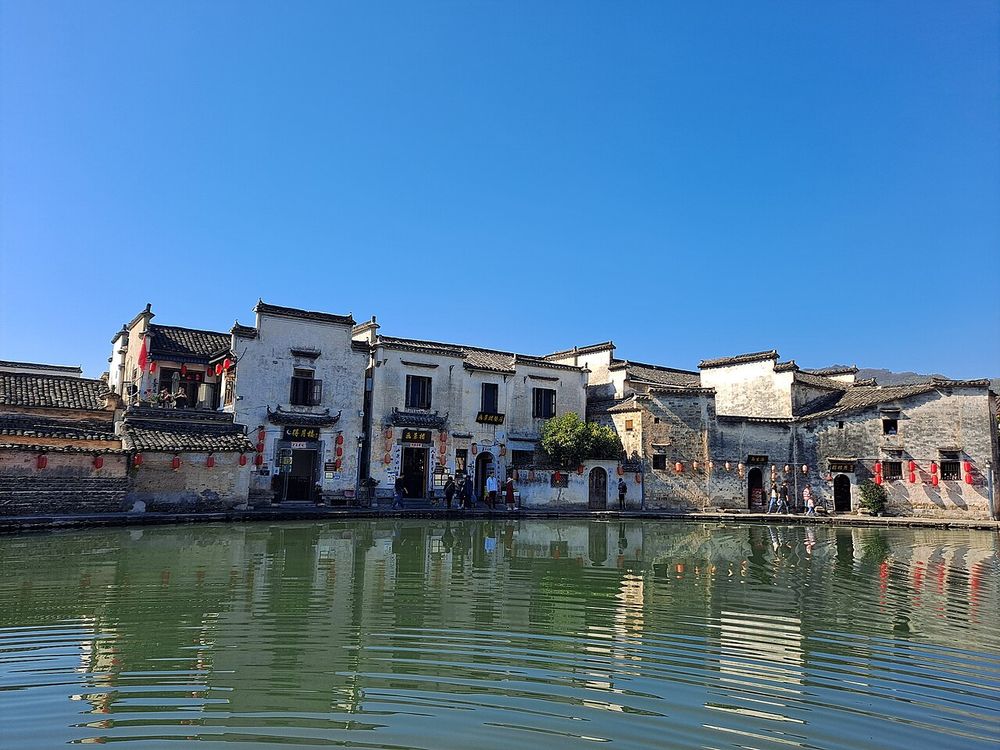
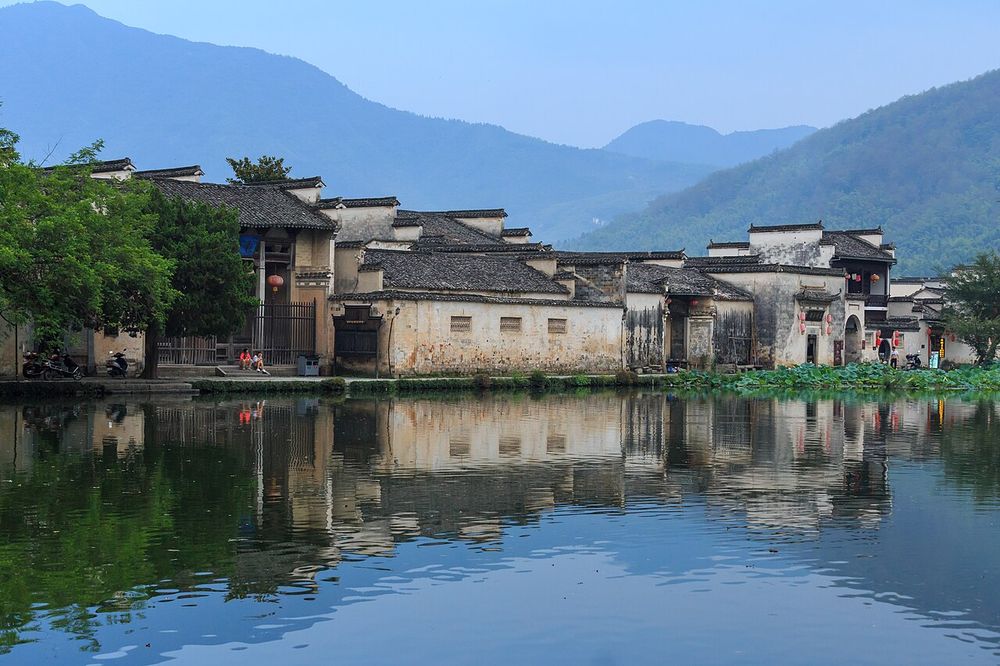
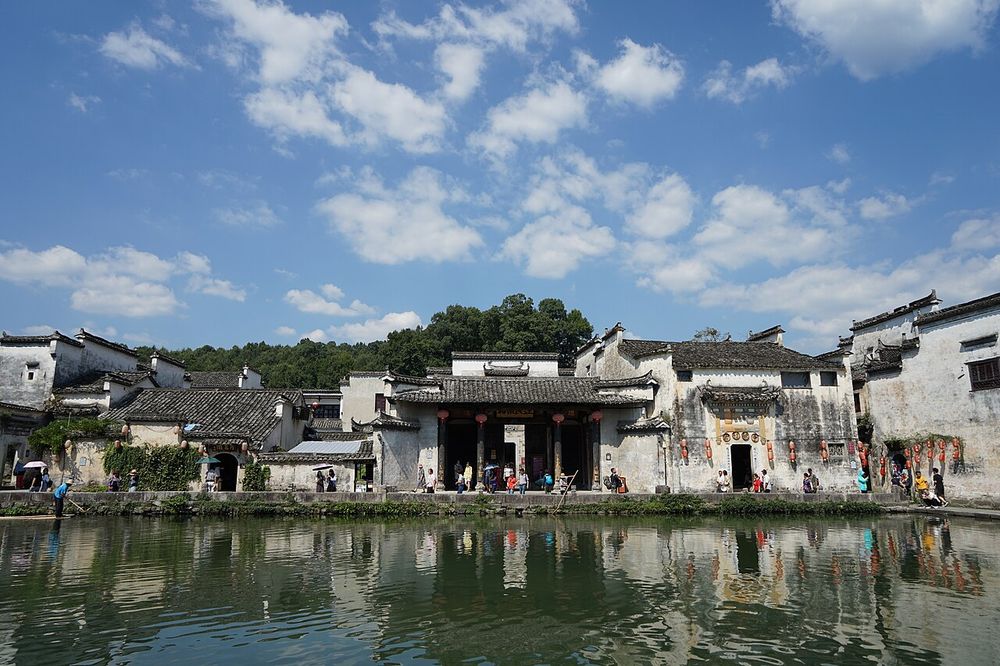
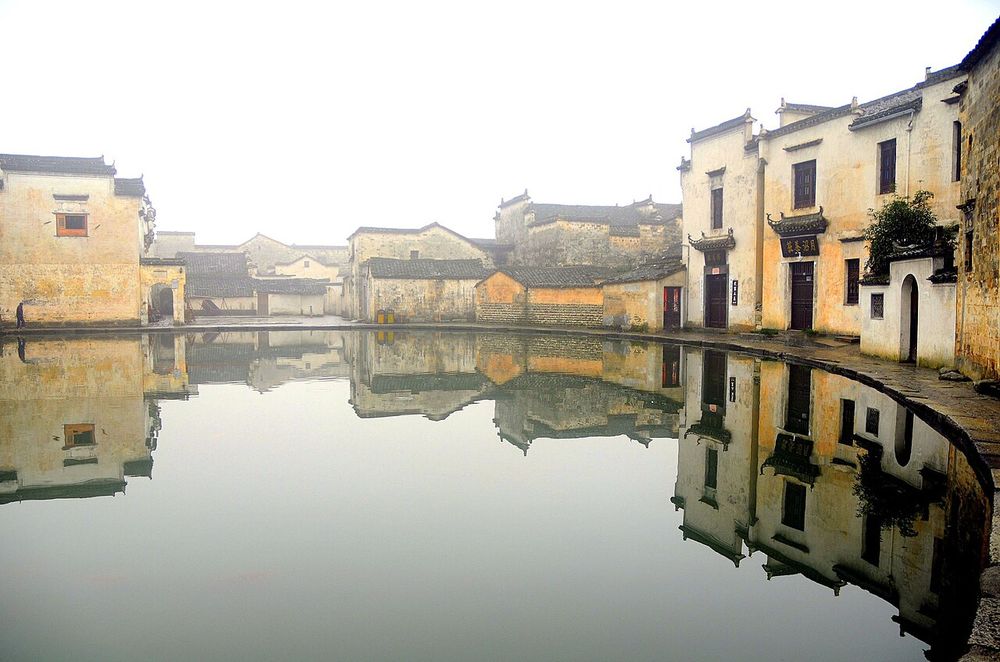
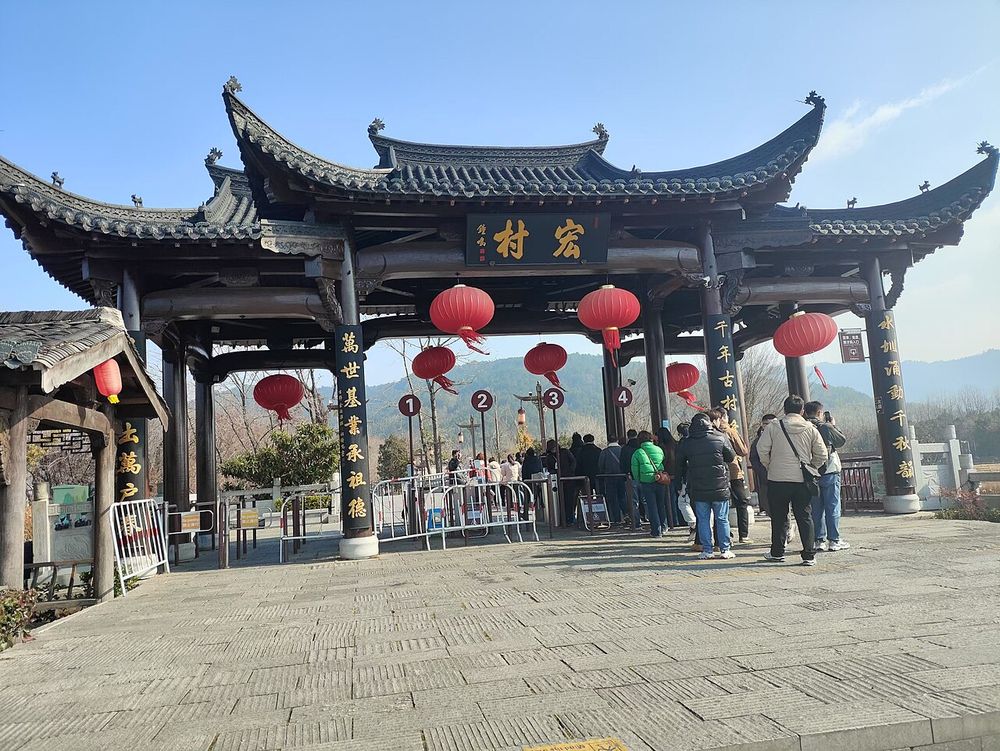
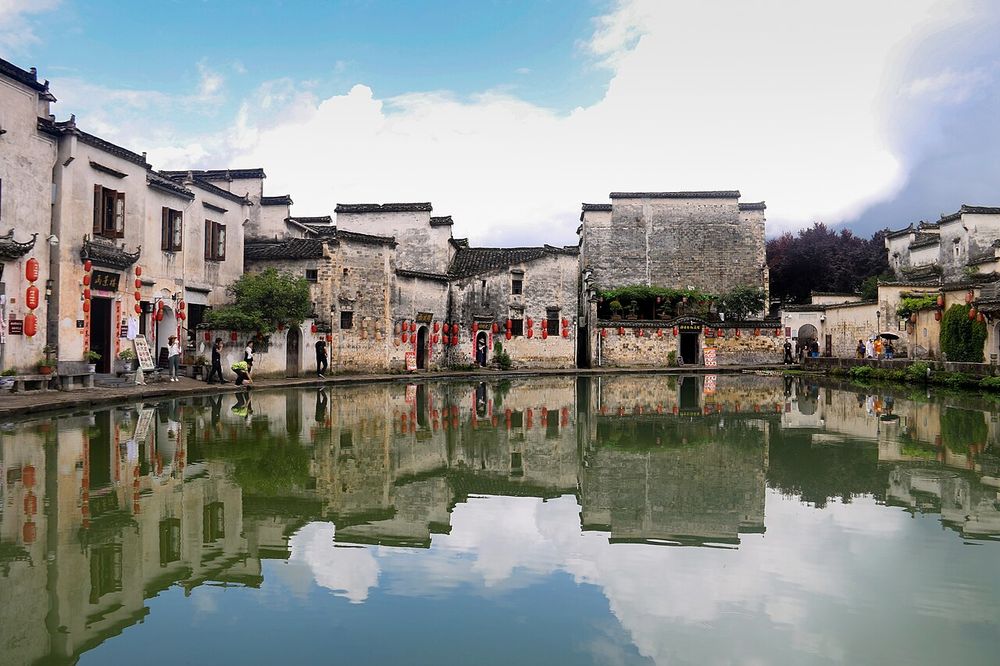
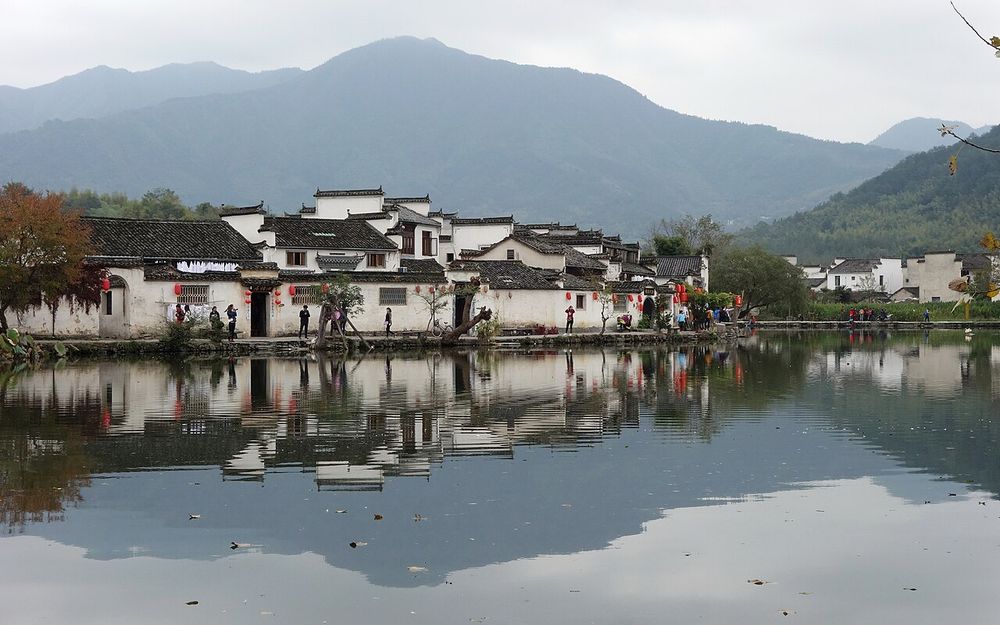
A village of white walls and black tiles at the foot of the Huangshan hills, built by one clan, the Wang, round a system of water: a stream led through every lane, a half-moon pond at its heart and a lake at its edge, all laid out, they said, in the shape of an ox. The merchants who grew rich in salt and tea came home and filled it with carved halls.
Photo: Davidmcbride, CC BY-SA 3.0, Wikimedia Commons
The story
The Wang family moved here in the 12th century. In the early Ming (1368–1644), the story goes, a feng shui master laid the village out as an ox lying by the hill: the hill is its head, two great trees at the entrance its horns, the houses its body, the canals its intestines and the pond and lake its stomachs. In practice the water system gave every house running water and a defence against fire.
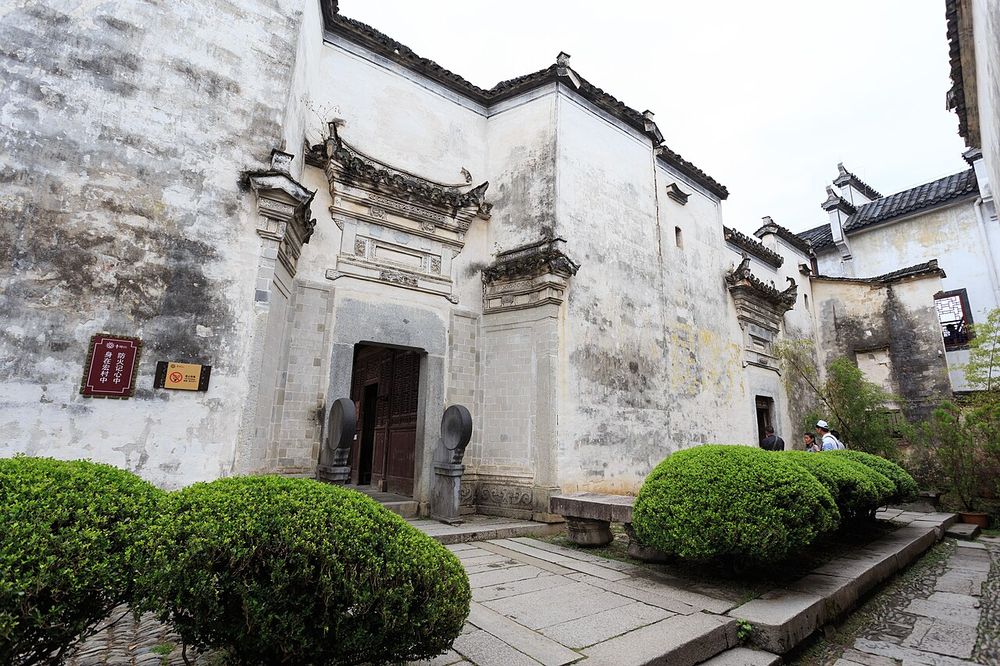
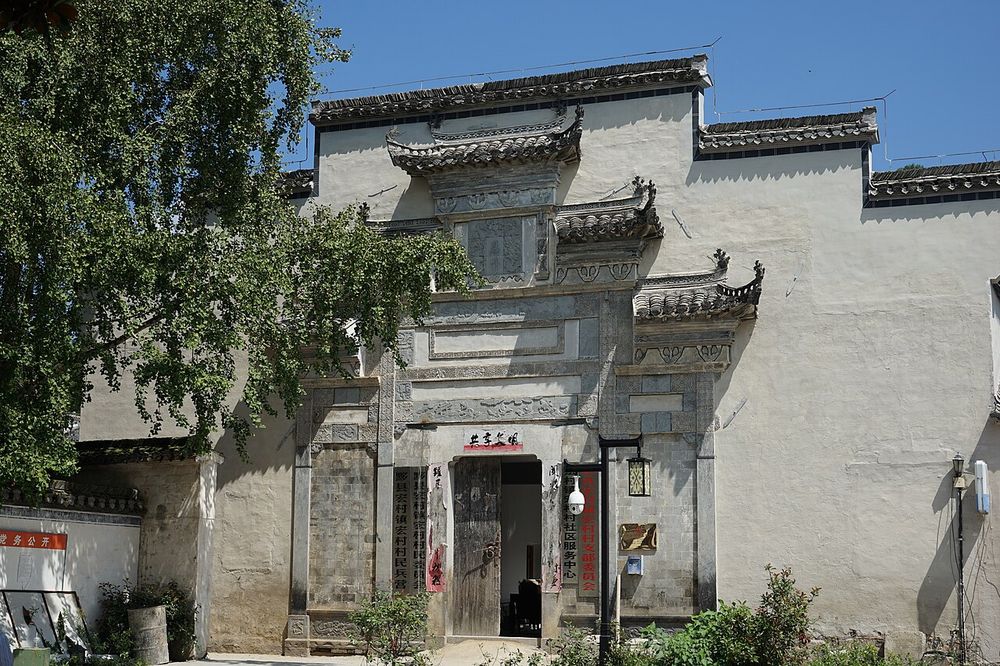
In the Ming and Qing (1644–1912), Huizhou men left the hills to trade salt, tea and timber across China, and sent their fortunes home. Hongcun's lanes are lined with their houses, high blank walls outside and carved wood within. With its neighbour Xidi, it was listed as a World Heritage Site in 2000.
What is here
One ticket covers the village and its open houses.
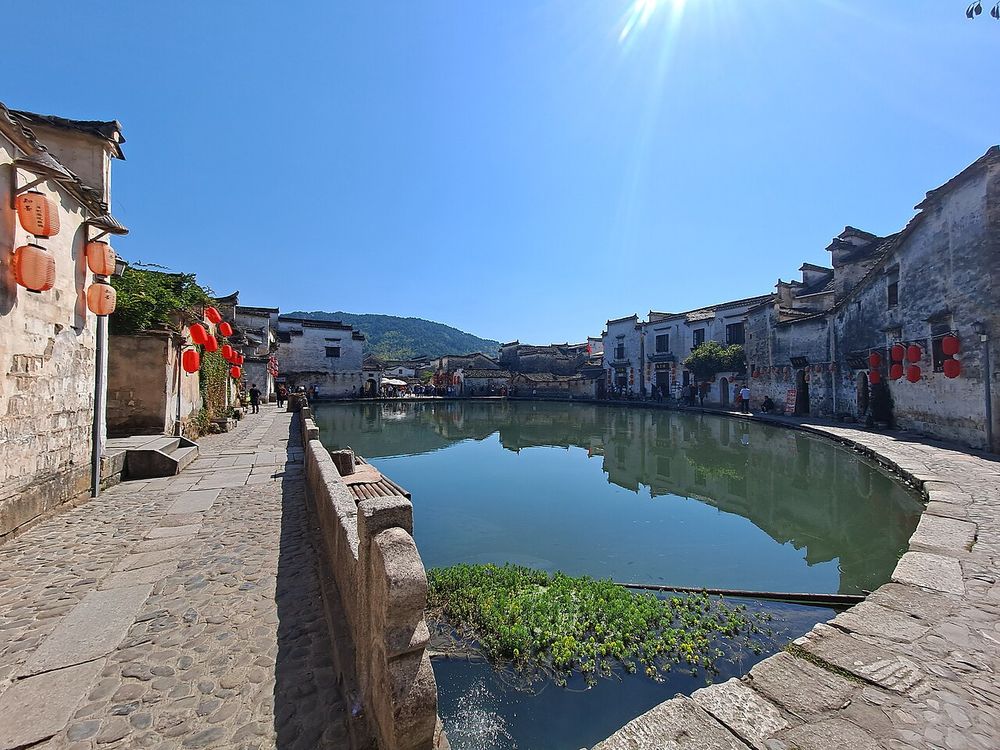
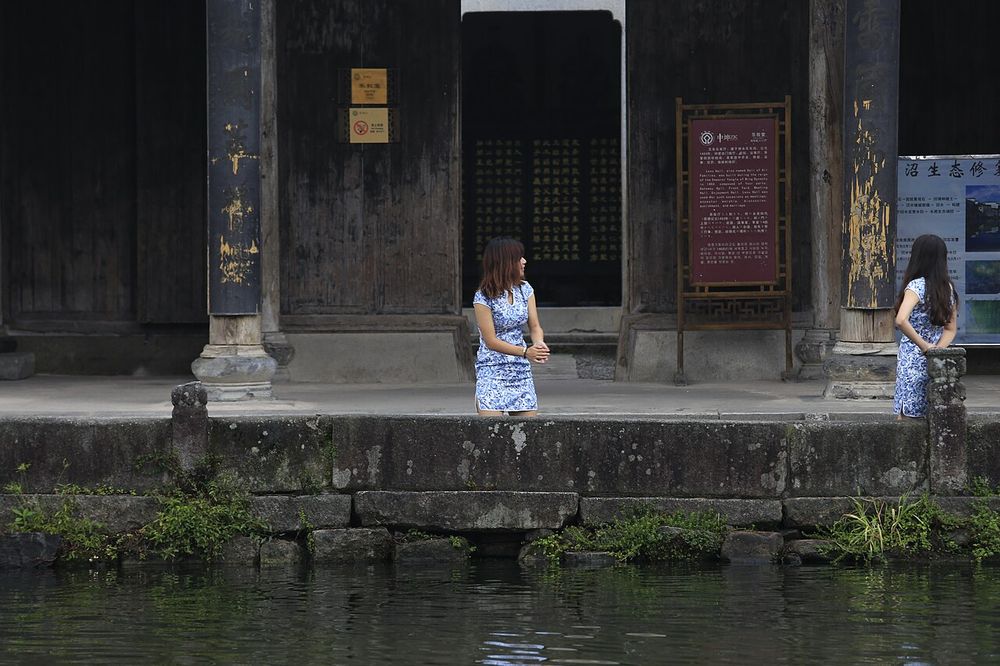
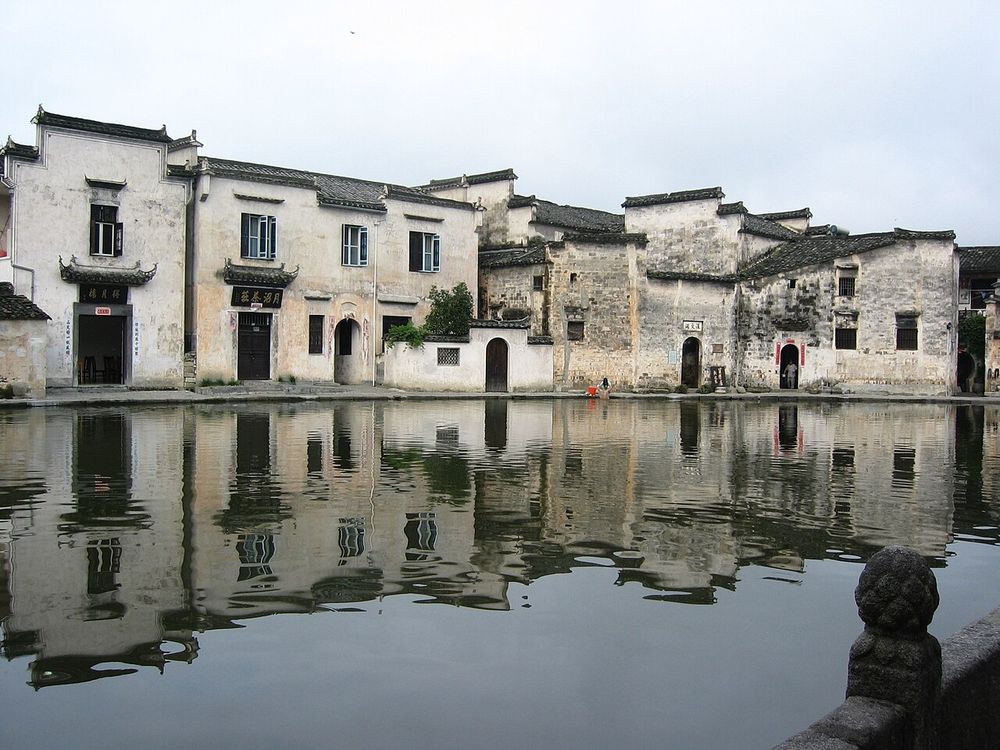
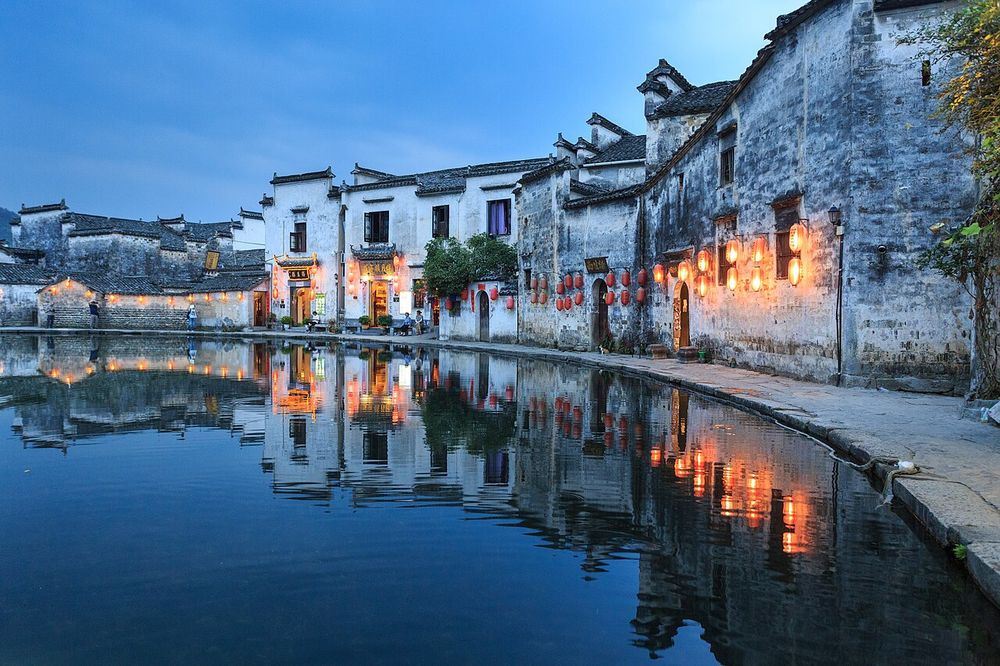
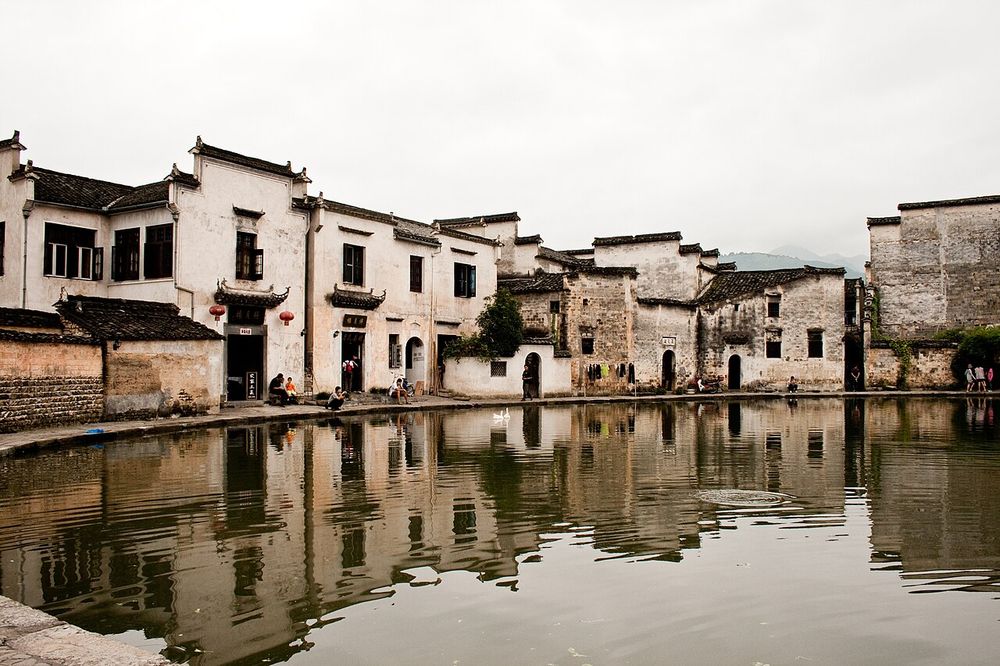
A half-moon pond at the centre of the village, dug in the early 15th century: the ox's stomach. Houses and the ancestral hall stand round it, doubled in the still water. Early in the morning, women still wash vegetables on its stone steps, and art students sit sketching along its edge.
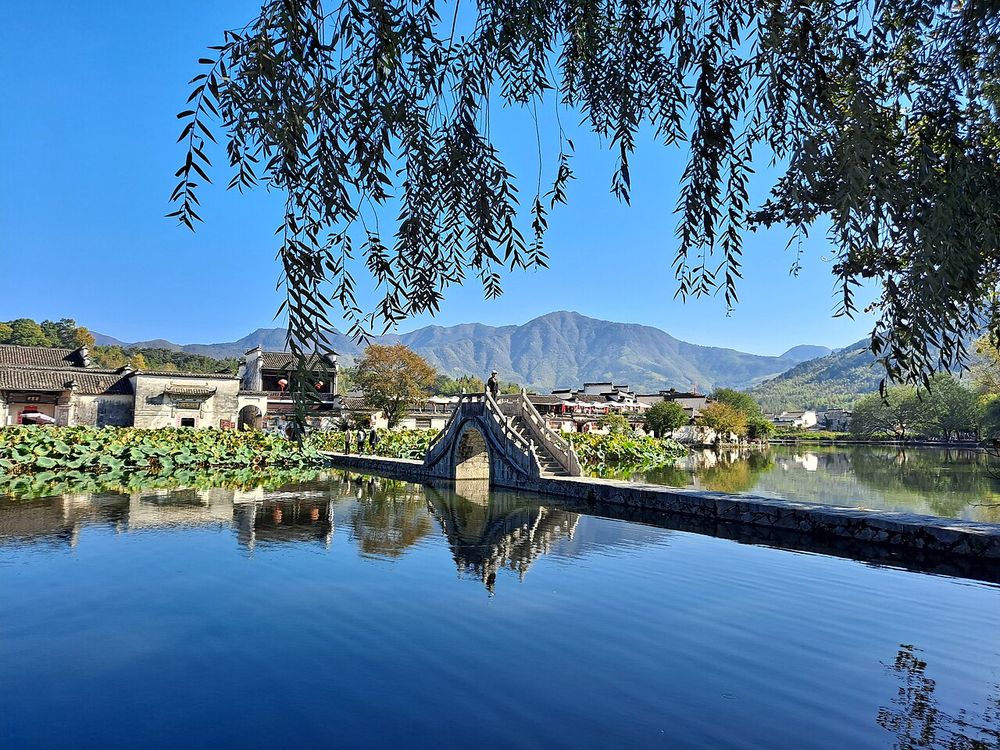
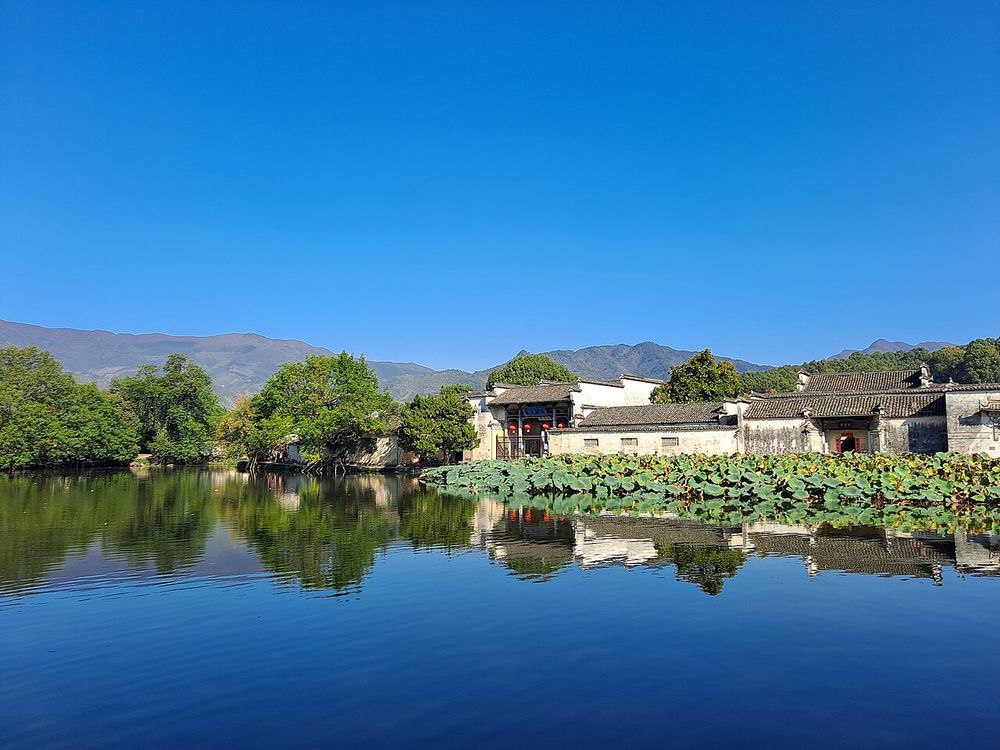
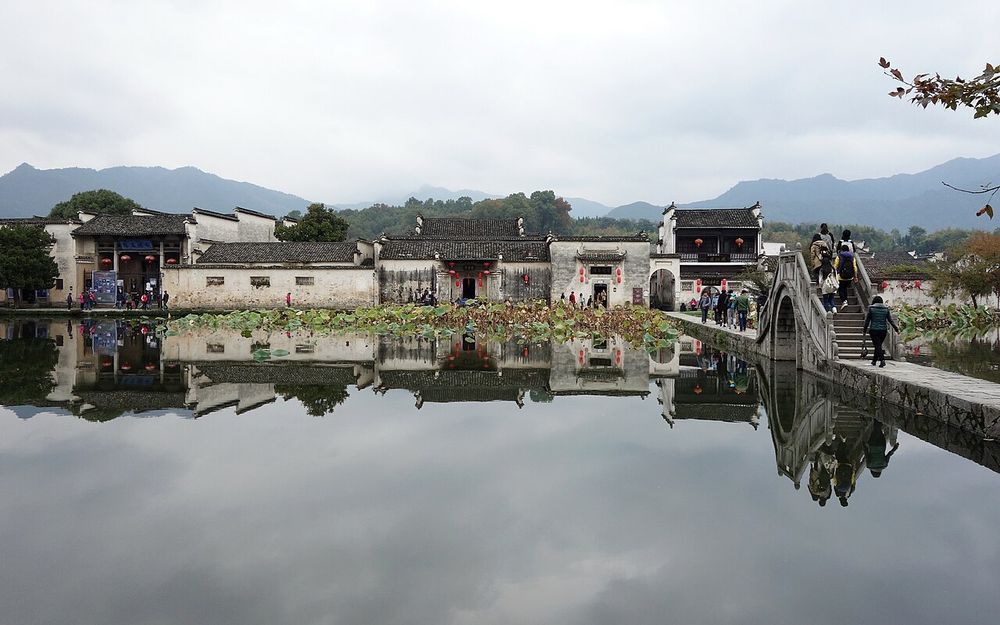
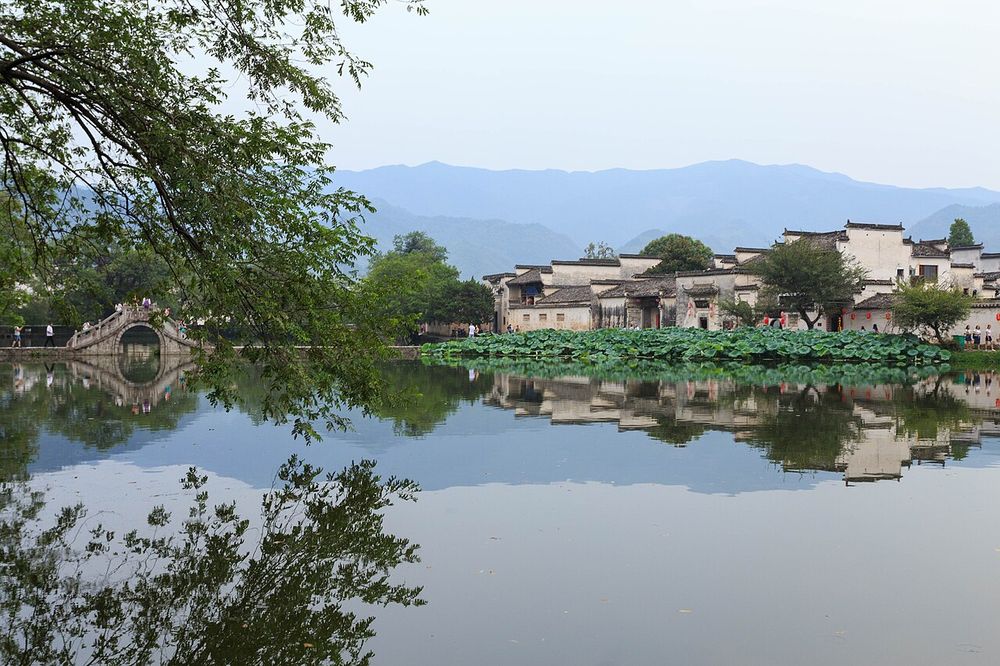
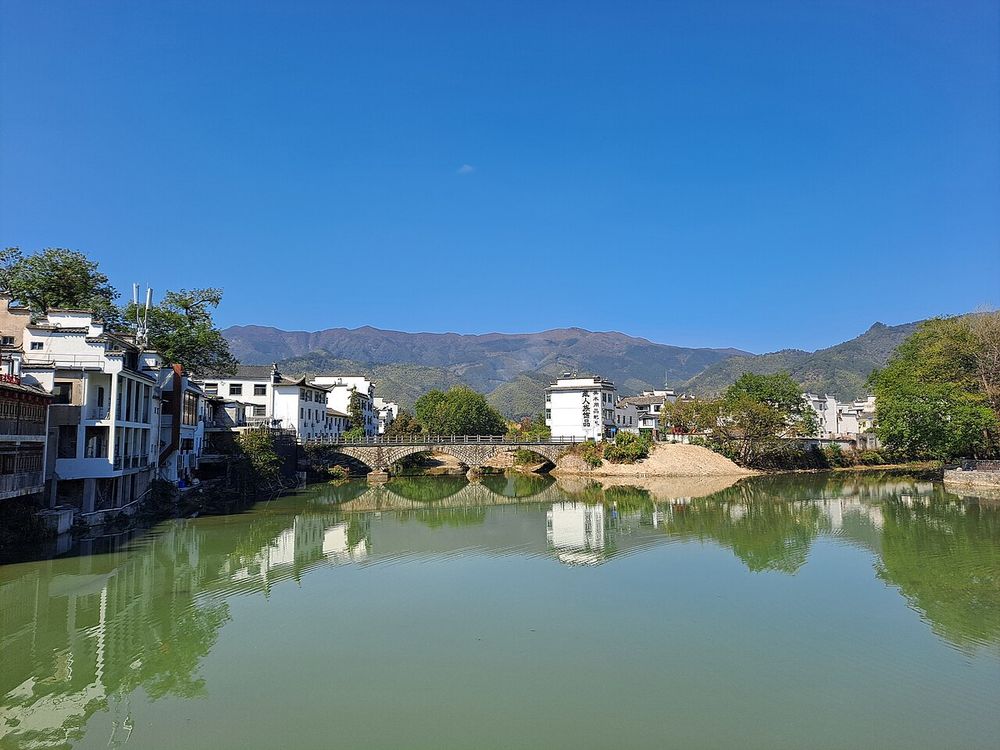
Then walk down to the South Lake, dug in 1607. "Crouching Tiger, Hidden Dragon" (2000) shot scenes by its arched bridge. Stand on the far bank looking back at the bridge and the white houses behind it, and you have a film-still shot of your own.
The South Lake and its arched bridge, 2022EditQ, CC BY-SA 4.0
Things people often get wrong
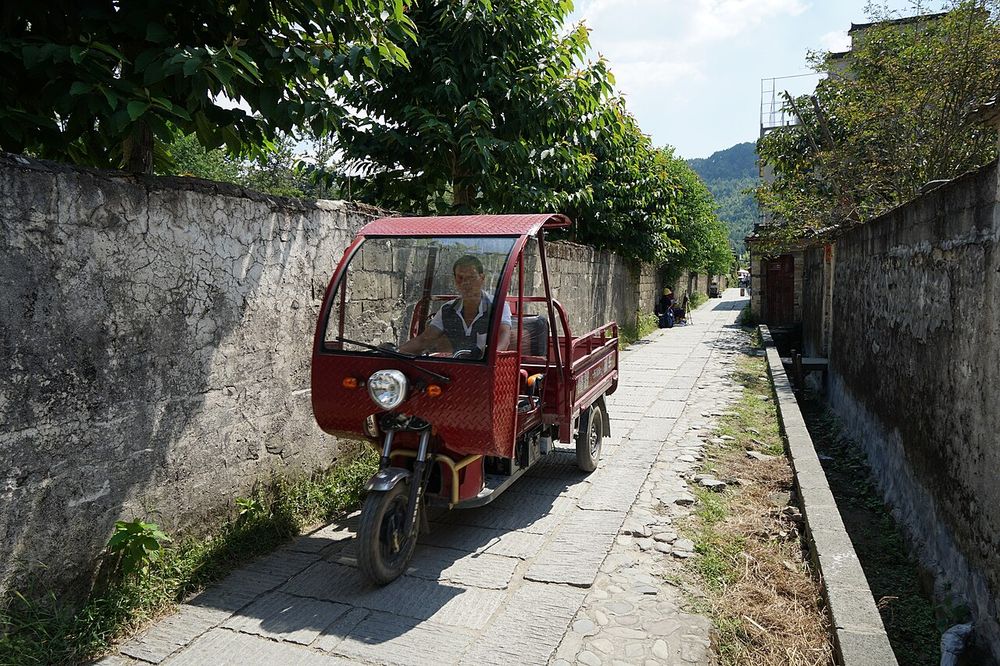
"It is a museum village." About a thousand people still live here; many houses are now guesthouses and shops, but families still use the canals.
"The ox shape is visible from the air." It is a way of reading the plan, not a picture; you need the story to see it.
People who stood here
We searched Chinese sources first for this list, then English ones.
Wang Dinggui (salt merchant, 19th century)He built the Chengzhi Hall in 1855, the grandest house in the village, with carvings covered in gold leaf.
Wang Daxie (statesman, 1859–1929)A diplomat of the late Qing and briefly premier of the Republic in 1917; his family house in Hongcun is open to visitors.
Ang Lee (director, born 1954)He shot scenes of "Crouching Tiger, Hidden Dragon" at the South Lake, and the film made Hongcun known across the world.
Chow Yun-fat (actor, born 1955)As the swordsman Li Mu Bai, he led his horse across the bridge on the South Lake.
Go deeper: from the old trees to the South Lake, six stops7 stops · about 1 min to read
The village is small; two or three hours are enough, but the light at dawn and dusk is the reason to stay a night.
1. The two old trees
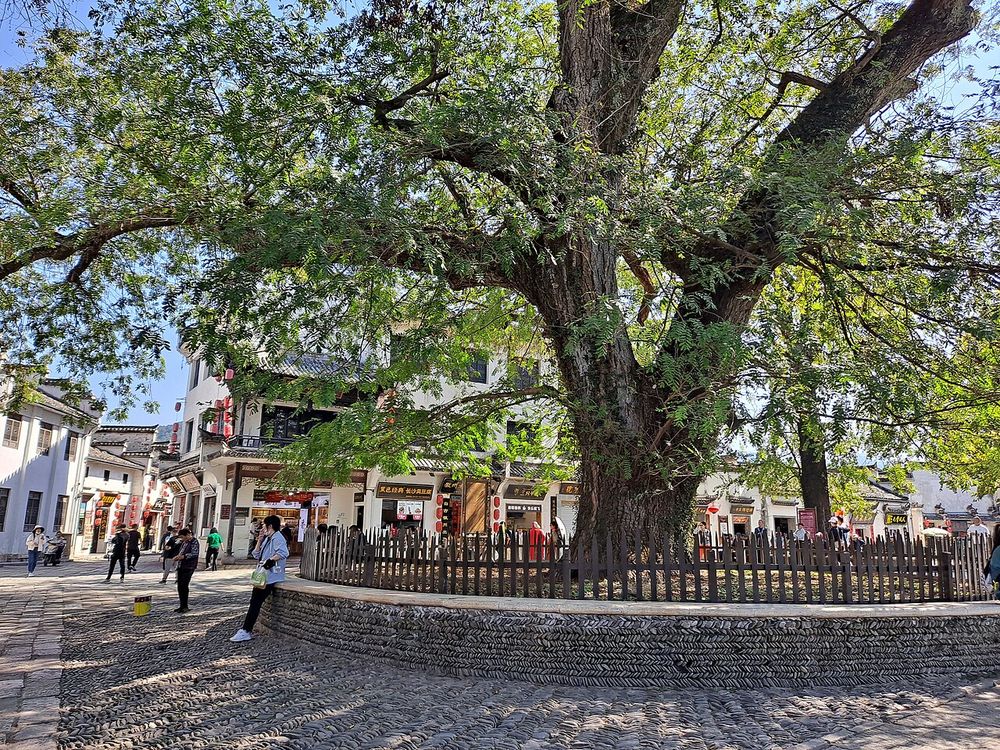
The old trees at the entrance, 2022EditQ, CC BY-SA 4.0
A gingko and a maple-poplar at the entrance, the ox's horns, said to be several hundred years old.
2. The Moon Pond and the Wang ancestral hall
The curve of the Moon Pond, 2022EditQ, CC BY-SA 4.0
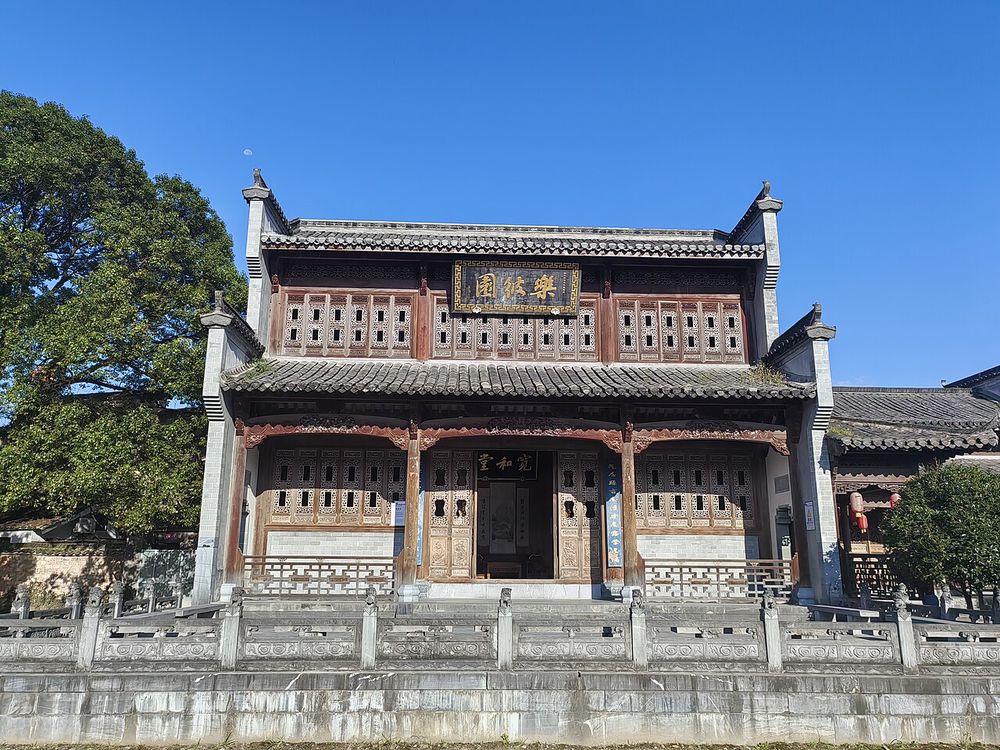
The heart of the village, with the clan's ancestral hall, Lexu Tang, on its north side.
The ancestral hall by the pond, 2016Zhangzhugang, CC BY-SA 4.0
3. The Chengzhi Hall
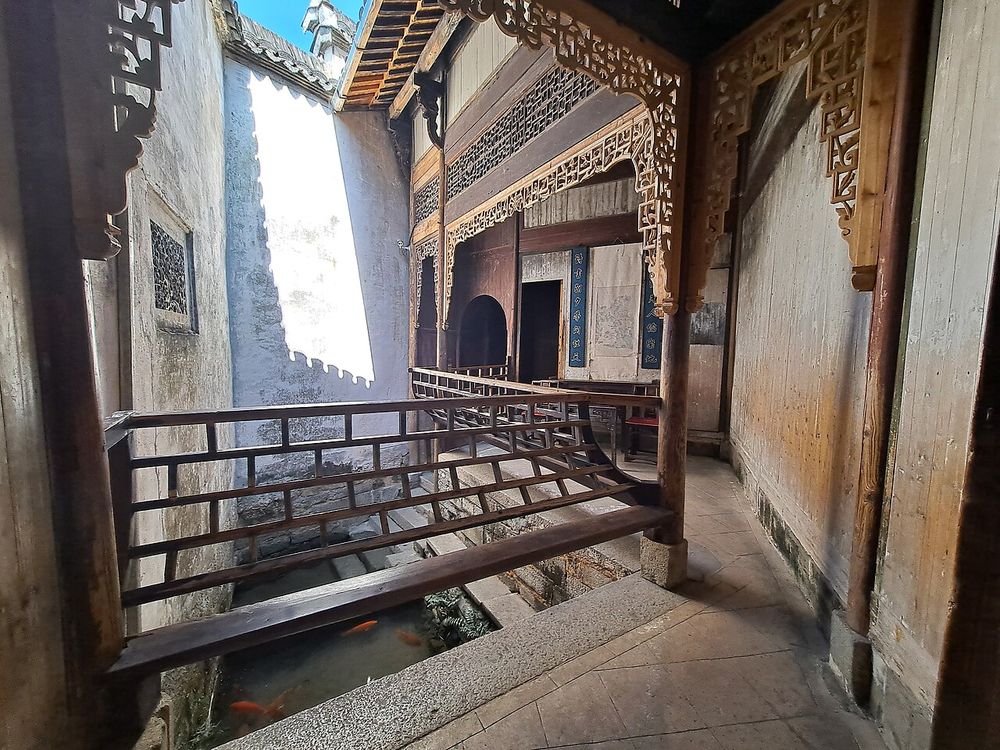
Carved woodwork in the Chengzhi Hall, 2022EditQ, CC BY-SA 4.0
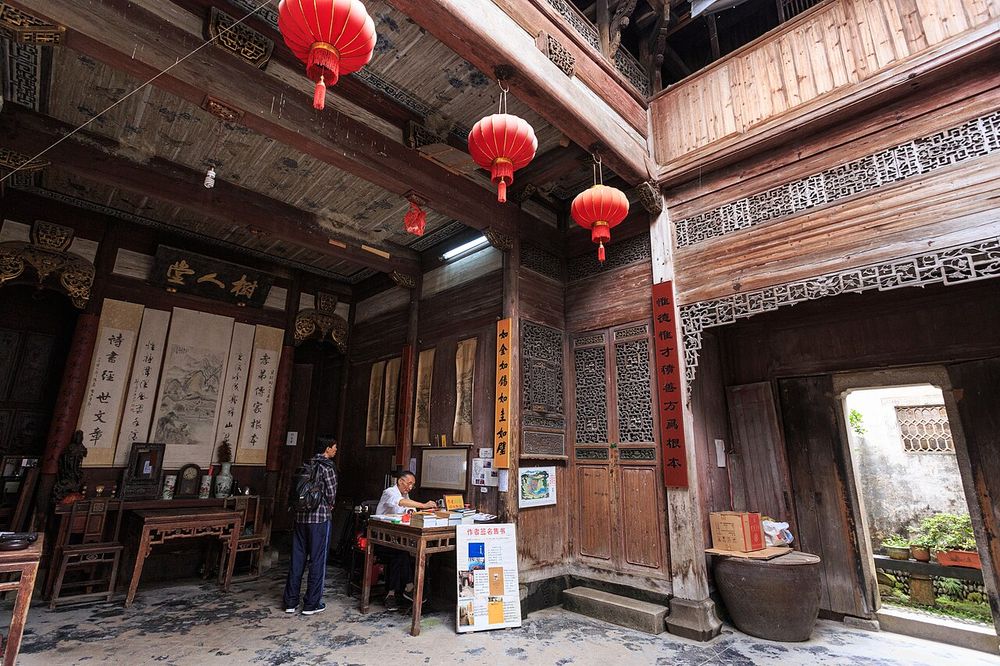
Built in 1855 by the salt merchant Wang Dinggui: some sixty rooms, a fishpond room and carvings on every beam, among them a scene of a banquet in which, guides say, every figure has a different face.
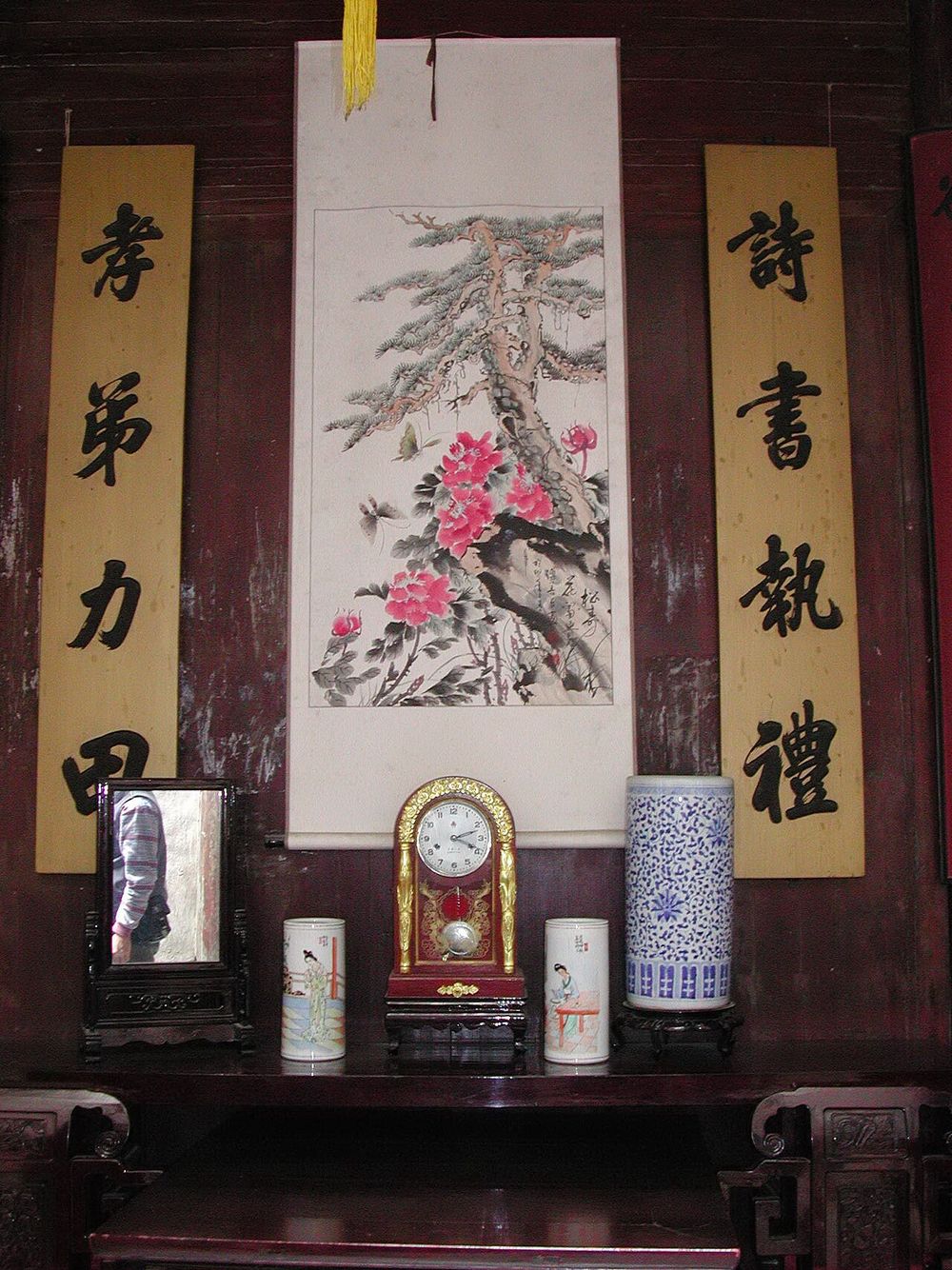
The main hall of a merchant's houselienyuan lee, CC BY 3.0
4. The lanes and the canals
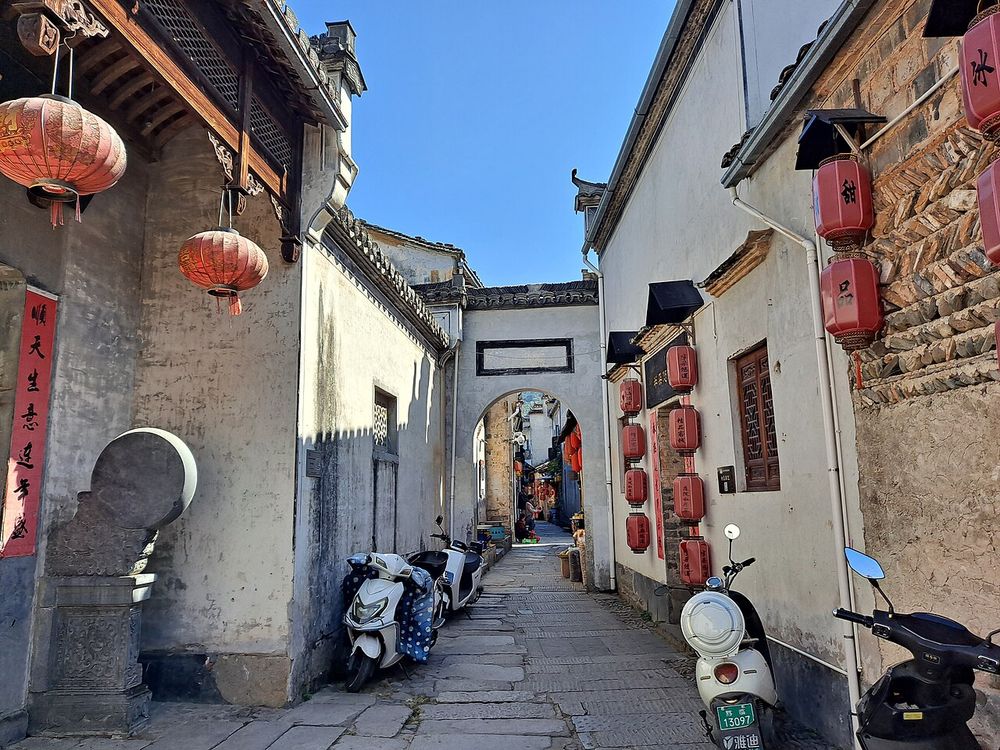
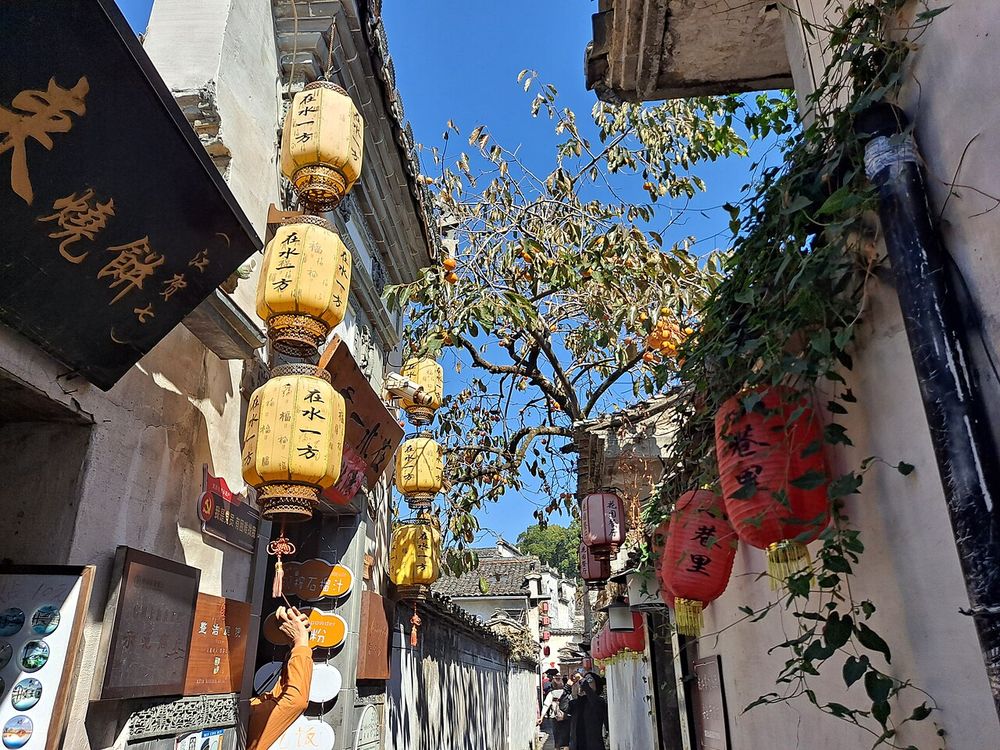
A lane with lanterns, 2022EditQ, CC BY-SA 4.0
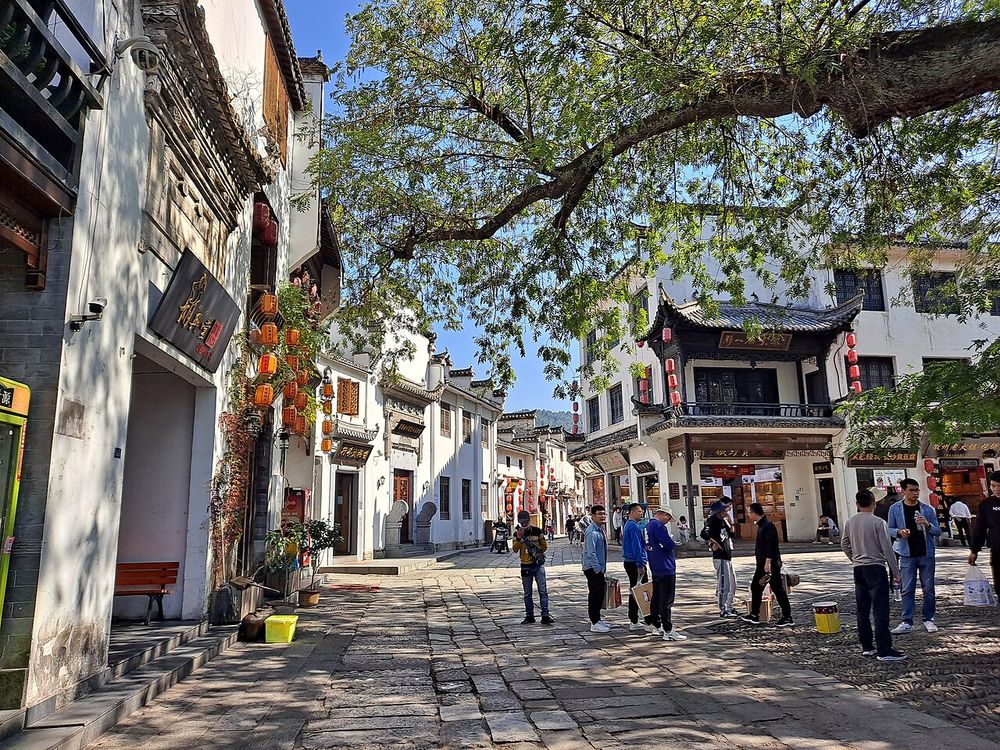
Follow the stone-lined channel through the lanes; the water passes the doors of every house before reaching the pond.
5. The South Lake and its academy
The South Lake on a clear day, 2022EditQ, CC BY-SA 4.0
The lake dug in 1607, with its arched bridge, and on its north shore the Nanhu Academy of 1814, where the village's boys studied for the examinations.
A gate building by the lake, 2023Yumeto, CC BY-SA 4.0
6. The view at dawn
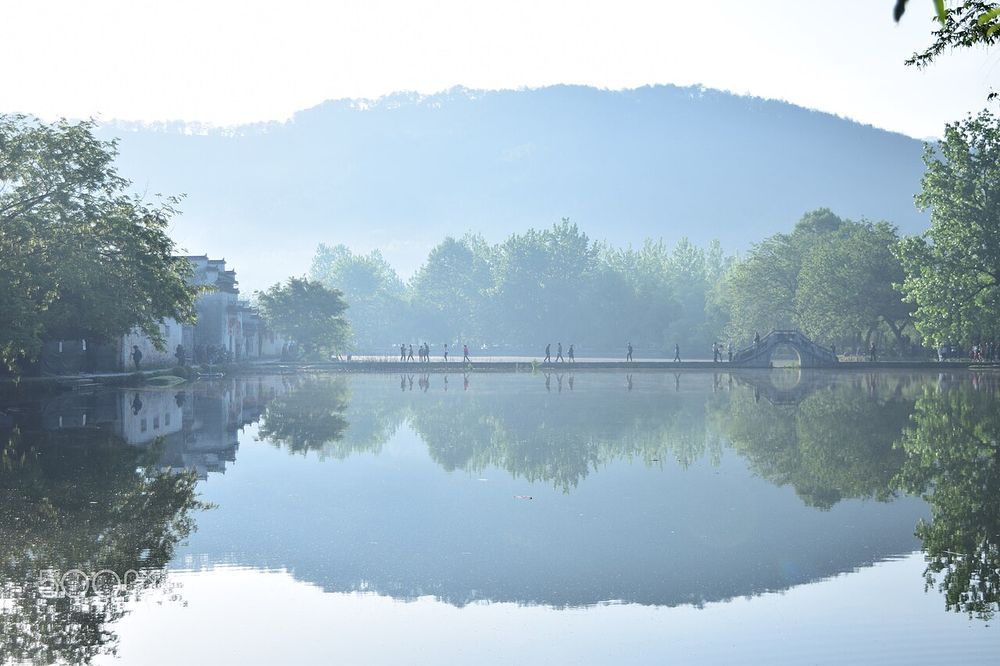
Mist on the lake at dawnCecilia Yip, CC BY 3.0
Come back to the South Lake at first light, when mist lies on the water and the hills behind are still blue.
The village and the same years elsewhere
In 1607, the year the South Lake was dug, English settlers founded Jamestown in Virginia.
Meanwhile in the world
Year
Here
Elsewhere
1131
The Wang family settles at Hongcun
The future king Louis VII is crowned in France
1607
The South Lake is dug
English settlers found Jamestown
1855
Wang Dinggui builds the Chengzhi Hall
Paris holds its first World's Fair
2000
Listed as a World Heritage Site with Xidi
A first draft of the human genome is announced
One line to remember: a village built round its water, where every lane has a stream and every house a carved hall.
Lake, pond and lanes
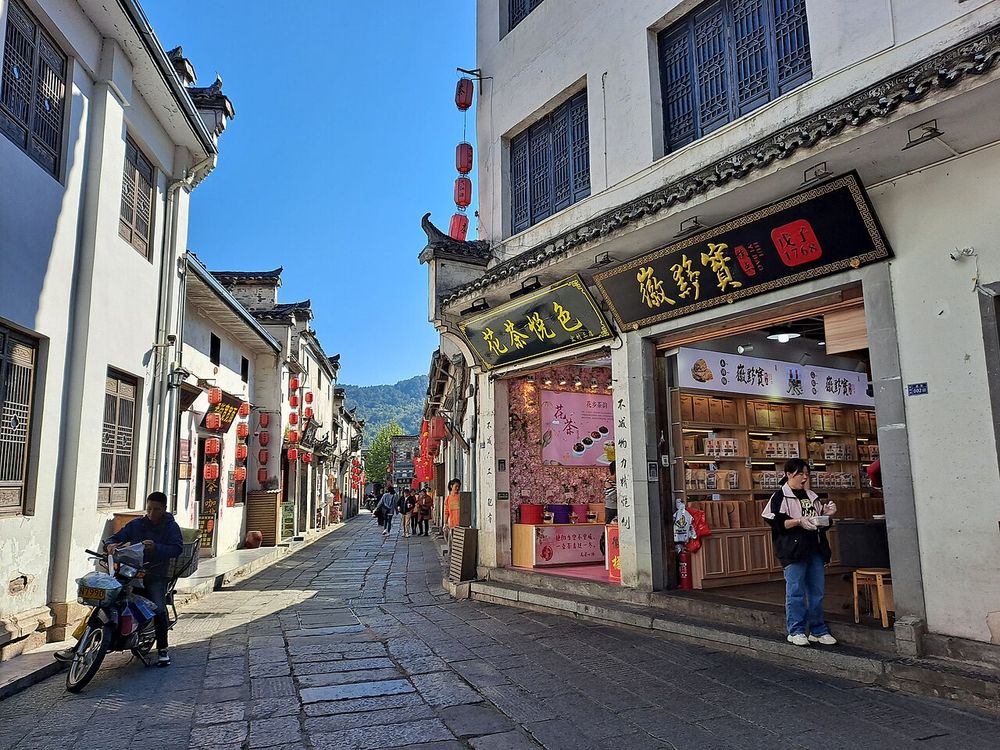
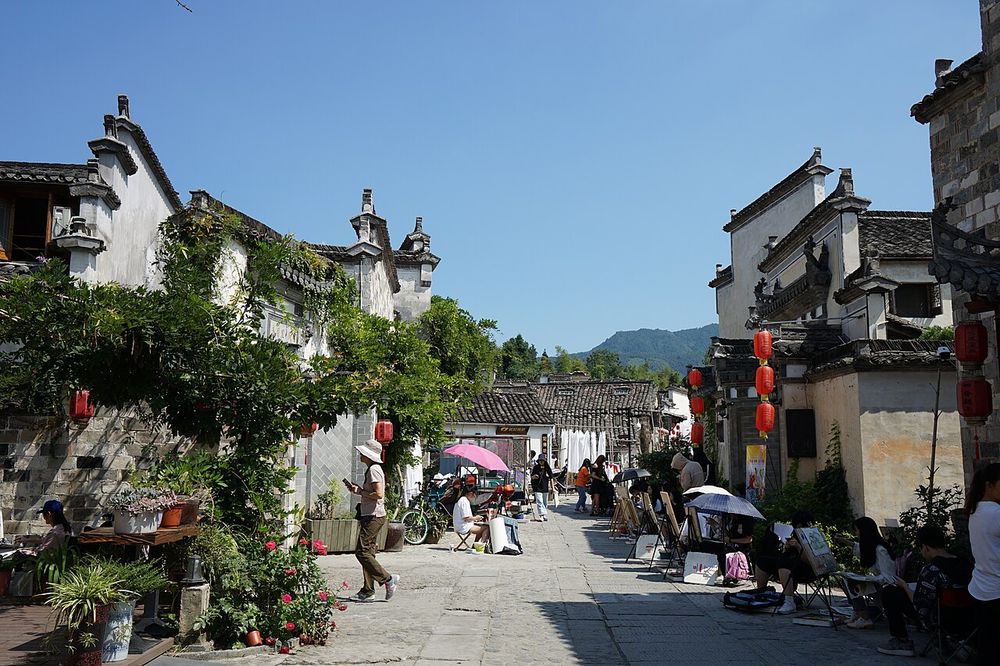
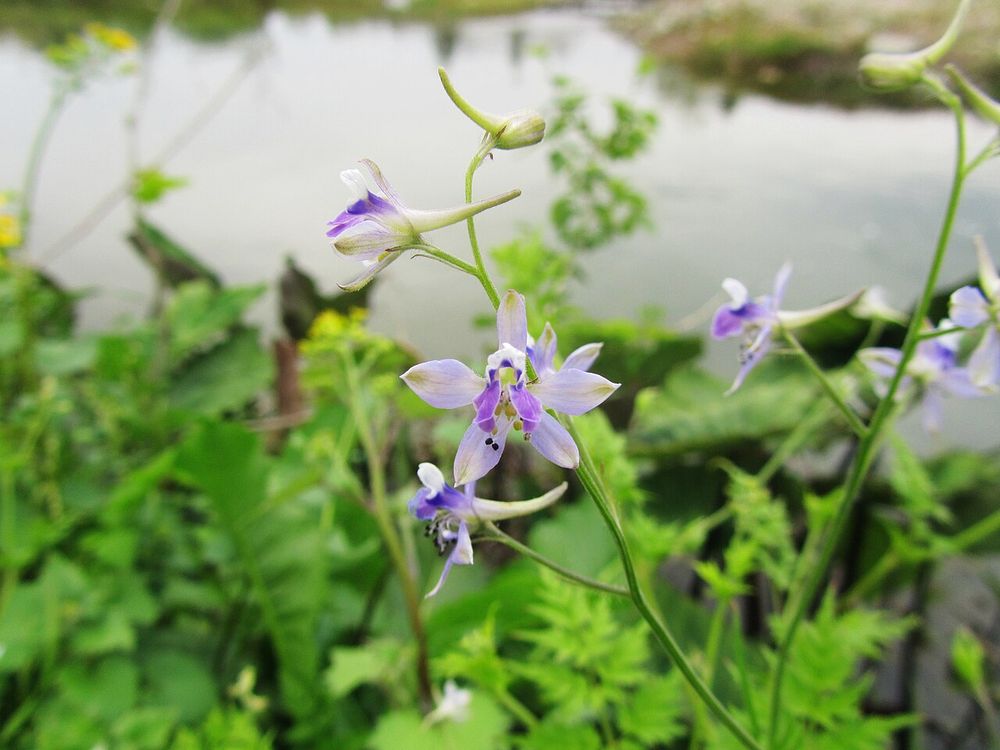
Panorama of the village, 2014Davidmcbride, CC BY-SA 3.0, Wikimedia CommonsThe South Lake and its arched bridge, 2022EditQ, CC BY-SA 4.0, Wikimedia CommonsThe South Lake on a clear day, 2022EditQ, CC BY-SA 4.0, Wikimedia CommonsHouses over the South Lake, 2014颐园新居, CC BY-SA 4.0, Wikimedia CommonsThe village and the hills, 2016Zhangzhugang, CC BY-SA 4.0, Wikimedia CommonsThe lake through the trees, 2016Zhangzhugang, CC BY-SA 4.0, Wikimedia CommonsA gate building by the lake, 2023Yumeto, CC BY-SA 4.0, Wikimedia CommonsThe Moon Pond, 2022EditQ, CC BY-SA 4.0, Wikimedia CommonsThe curve of the Moon Pond, 2022EditQ, CC BY-SA 4.0, Wikimedia CommonsHouses mirrored in the Moon Pond, 2008Jma, CC BY-SA 4.0, Wikimedia CommonsThe Moon Pond at dusk, 2016Zhangzhugang, CC BY-SA 4.0, Wikimedia CommonsThe ancestral hall by the pond, 2016Zhangzhugang, CC BY-SA 4.0, Wikimedia CommonsHouses round the water, 2018De-Shao Liu (Terry850324), CC BY-SA 4.0, Wikimedia CommonsCarved woodwork in the Chengzhi Hall, 2022EditQ, CC BY-SA 4.0, Wikimedia CommonsA doorway in the lanes, 2016Zhangzhugang, CC BY-SA 4.0, Wikimedia CommonsThe main hall of a merchant's houselienyuan lee, CC BY 3.0, Wikimedia CommonsA hall with lanterns, 2016Zhangzhugang, CC BY-SA 4.0, Wikimedia CommonsThe old trees at the entrance, 2022EditQ, CC BY-SA 4.0, Wikimedia CommonsThe great tree by the square, 2022EditQ, CC BY-SA 4.0, Wikimedia CommonsA shopping lane, 2022EditQ, CC BY-SA 4.0, Wikimedia CommonsA lane with lanterns, 2022EditQ, CC BY-SA 4.0, Wikimedia CommonsLanterns and a shop sign, 2022EditQ, CC BY-SA 4.0, Wikimedia CommonsThe lake and a bridge, 2022EditQ, CC BY-SA 4.0, Wikimedia CommonsA street by the water, 2018De-Shao Liu (Terry850324), CC BY-SA 4.0, Wikimedia CommonsA delivery tricycle in a lane, 2018De-Shao Liu (Terry850324), CC BY-SA 4.0, Wikimedia CommonsA carved gatehouse, 2018De-Shao Liu (Terry850324), CC BY-SA 4.0, Wikimedia CommonsA village shop, 2018De-Shao Liu (Terry850324), CC BY-SA 4.0, Wikimedia CommonsReflections on the lake, 2009Tom Thai, CC BY 2.0, Wikimedia CommonsWhite walls in the waterLuo Shaoyang from Beijing, China, CC BY 2.0, Wikimedia CommonsMist on the lake at dawnCecilia Yip, CC BY 3.0, Wikimedia CommonsThe entrance gate, 2025HCCB3947, CC BY-SA 4.0, Wikimedia CommonsHouses above the lake, 2018ValentinaLitvintseva, CC BY 4.0, Wikimedia CommonsThe village under the hills, 2014颐园新居, CC BY-SA 4.0, Wikimedia CommonsWild larkspur by a wall in spring, 2013猫猫的日记本, CC BY-SA 3.0, Wikimedia Commons
Local legends
These are stories people tell about this place. They are legends, not history, and each one says where it comes from.
LegendThe village of the ox
A feng shui master, the story goes, told the Wang family to build their village as an ox, so that it would be strong and prosperous; the clan dug the pond and lake to complete its body.
Source: The village's own account of its plan
Later, people who live here will be able to add the stories they grew up with, and say which of these they have heard.
Not certain, and where accounts conflict
When was the Moon Pond dug?
Village records place it in the Yongle years (1403–1424) of the Ming; the exact year varies between sources.
Visiting
Tickets and hours
104 yuan. Shops and houses keep daytime hours; the lanes are open at all hours to those staying inside.
Some old houses inside charge nothing extra; a few private ones ask a small fee.
Last checked 2026-11-12. Ticket price from Ctrip (2026); we did not find official 2026 opening hours, so none are given.
Booking without WeChat
Official page in English Tickets are sold at the village gate and online.
International booking platform Ctrip (Trip.com) sells tickets for Hongcun.
Note Foreign visitors buy with a passport. If you stay at a guesthouse inside the village, ask how to re-enter.
Checked 2026-11-12
Where to start
Enter by the South Lake, see the old trees, then follow the canals to the Moon Pond and the Chengzhi Hall.
Go at dawn or after 16:00 to avoid the tour groups.
Before you go
Hongcun is about an hour by bus from Huangshan North station; Xidi is twenty minutes away.
In autumn the fields round the village turn gold and it is busiest.
Customs and manners
People live here: do not walk into open doors uninvited, and do not wash anything in the canals.
Do not block the lanes with tripods; they are narrow.
Opening hours are given in the local time of the place. Prices are in the local currency. The figure after ≈ is approximate, at exchange rates checked on 9 November 2026, in .
Look for these
At the Moon Pond, find the ancestral hall in the reflection.
In the Chengzhi Hall, find the gold leaf on the carvings.
In the lanes, follow the water to see where it enters the pond.
I am here
Stand at the site, sign in, press the button, and collect its stamp. Your browser will ask to use your location. It is sent to us once to confirm that you are at the site; we keep how far you were from it, not the spot where you stood.
Your stamps are saved to your account, so they follow you to any device. Checking from a browser cannot rule out every false location; stricter checks arrive with the app.
Messages
Share your photos
Photos here show the place, not people. Each one is credited to the visitor who took it and appears after our team has looked at it. A photo with you in it belongs under “I am here”.