The Ming and Qing palace, finished in 1420. World Heritage since 1987.
Photo: Güldem Üstün, CC BY 2.0, Wikimedia Commons
The story
You are standing in the largest group of timber palace buildings left in the world. In 1420 the Yongle emperor moved his capital to Beijing, and this palace was finished the same year. For more than 500 years, 24 Ming (1368–1644) and Qing (1644–1912) emperors held court and lived here.
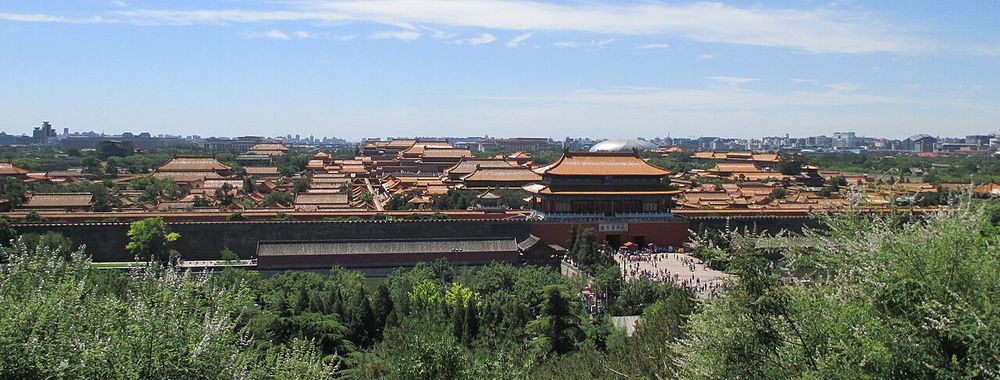
The palace measures 961 m from south to north and 753 m from east to west, larger than a hundred football pitches. In 1925, a year after the last emperor Puyi was moved out, it became the Palace Museum: the forbidden city turned into a place anyone can walk into.
What is here
One ticket takes you through the whole palace from south to north: the three great halls, the emperor's and empress's palaces behind them, the side palaces where the consorts lived, the Imperial Garden and the regular galleries. Two galleries inside need a small extra ticket, and two famous views are outside the walls.
Jingshan, the hill with the view of the whole palace
A separate park north of the palace, with its own ticket
If you have one minute
In the courtyard of the Hall of Supreme Harmony
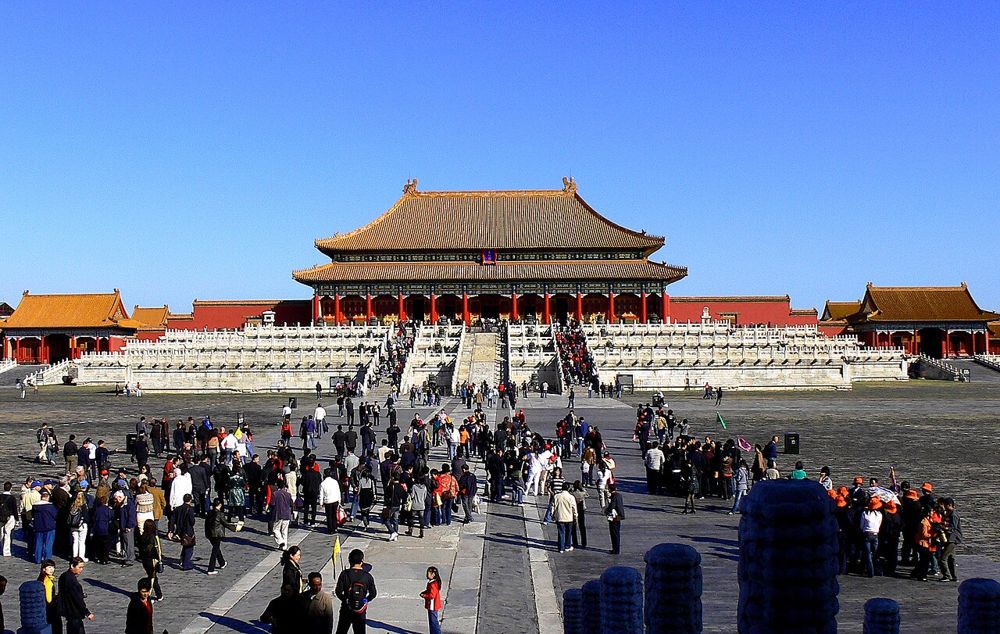
The Outer CourtJorge Láscar, CC BY 2.0
Look up at the hall in front of you. It is the largest and highest-ranking building in the palace, used for enthronements, imperial weddings and the New Year audience. It is eleven bays wide and five deep, and with its terrace stands more than 35 m high.
It has had three names and has burned several times. Nine months after it was first finished, lightning set it on fire. The hall you see was rebuilt in 1695 under the Kangxi emperor.
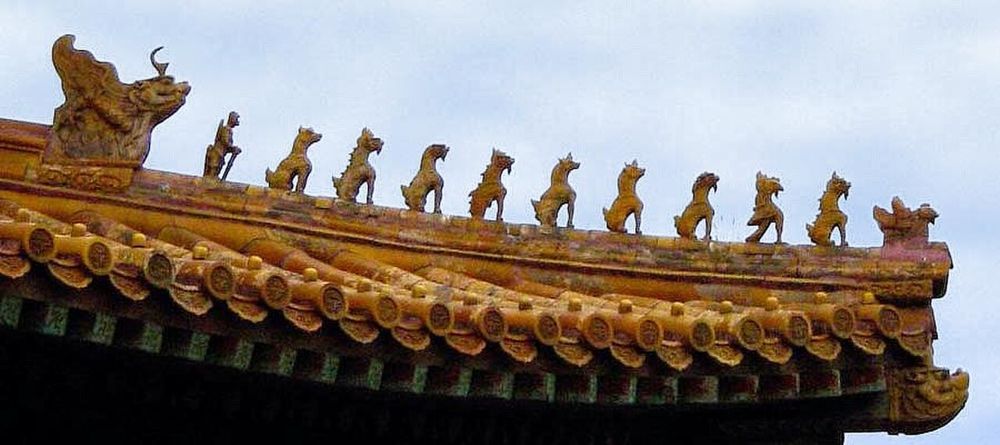
Now count the small figures along the corner of the roof. An immortal riding a phoenix leads, with ten beasts behind. Other halls have nine at most. Only this one has the tenth, called Hangshi, and it is found nowhere else in China.
People who stood here
For five centuries almost nobody was allowed to stand where you are standing. These are some who did.
The Yongle emperor, the Ming ruler who built the palace, New Year 1421He received his court and the envoys of foreign states in the new hall, weeks after the palace was finished.
The Qianlong emperor, Qing ruler, reigned 1735–1796He ruled China for sixty years from these courtyards, at the same time as George Washington and Catherine the Great. Picture him carried through this gate in a sedan chair before dawn.
Empress Dowager Cixi, ruled from behind a curtain 1861–1908For nearly half a century the real decisions of the empire were made by a woman seated behind a screen in the inner court, a few hundred metres from where you stand.
Puyi, the last emperor of ChinaHe lived on in the inner palace after the dynasty fell and married here in 1922. A year after he was moved out, the palace opened as a museum.
Bernardo Bertolucci, Italian film director, 1987He brought the first Western feature film crew allowed to shoot inside, for The Last Emperor.
Go deeper: seven stops along the central axis
How the palace is laid out
Walk the central axis from south to north. The front half is the Outer Court, where the emperor worked. Past the Gate of Heavenly Purity is the Inner Court, where the family lived. The Chinese phrase for this is “court in front, bedchambers behind”.
1. The Meridian Gate: rank in a doorway
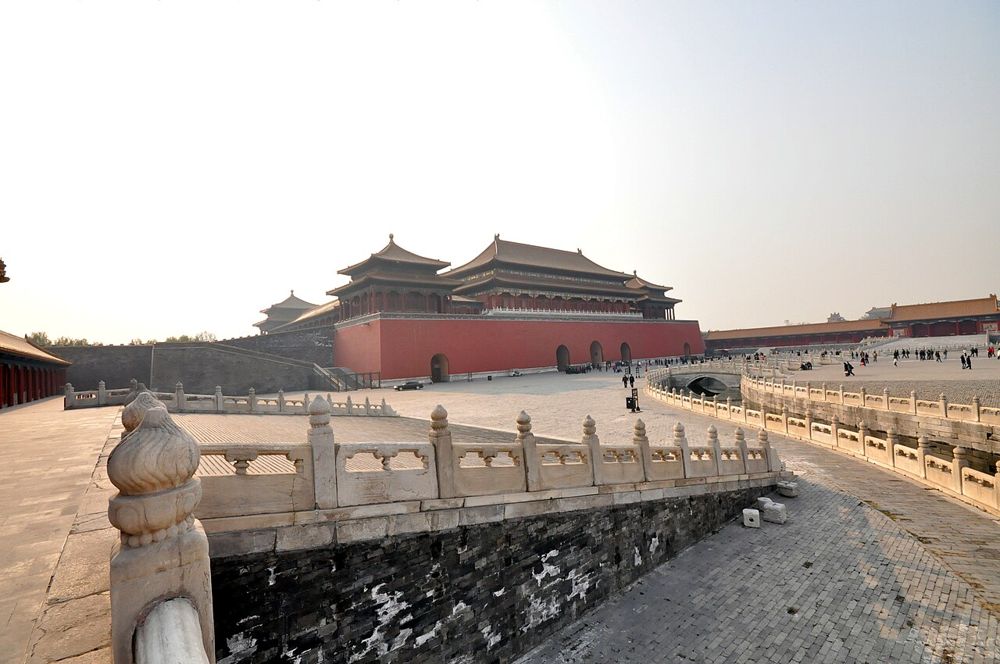
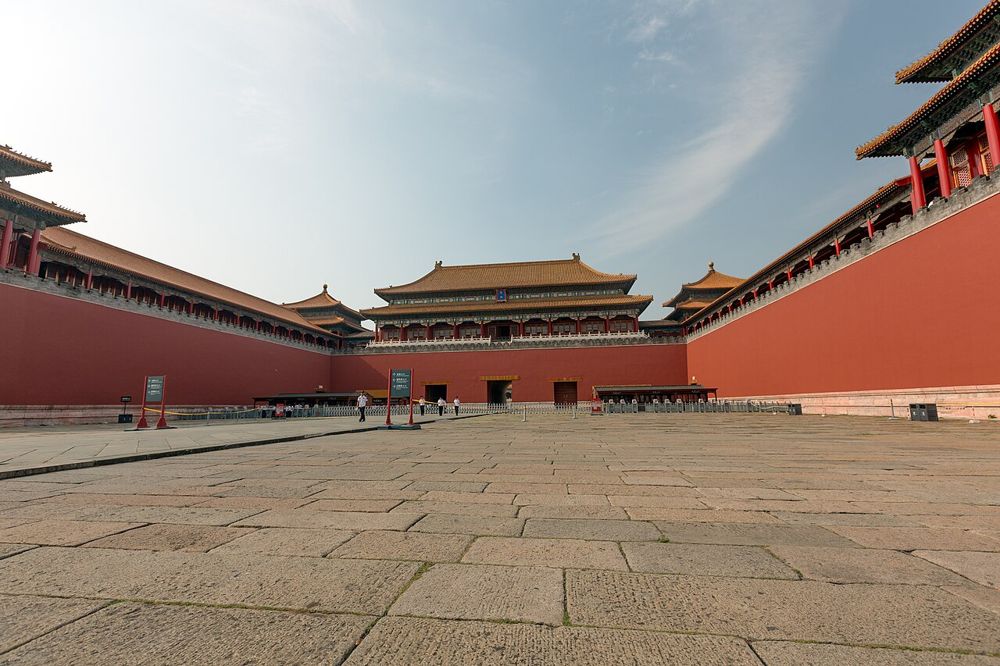
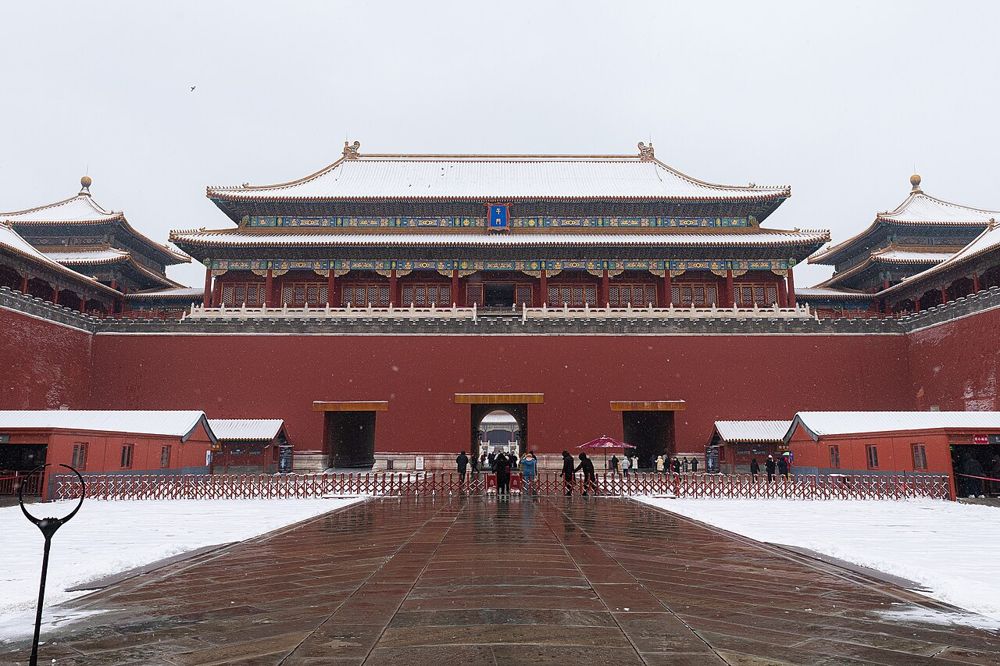
The Meridian Gate, the only entranceMorio, CC BY-SA 4.0
In plan the gate is a U. Two wings reach forward from the main tower, each with two pavilions, making five towers in all, which is why it is also called the Five Phoenix Towers.
The central opening was for the emperor alone, with two exceptions: an empress entered through it once, on her wedding day, and the top three graduates of the palace examination left through it once. Princes used the west opening and officials the east.
“Take him out of the Meridian Gate and behead him” is a line from the opera stage. What happened outside this gate in Ming times was the court beating, in which officials were flogged in public. The execution grounds were elsewhere in the city.
2. The Hall of Supreme Harmony: the highest rank of everything
The Hall of Supreme HarmonyGisling, CC BY 3.0
Three names: Fengtian Hall under Yongle, Huangji Hall from 1562, and Taihe, Supreme Harmony, from 1645.
It burned nine months after completion and again under the Jiajing, Wanli and Kangxi emperors. When the Shunzhi emperor took the throne the hall was still a ruin, and the ceremony was held at the gate in front of it.
The roof is a double-eaved hip roof, the highest grade in Chinese building. Inside stand 72 great timber columns.
The roof figures: behind the immortal on the phoenix come a dragon, a phoenix, a lion, and seven more beasts ending with Hangshi. Accounts differ on the order of the middle ones.
Zhou Qian, a researcher at the Palace Museum, reads the immortal on the phoenix as a fire charm: the phoenix stands for the fire god Zhurong. A hall that burned again and again has a roof lined with creatures meant to put fires out.
3. The carved stone ramp behind the Hall of Preserving Harmony
This is the largest stone carving in the palace: a single block of white marble from Fangshan, 16.57 m long, 3.07 m wide and 1.7 m thick, carved with nine dragons.
It was moved in winter. Wells were dug along the road, water was poured out to freeze into an ice track, and mules and men dragged the block into Beijing. Its weight is given as 200 tonnes in one account and 250 in another.
4. The Palace of Heavenly Purity: the throne behind the tablet
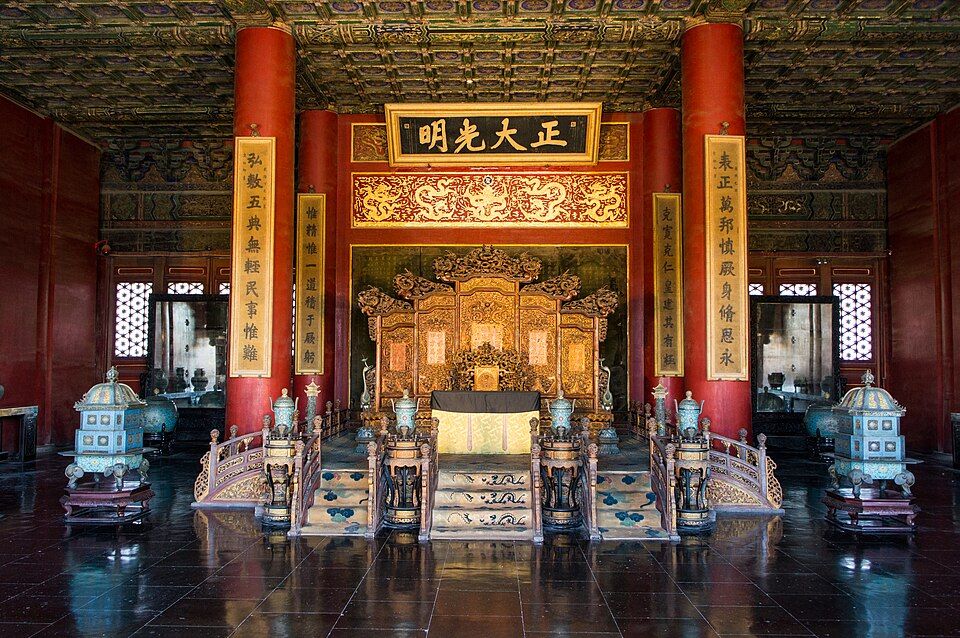
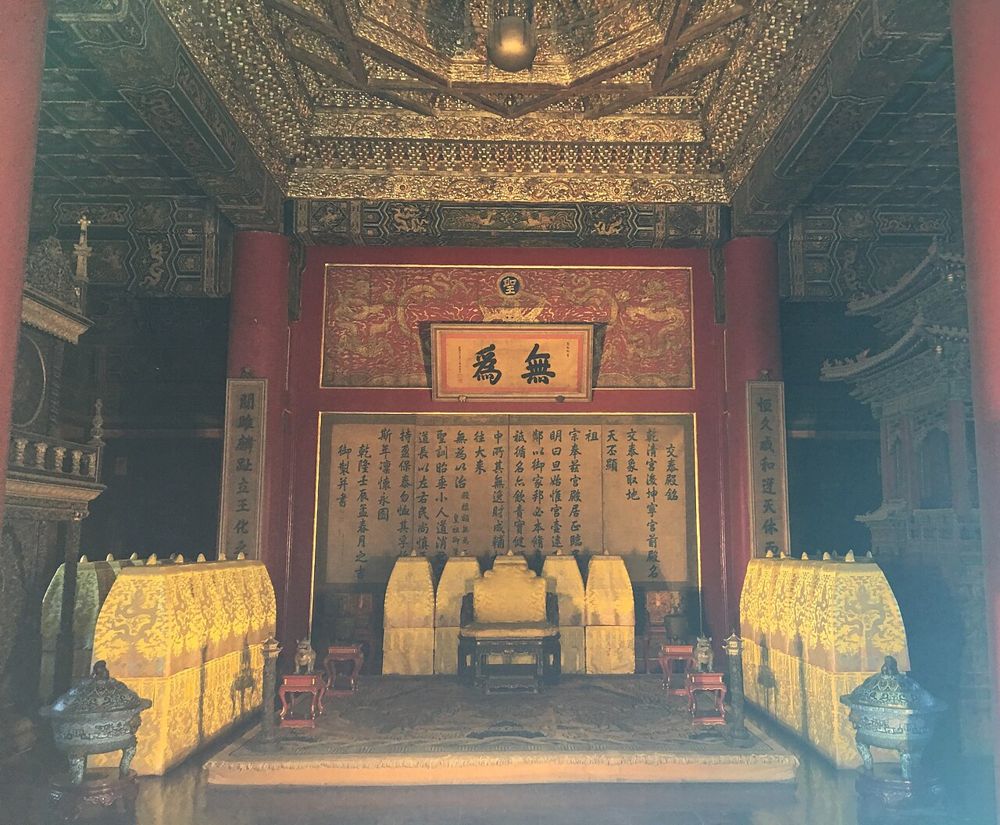
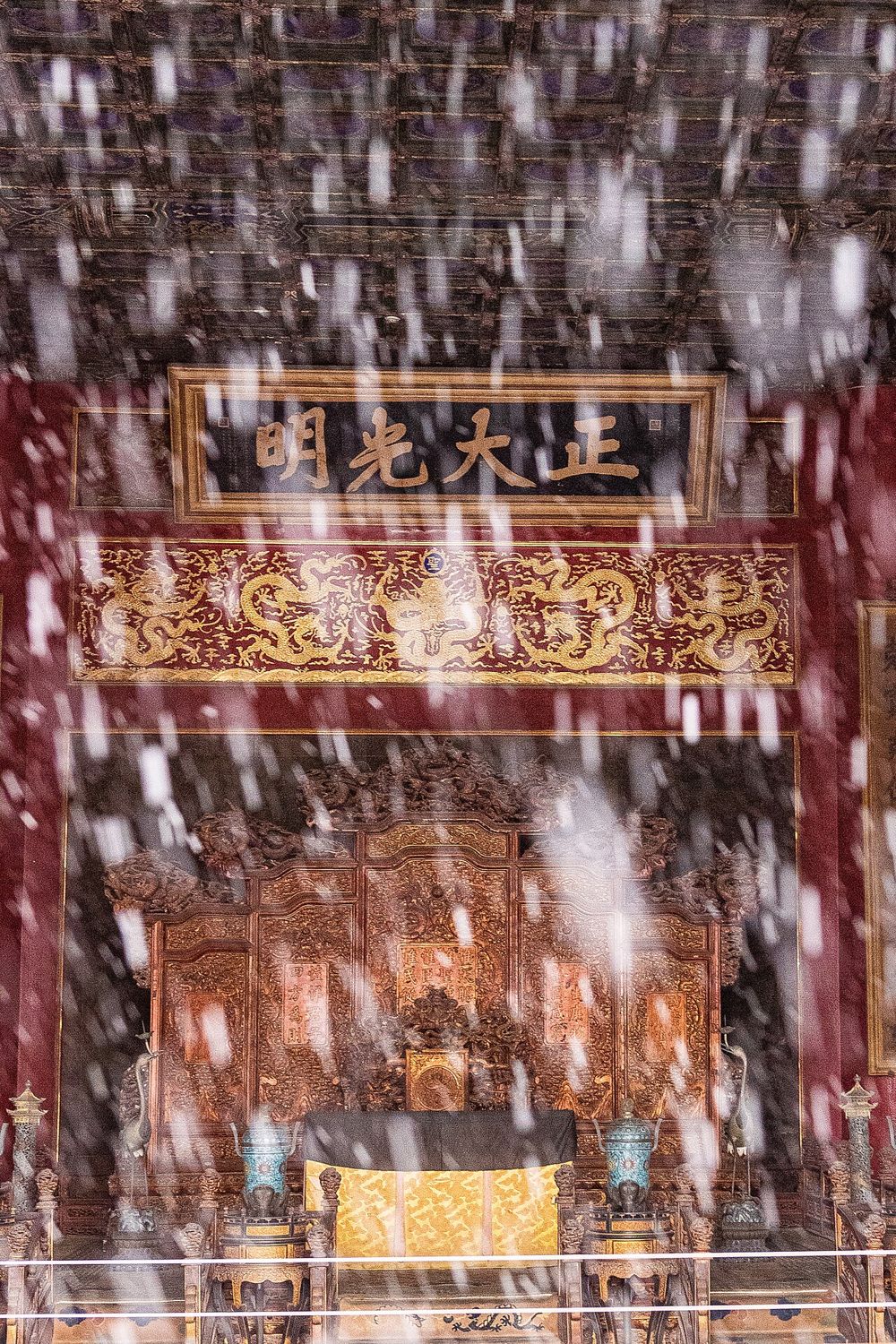
The throne and the “upright and bright” tablet in the Palace of Heavenly PurityVaiz Ha, CC BY 2.0
Above the throne hangs a tablet in the Shunzhi emperor's hand: “upright and bright”.
After the bitter succession struggle among Kangxi's sons, the Yongzheng emperor stopped naming an heir in public. He wrote the name twice, kept one copy on his person and sealed the other in a box placed behind this tablet. After his death the two were compared and the new emperor took the throne.
From Yongzheng on, emperors slept in the Hall of Mental Cultivation instead, and this palace became a place for business and banquets. The abdication edict of 1912 was issued here.
5. The Hall of Union: twenty-five seals
The Hall of UnionBjoertvedt, CC BY-SA 4.0
The hall held the 25 seals with which a Qing emperor exercised power. The Qianlong emperor fixed the number in 1746 from a line in the Book of Changes, hoping the dynasty would last 25 reigns. It had twelve emperors.
On the east side stands a bronze water clock and on the west a large chiming clock made in 1798: old timekeeping and mechanical clockwork face to face.
6. The Palace of Earthly Tranquility: a shaman's kitchen
In Ming times this was the empress's residence. The Qing rebuilt it to Manchu custom as a place of sacrifice, with heated brick platforms around three sides and great pots for boiling the offering meat.
The unusual thing: the emperor's seat is not in the centre and does not face south. It sits under the south window facing north. In this room the rules of a Chinese palace, symmetry, centre and south, do not apply.
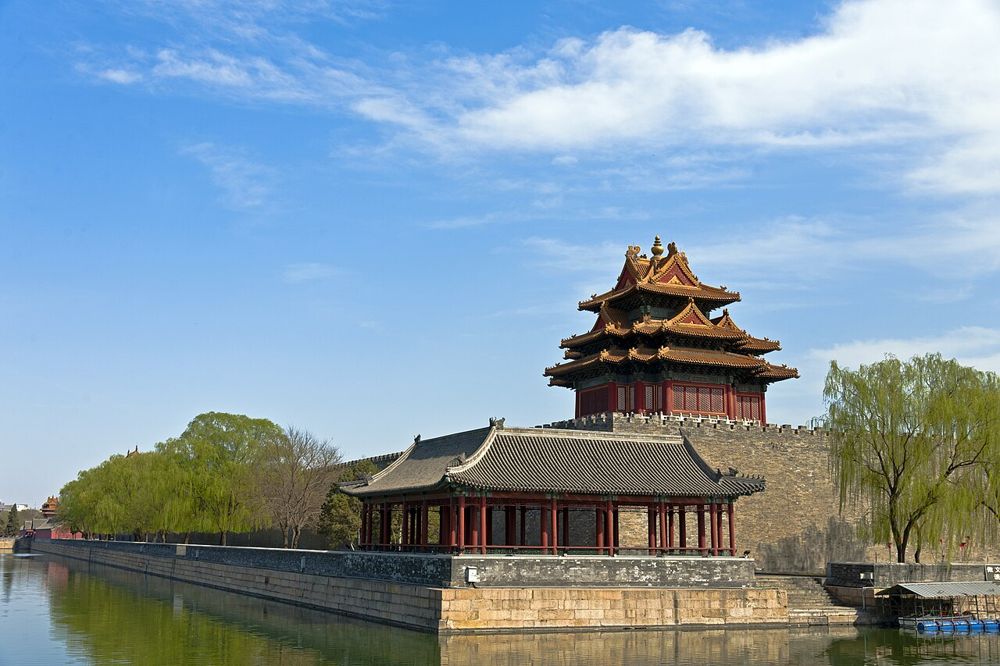
7. The corner towers: look back from the moat
The north-west corner tower and the moatDaniel Case, CC BY-SA 3.0
Each corner of the palace wall carries a tower with one storey and three tiers of eaves.
Links across time and culture
Two wonders in one year. The palace was finished in the winter of 1420; on 7 August that year work began on the dome of Florence Cathedral, designed by Brunelleschi. One is the largest timber palace in the world, the other still the largest brick dome.
At New Year 1421 the Yongle emperor received his officials and foreign envoys in the new hall. The same year Zheng He set out on his sixth voyage. The claim in Gavin Menzies' book 1421 that this fleet reached America before Columbus is not accepted by historians.
Another palace inside red walls. The red brick walls of the Moscow Kremlin were built in 1485–1495 by Italian architects for Ivan III, 65 years after the Forbidden City.
The palace has a father and brothers. The first Ming emperor built palaces at Fengyang and Nanjing; Beijing followed the Nanjing plan “but taller and grander”. The Qing built another at Shenyang before taking Beijing, and since 2004 the two are listed together as World Heritage.
In 2024 the palace was listed a second time, as the core of the Beijing Central Axis.
The Last Emperor (1987, Bernardo Bertolucci) was the first Western feature film allowed to shoot inside the palace. It won all nine Oscars it was nominated for, and Ryuichi Sakamoto became the first Asian composer to win for best original score.
Puccini's opera Turandot is set in an imagined Beijing palace. The princess's theme is the Chinese folk song Jasmine Flower, which Puccini heard from a music box. The famous 1998 “Forbidden City” production was in fact staged just outside it, at the Imperial Ancestral Temple.
Masters in the Forbidden City (2016), a three-part documentary about the museum's restorers of clocks, bronzes and paintings, sent many young people to apply for jobs here.
In pictures
The whole palace from Jingshan HillTojan76, CC BY-SA 3.0, Wikimedia CommonsThe Meridian Gate, the only entranceMorio, CC BY-SA 4.0, Wikimedia CommonsThe Meridian Gate in snowN509FZ, CC BY-SA 4.0, Wikimedia CommonsThe Hall of Supreme HarmonyGisling, CC BY 3.0, Wikimedia CommonsRoof figures on a high-ranking hall, led by the immortal on a phoenixWikimedia Commons contributor, CC SA 1.0, Wikimedia CommonsThe Outer CourtJorge Láscar, CC BY 2.0, Wikimedia CommonsThe throne and the “upright and bright” tablet in the Palace of Heavenly PurityVaiz Ha, CC BY 2.0, Wikimedia CommonsThe Palace of Heavenly Purity in snowfallN509FZ, CC BY-SA 4.0, Wikimedia CommonsThe Hall of UnionBjoertvedt, CC BY-SA 4.0, Wikimedia CommonsThe north-west corner tower and the moatDaniel Case, CC BY-SA 3.0, Wikimedia Commons
Local legends
These are stories people tell about this place. They are legends, not history, and each one says where it comes from.
LegendThe corner towers
People say each corner tower has “nine beams, eighteen columns and seventy-two ridges”, and that the carpenter god Lu Ban showed the builders how to make it by handing them a cricket cage. Counts of the actual parts do not agree with the saying.
Source: Beijing folk tale
Later, people who live here will be able to add the stories they grew up with, and say which of these they have heard.
Not certain, and where accounts conflict
When did building start?
1406 and 1417 are both given. They do not conflict: in 1406 the order went out and materials were gathered; the palace works proper began in 1417.
How many rooms are there?
A survey in the early 1970s counted 8,707; a recount in 2012 gave 9,371. The famous “9,999 and a half” is a legend.
How many emperors came to the throne by the box behind the tablet?
One scholar counts four: Qianlong, Jiaqing, Daoguang and Xianfeng. Another holds that the box was used only once, for Qianlong.
Who is the immortal on the phoenix?
The legend says a defeated king of Qi who was carried across a river by a great bird. The scholarly reading is a Daoist on the fire god's bird, a charm against fire.
Who designed the palace?
The court record names the supervising officials. Popular accounts credit the craftsman Kuai Xiang. There is no settled scholarly answer.
Visiting
Tickets
There are no same-day tickets. Booking opens at 20:00 seven days before your visit, by real name, through the Palace Museum's official booking channel. Popular dates sell out within minutes.
Admission is 60 yuan from April to October and 40 yuan from November to March. The Treasure Gallery and the Clock Gallery cost 10 yuan each.
Bring the original document you booked with. Foreign visitors book and enter with a passport.
The palace ticket covers the halls on the central axis, the six eastern and six western palaces, the Imperial Garden and the regular galleries. Jingshan, the hill behind the north gate, is a separate park with its own ticket.
Last checked 2026-11-11. Travel and news reports, not the site's own notices.
Where to start
The route is one-way, south to north. The Meridian Gate is the only entrance; you leave by the north gate or the east gate.
Opening is 08:30. Last entry is 16:00 and closing 17:00 in the high season; 15:30 and 16:30 from November to March. The museum is closed on Mondays, public holidays excepted.
Walking the central axis takes about two hours. Allow half a day if you add the side palaces and galleries.
Before you go
The courtyards have almost no shade. Carry water and sun protection in summer.
Do not trust anyone offering tickets after the official channel shows sold out. The museum says it authorises no agents.
Rules and prices change. Check the Palace Museum's official notice before you travel.
Customs and manners
Old halls and gates have a raised wooden threshold. Step over it, not on it.
Many visitors dress in historical costume for photographs. Ask before you photograph someone close up.
Do not touch the painted doors, bronze vessels or carved stone. Hand grease damages them.
Crowds are dense and people stand closer than you may be used to. Being jostled in a queue is not meant as rudeness.
Tipping is not expected in China, at sites or in restaurants.
Look for these
Count the roof beasts on the Hall of Supreme Harmony, then on the halls of the Inner Court. Does the number fall? (Ten here; five on the side palaces.)
Find the stone trumpet. In front of the Gate of Supreme Harmony is a hollow stone lotus bud. In an emergency a guard pushed a horn into it and blew, and the stone made the sound louder.
On the terrace of the Hall of Supreme Harmony stand a sundial and a standard measure: one for time, one for volume. Find both.
The sundial is marked on both faces. Which face do you read from the spring equinox to the autumn equinox? (The upper one.)
Look at the door of the Palace of Earthly Tranquility. Ordinary halls have the door in the middle. This one does not, because it was rearranged as a Manchu shrine.
I am here
Stand at the site, sign in, press the button, and collect its stamp. Your browser will ask to use your location. It is sent to us once to confirm that you are at the site; we keep how far you were from it, not the spot where you stood.
Your stamps are saved to your account, so they follow you to any device. Checking from a browser cannot rule out every false location; stricter checks arrive with the app.
Messages
Share your photos
Photos here show the place, not people. Each one is credited to the visitor who took it and appears after our team has looked at it. A photo with you in it belongs under “I am here”.