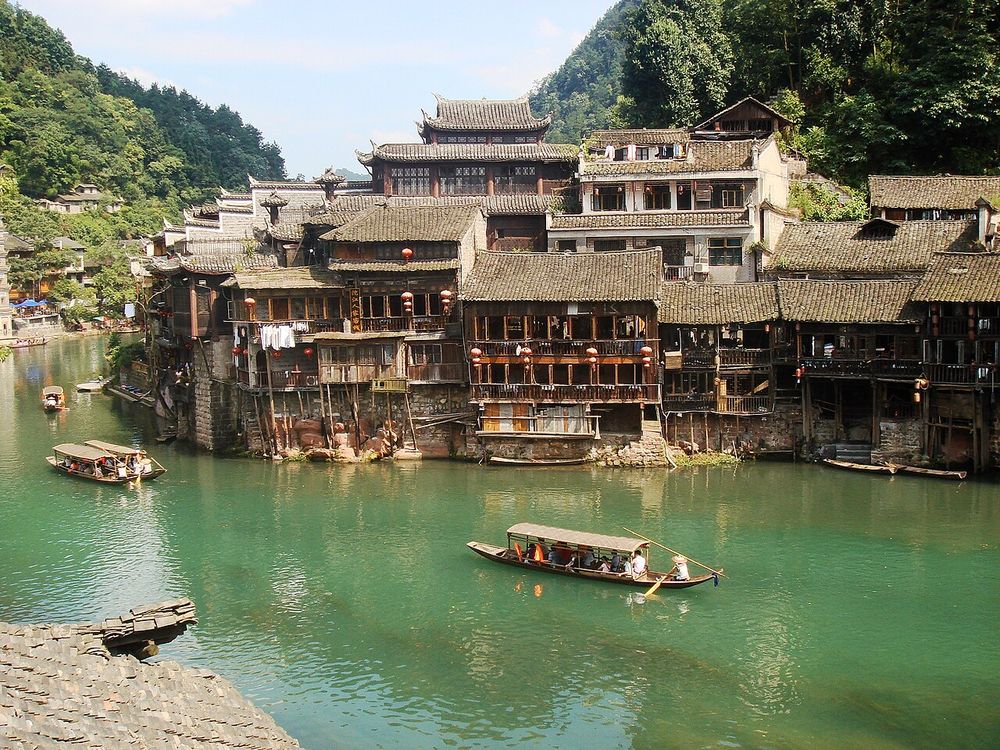
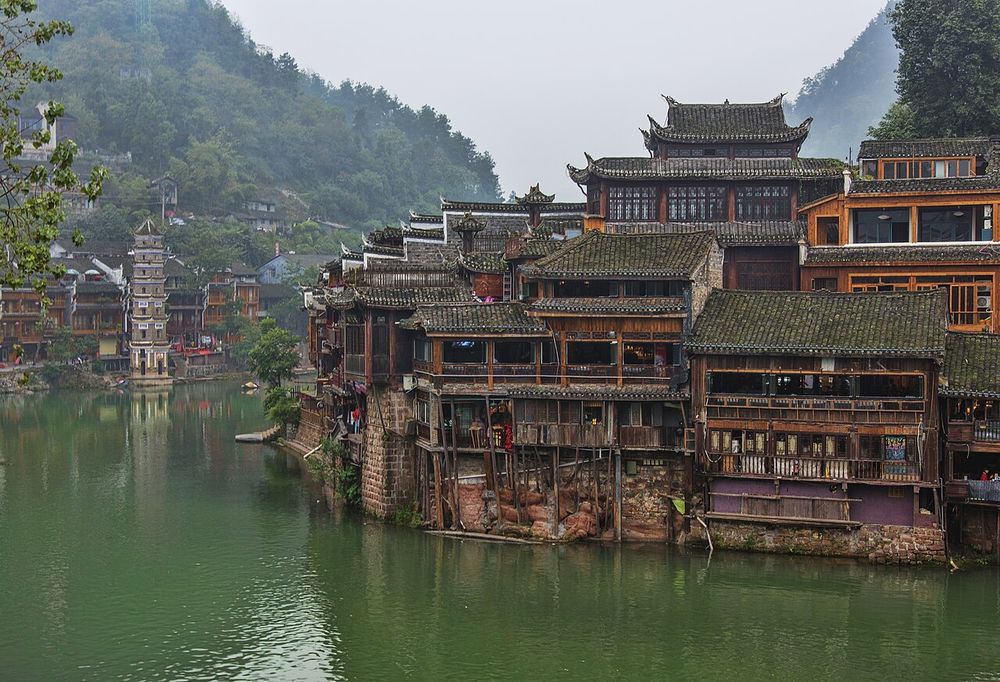
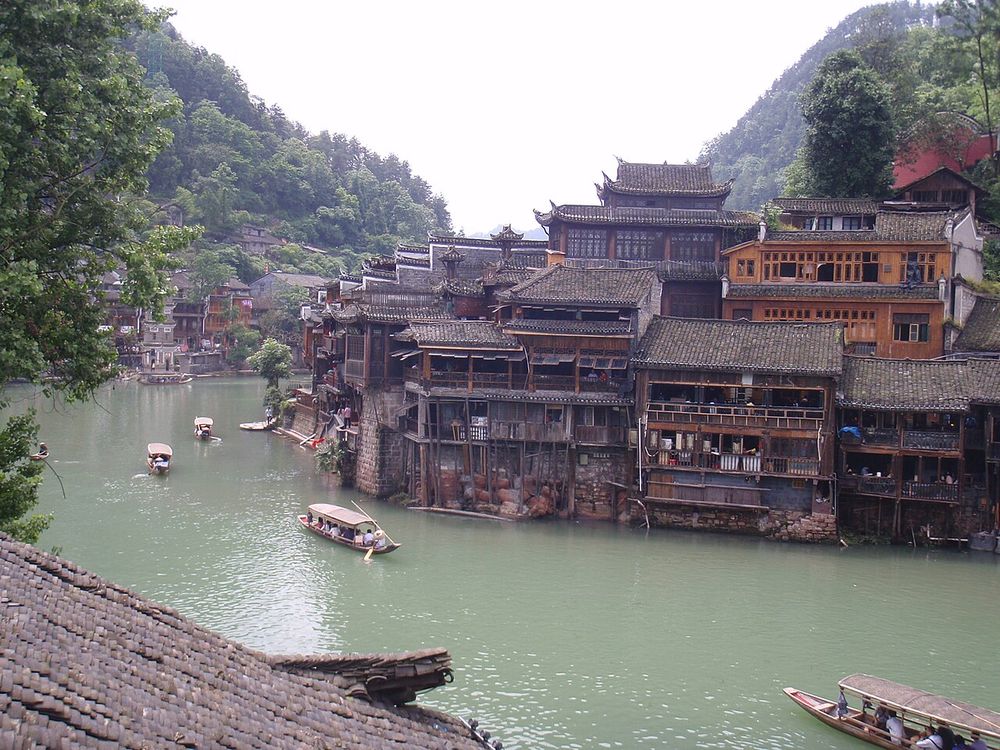
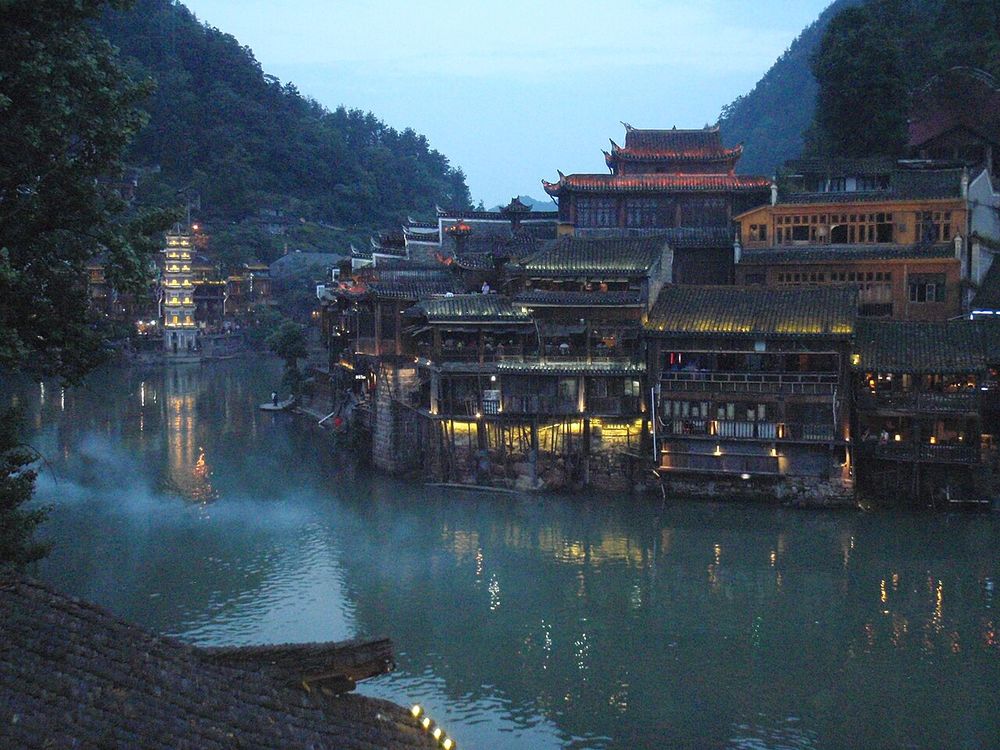
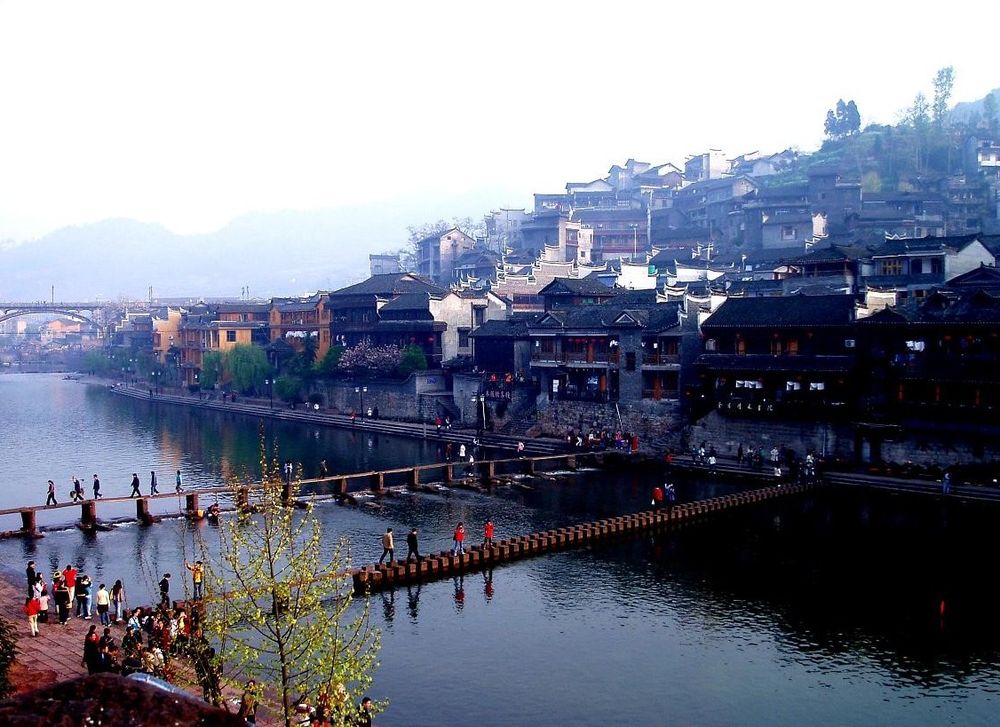
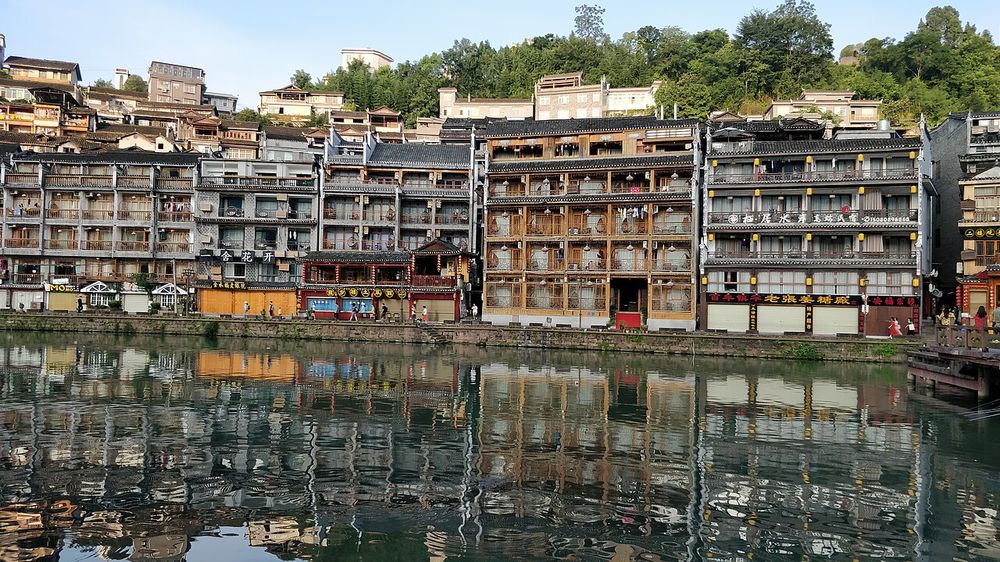
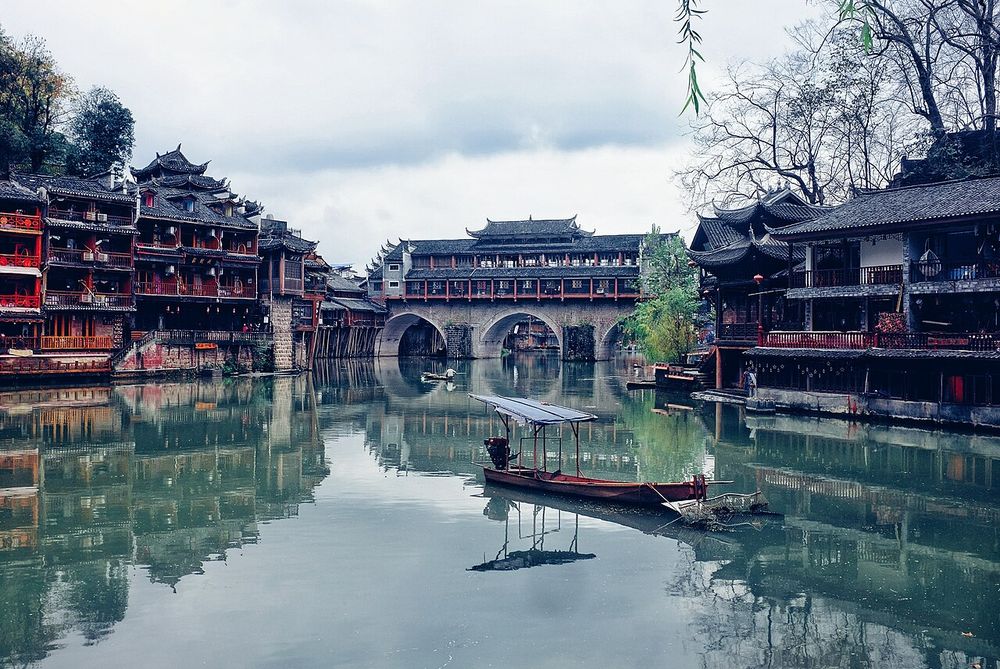
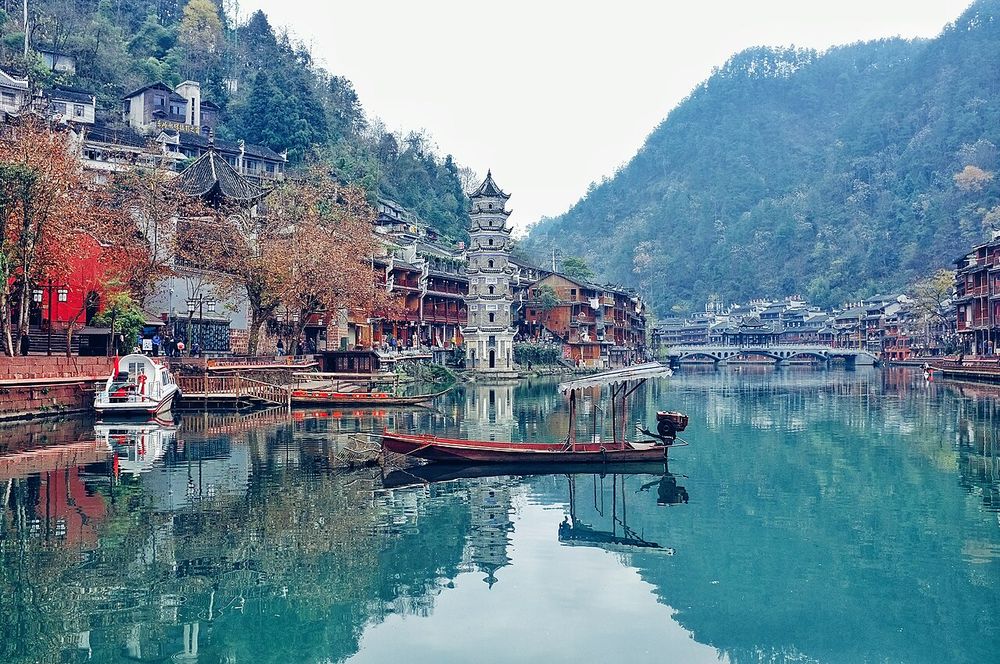
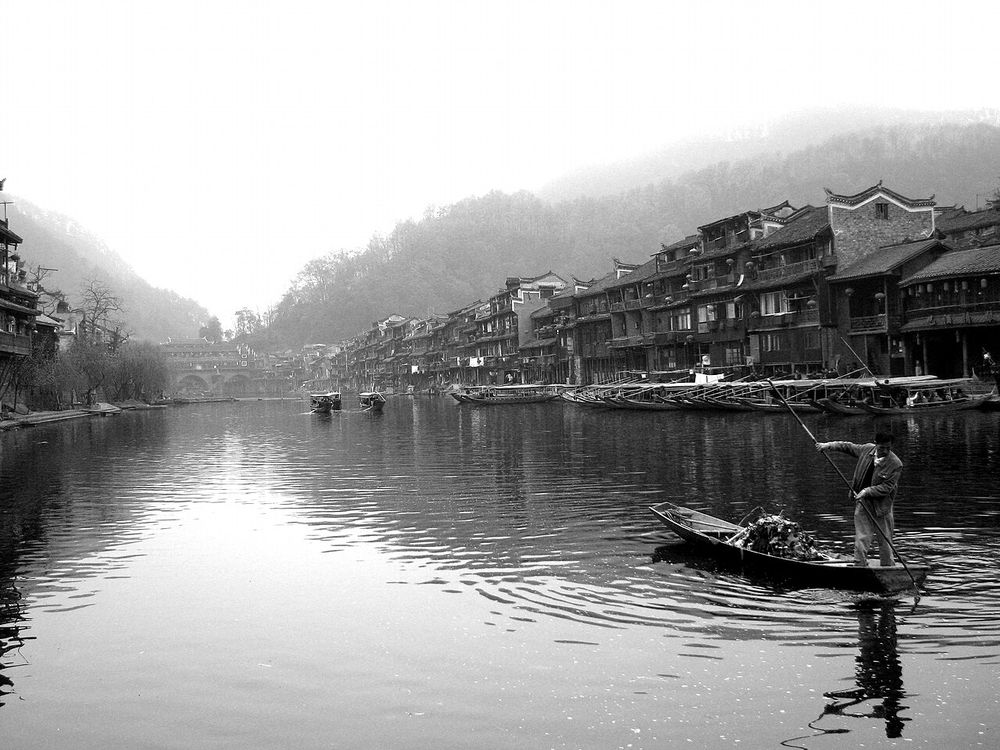
A river town in the hills of western Hunan, where wooden houses on tall stilts lean over the green Tuojiang, stepping stones cross the water and a covered bridge joins the two banks. It began as a Qing garrison on the edge of the Miao lands, and became famous through the novels of Shen Congwen, who was born here.
Photo: Chensiyuan, CC BY-SA 4.0, Wikimedia Commons
The story
In the early Qing (1644–1912), the government built a fortified town here to watch over the Miao people of the hills, and soldiers, officials and traders settled along the river. The Miao and Tujia still make up much of the county; their silver, embroidery and festivals fill its streets.
Shen Congwen, born here in 1902, wrote this river and its boatmen into "Border Town" (1934), one of the best-loved Chinese novels. The New Zealand writer Rewi Alley called Fenghuang one of the two most beautiful small towns in China. Since 2016 there has been no ticket to enter the old town.
What is here
The old town is free to walk in. A combined ticket covers nine sights, among them the houses of Shen Congwen and Xiong Xiling, the city gate tower and the Hong Bridge; river boats are extra.
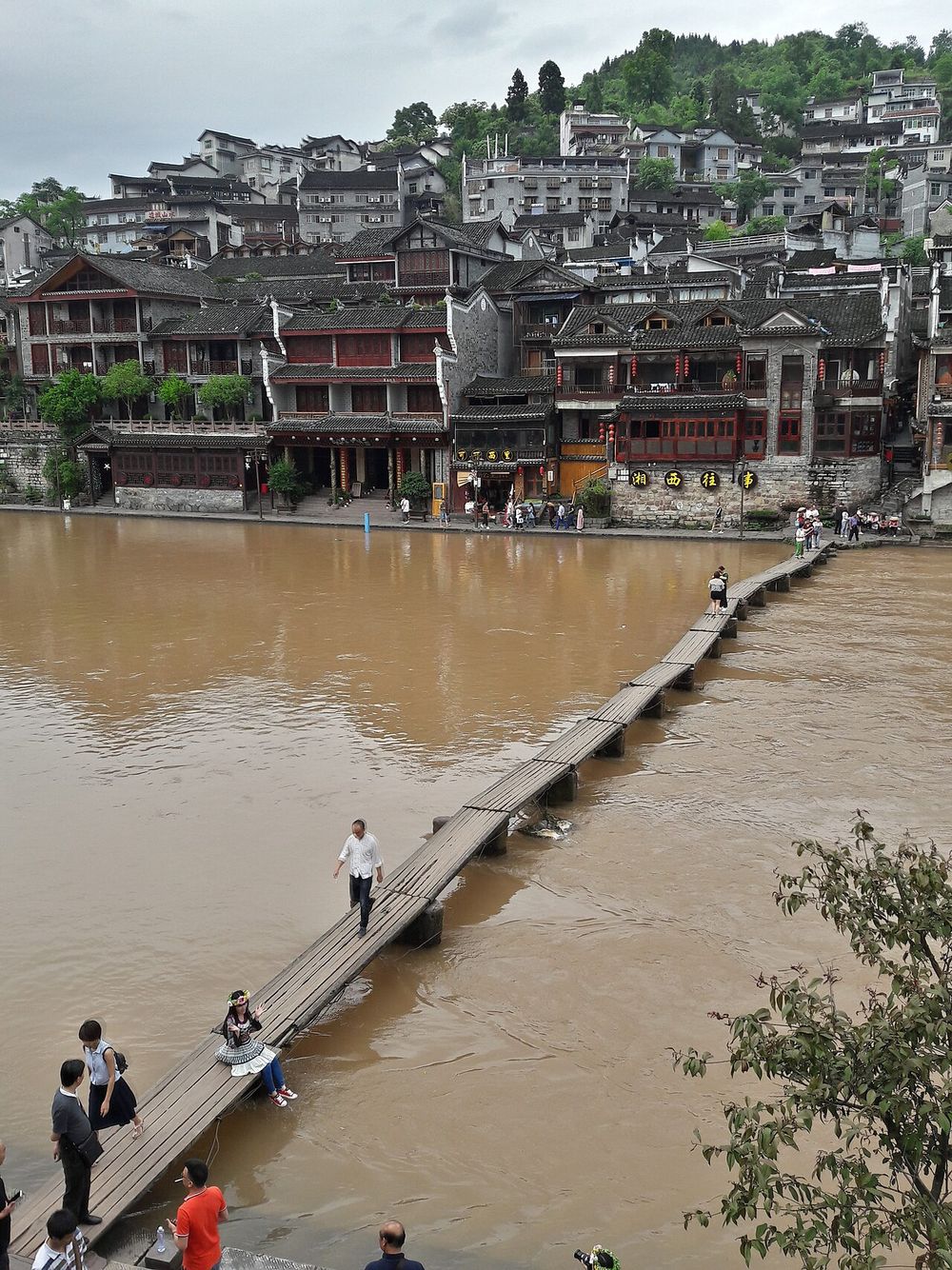
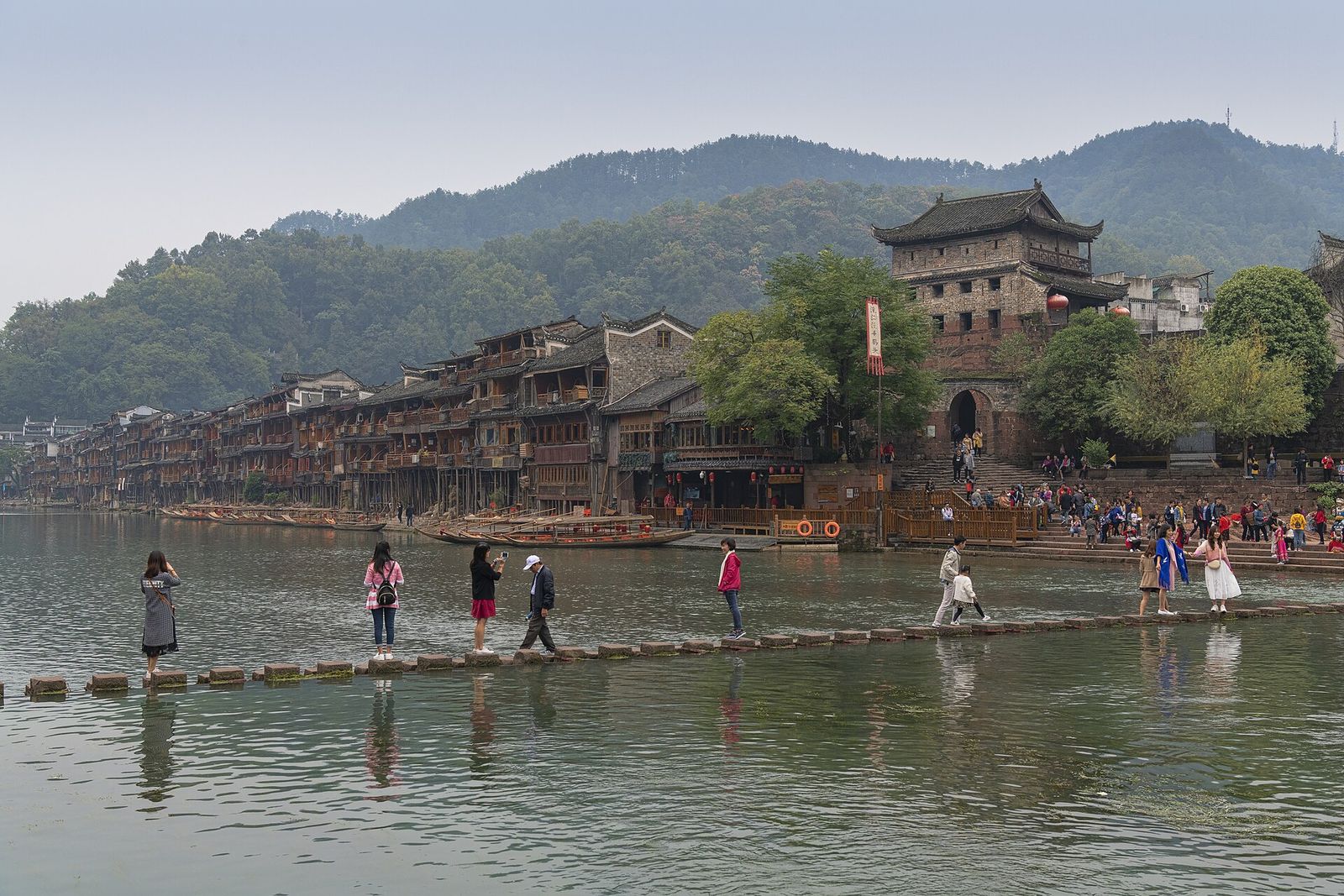
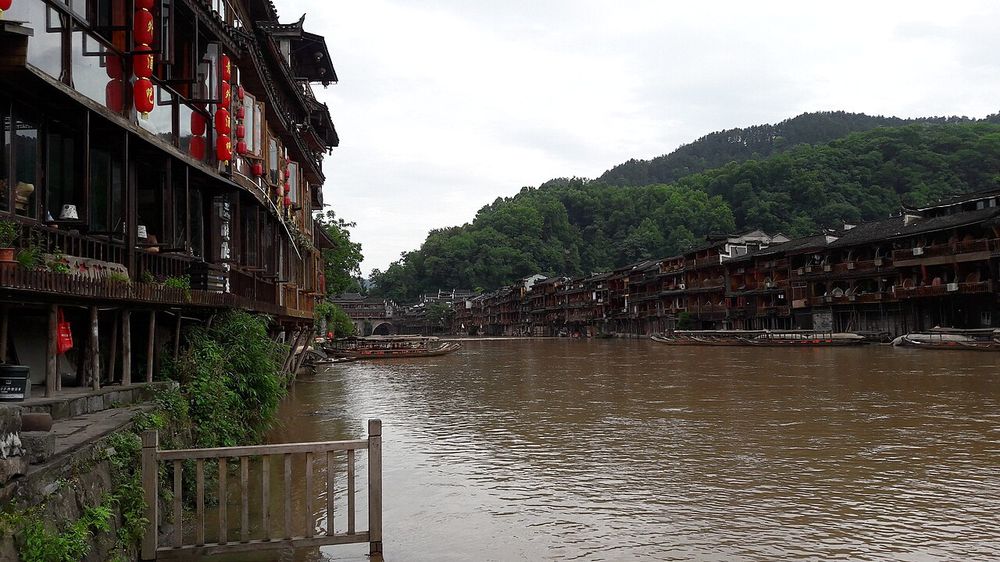
Stepping stones over the brown flood water, 2017Popolon, CC BY-SA 4.0
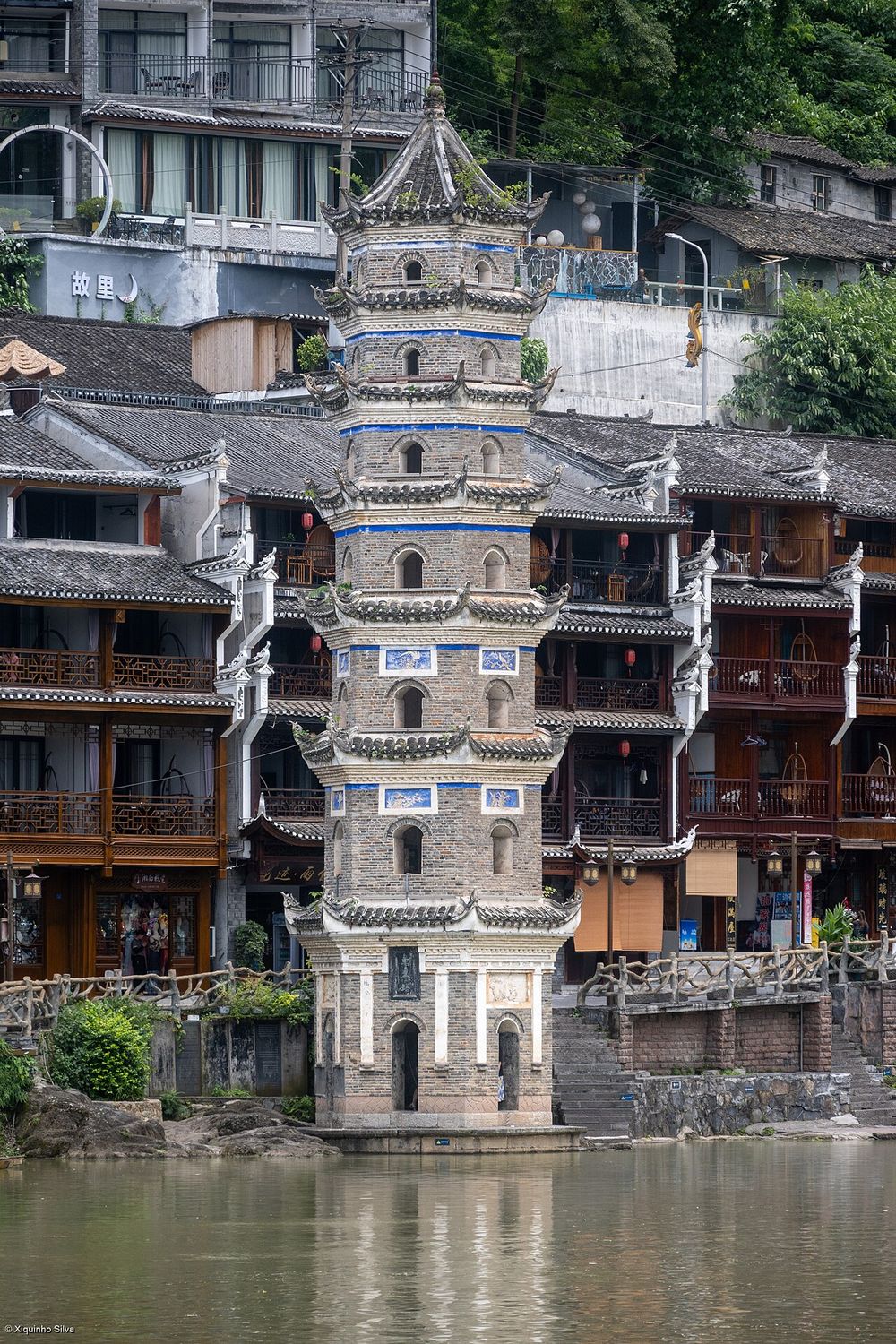
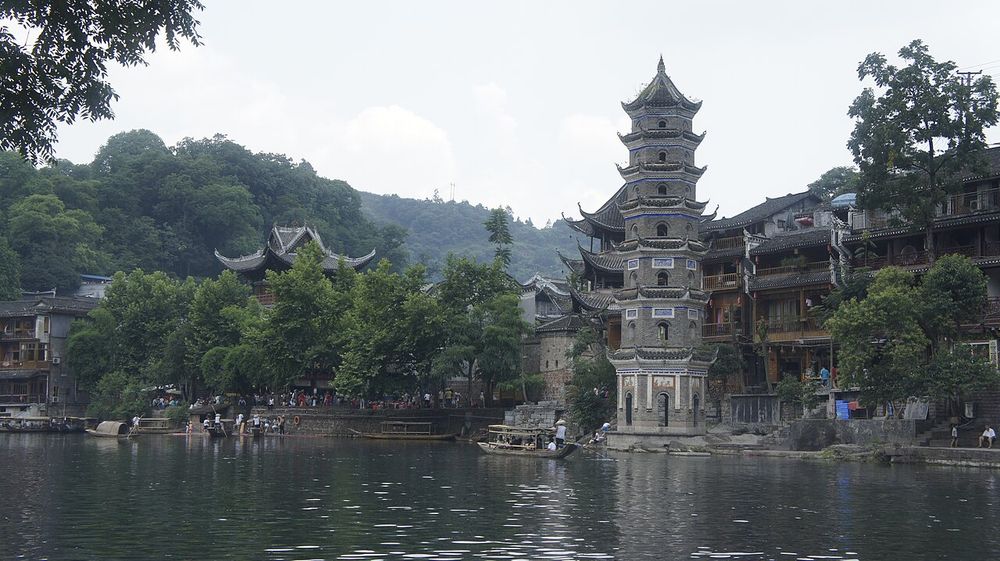
A line of square stones crosses the Tuojiang just above the Hong Bridge. Stop halfway across: on one side the stilt houses rise on their wooden legs straight out of the water, on the other the red sandstone city wall and the North Gate tower; downstream the covered bridge and, beyond it, the white pagoda.
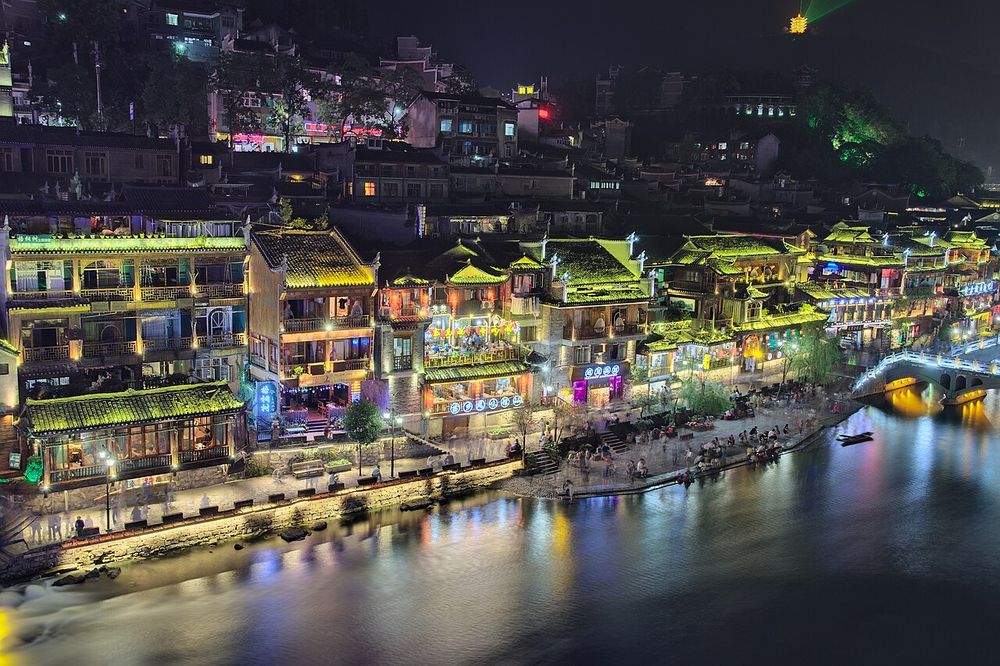
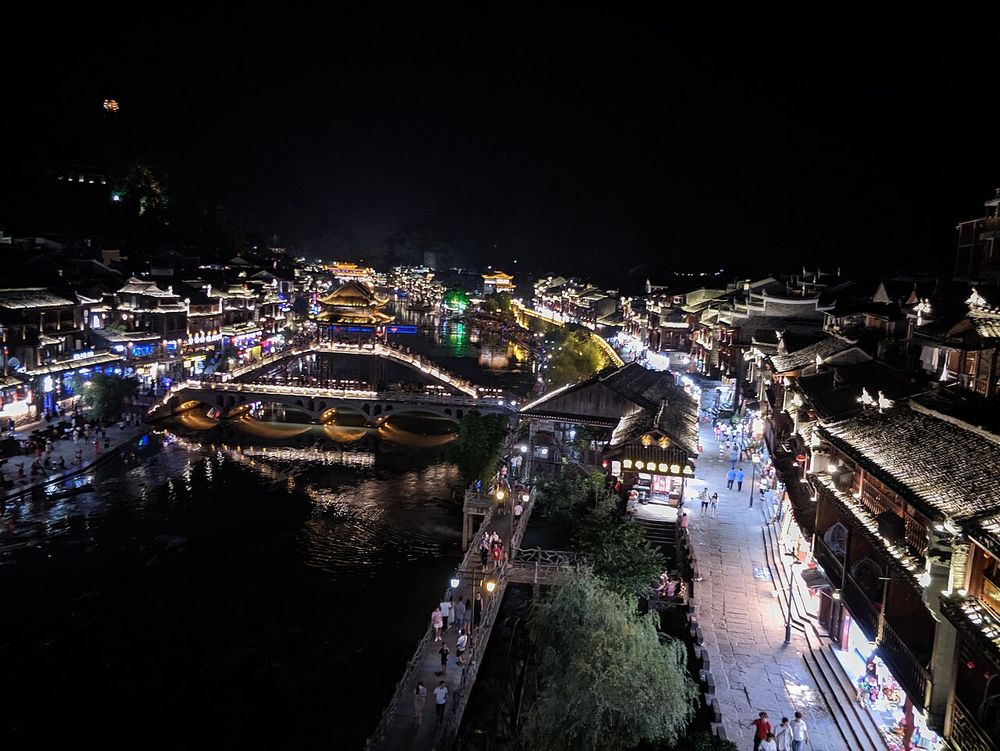
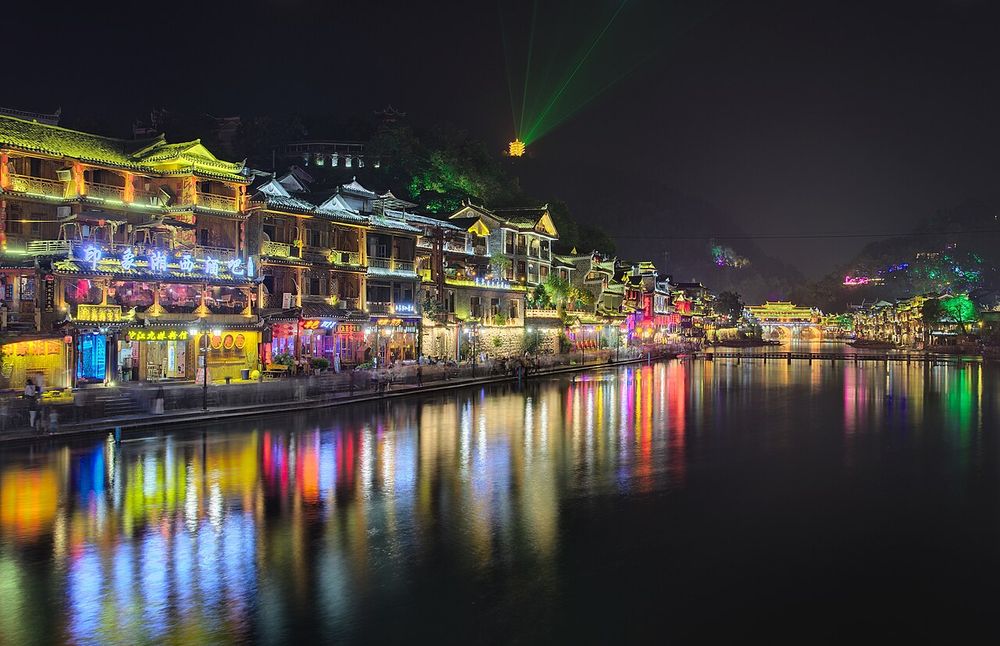
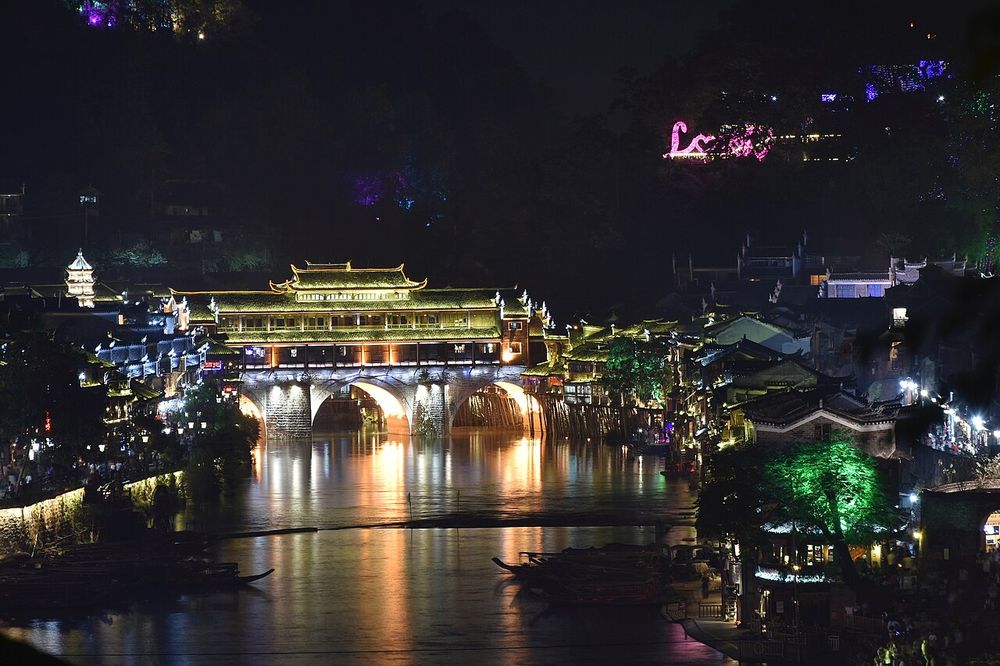
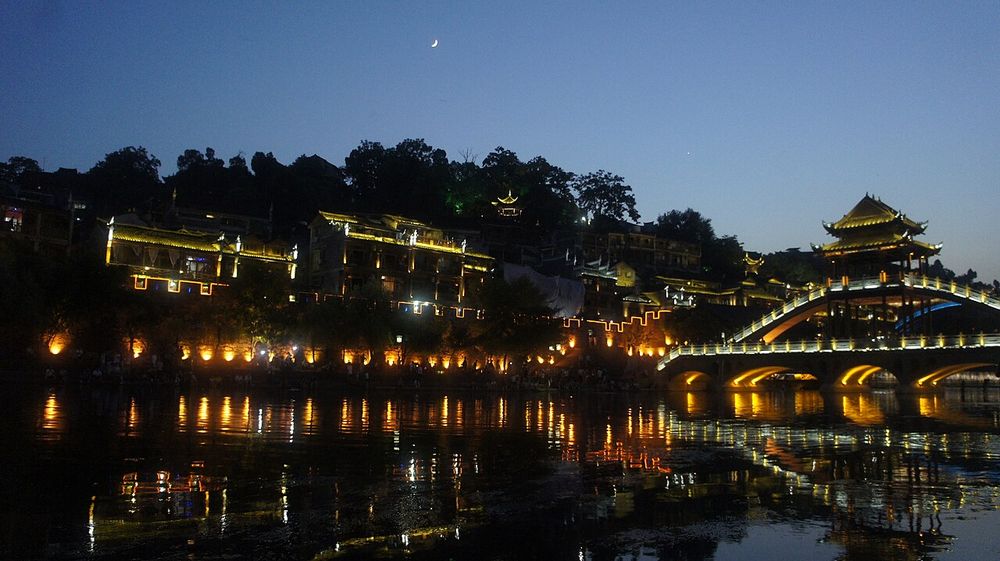
After dark the whole riverbank lights up and the bars along it play loud music; come back at dawn, when the river is misty and quiet and women wash clothes on its steps.
The riverbank lit at night, 2016Ludger Heide, CC BY-SA 2.0
Things people often get wrong
"The whole town is old." The riverside core is old, but many houses were rebuilt or raised after floods and for tourism; Shen Congwen's town was smaller and quieter.
"You still need a 148-yuan ticket." The entry charge was dropped in 2016; only some houses and museums charge.
People who stood here
We searched Chinese sources first for this list, then English ones.
Xiong Xiling (statesman, 1870–1937)Born in Fenghuang, he became premier of the Republic of China in 1913 and later founded schools and charities; his family house is open to visitors.
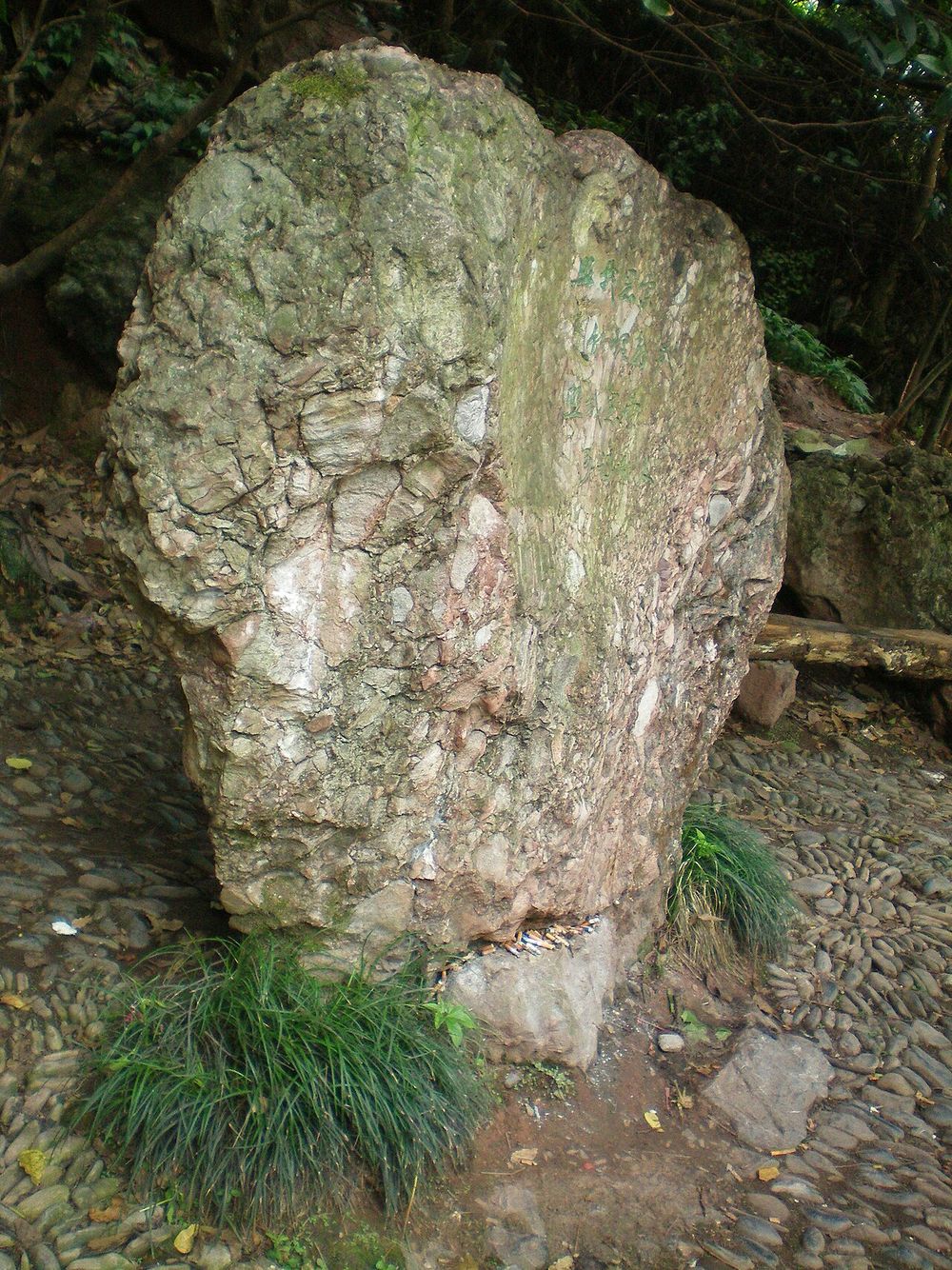
Shen Congwen (writer, 1902–1988)He grew up here, wrote "Border Town" about the river country, and is buried on a hill above the town under a rough stone.
Rewi Alley (writer and educator, 1897–1987)The New Zealander who lived in China for sixty years praised Fenghuang as one of the two most beautiful small towns in China.
Huang Yongyu (painter, 1924–2023)A relative of Shen Congwen, he grew up in Fenghuang, painted it all his life and built a house on its hills.
Go deeper: along the Tuojiang from the North Gate to the pagoda, six stops7 stops · about 1 min to read
The old town is small enough to walk in a few hours; stay a night to see it at dawn.
1. The North Gate and the wall
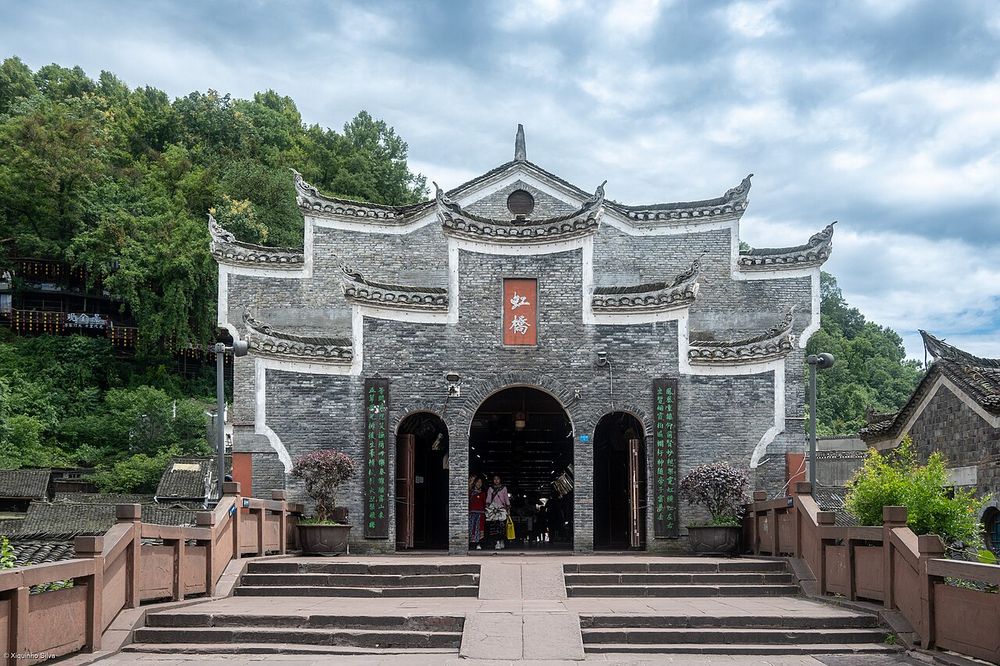
A gate tower of the old town, 2024xiquinhosilva, CC BY 4.0
The red sandstone gate towers and the stretch of wall along the river, built in the Qing.
2. The stepping stones and the wooden bridge
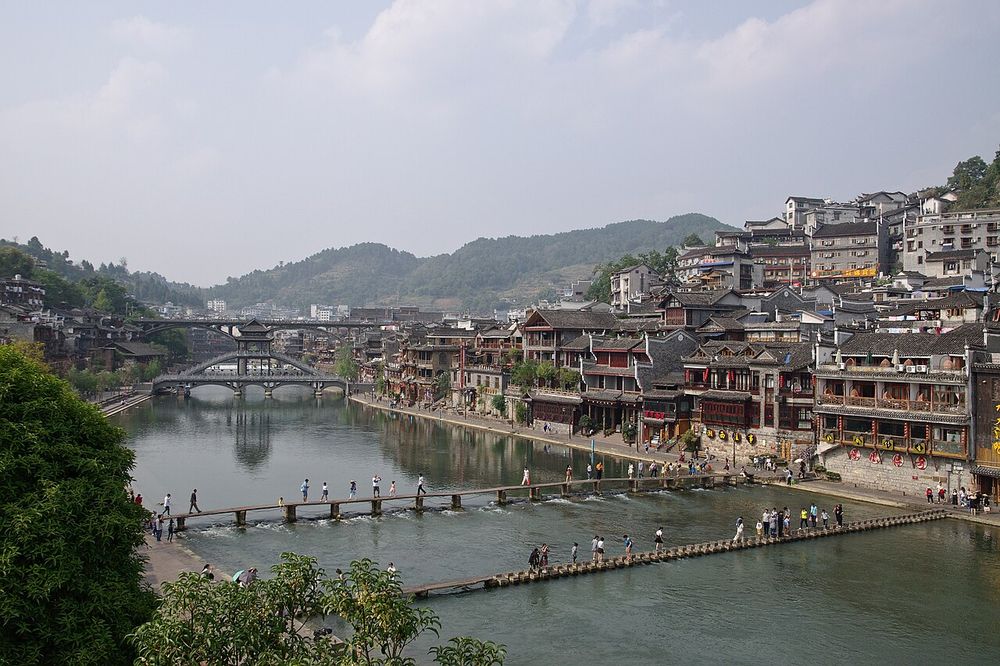
The plank bridge across the river, 2016Ludger Heide, CC BY-SA 2.0
Two ways across the river near the gate: square stones and a narrow plank bridge.
3. The stilt houses
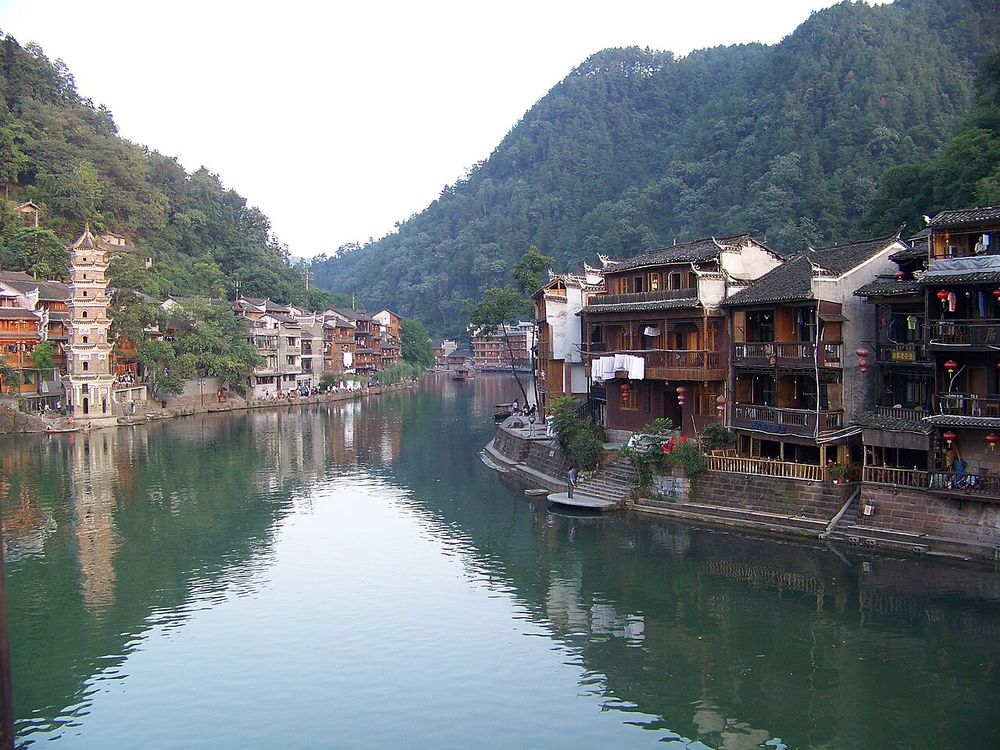
Boats in green water, 2009韩笃一, CC BY-SA 3.0
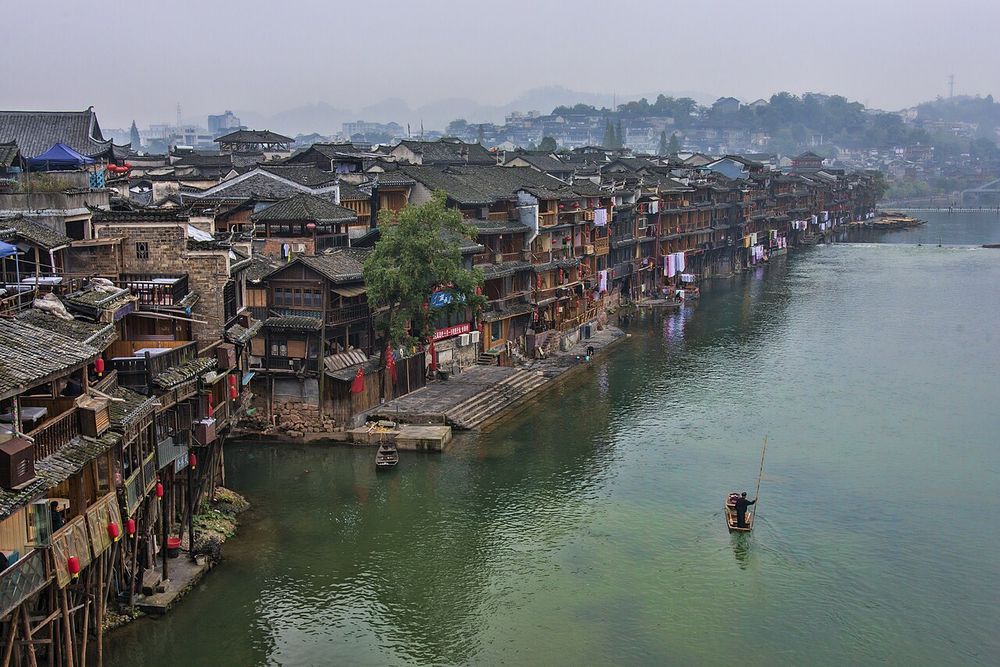
Wooden houses on the east bank, their back rooms carried over the water on posts. Many are now inns.
Stilt houses over the riverchensiyuan, CC BY-SA 4.0
4. The Hong Bridge
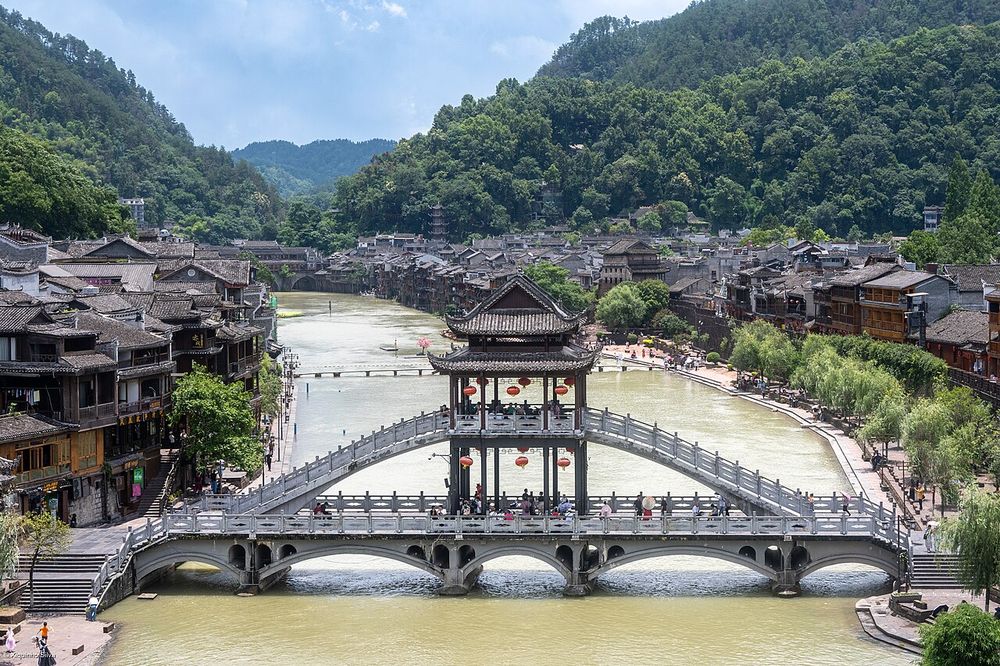
The Hong Bridge by day, 2024xiquinhosilva, CC BY 4.0
The covered bridge in the middle of town, rebuilt in its present form in the 1990s; from its upper floor there is a view up and down the river.
5. Shen Congwen's house
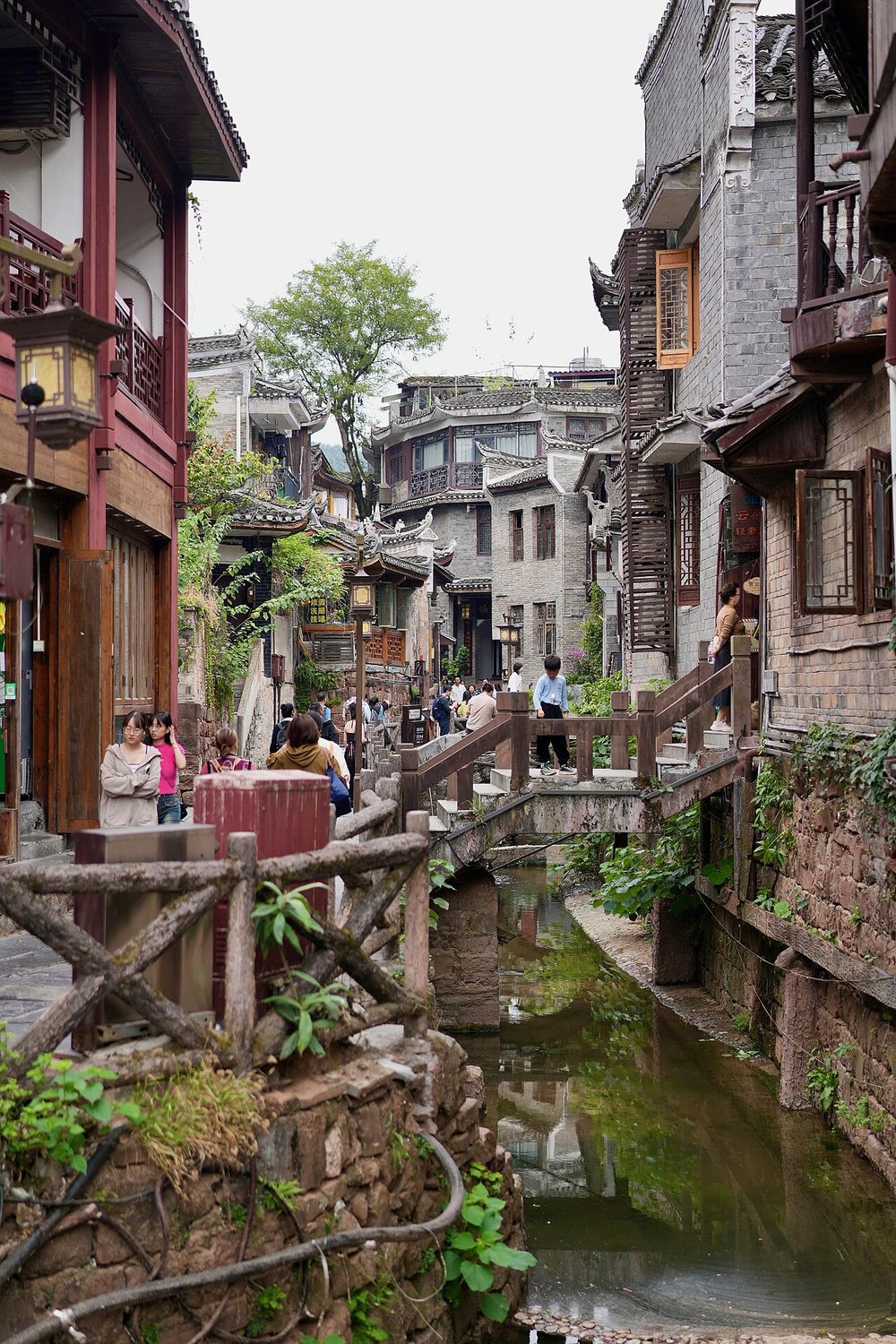
A narrow lane by a stream, 2024Lianguanlun, CC BY 4.0
A small courtyard house in a lane in the old town, where he was born; it shows his manuscripts and photographs.
6. The Wanming Pagoda and Shen Congwen's grave
The Wanming Pagoda, 2024xiquinhosilva, CC BY 4.0
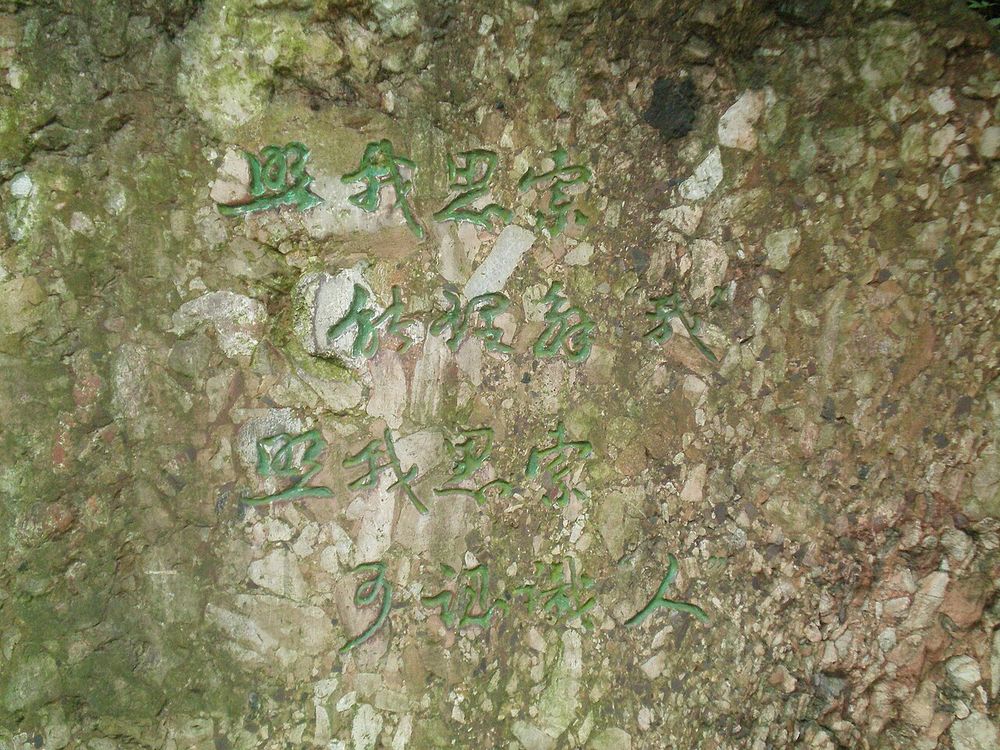
A white pagoda on the riverbank, and on the hill beyond, the writer's grave: a natural stone carved with his words, "Following my thoughts you can understand me; following my thoughts you can understand people."
Shen Congwen's grave stone, 2008Zhangmoon618, Public domain
The town and the same years elsewhere
Shen Congwen published "Border Town" in 1934; the same year Agatha Christie published "Murder on the Orient Express".
Meanwhile in the world
Year
Here
Elsewhere
1870
Xiong Xiling is born in Fenghuang
The Franco-Prussian War begins
1902
Shen Congwen is born
The Second Boer War ends
1934
"Border Town" is published
Agatha Christie publishes "Murder on the Orient Express"
2016
Entry to the old town becomes free
The Olympic Games are held in Rio de Janeiro
One line to remember: stilt houses over a green river, the border town of Shen Congwen's novel.
The river by day and night
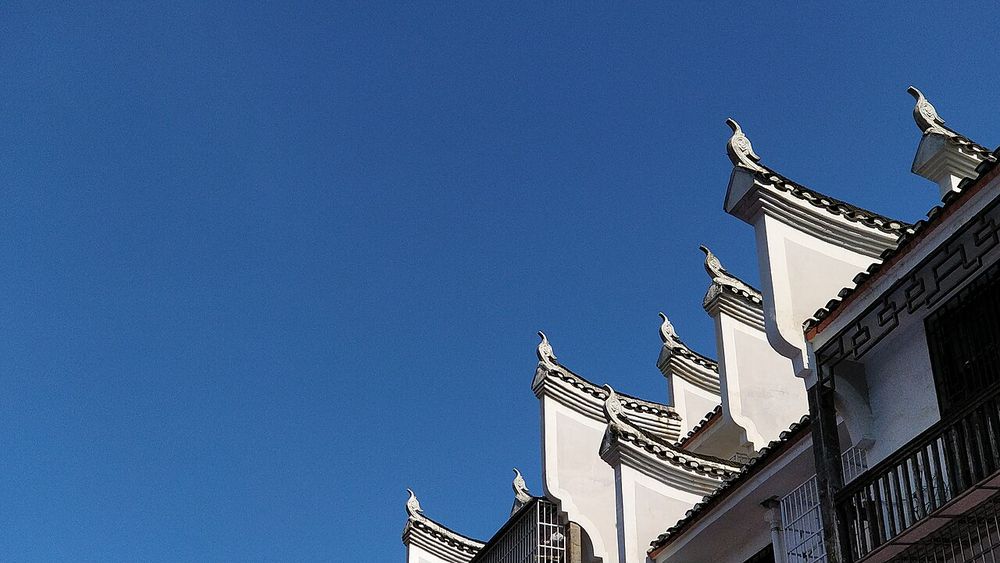
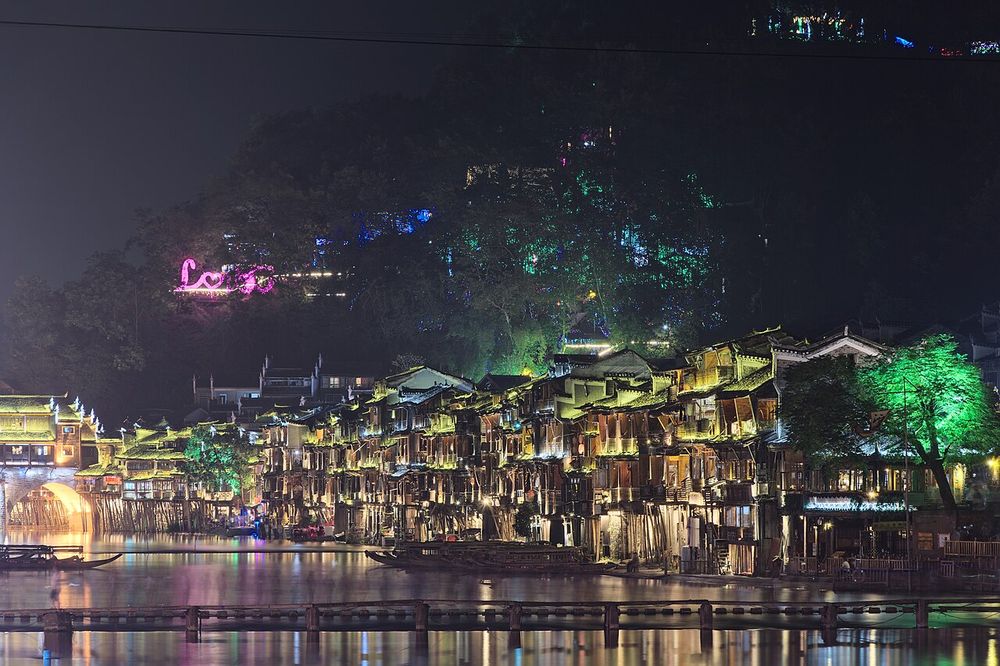
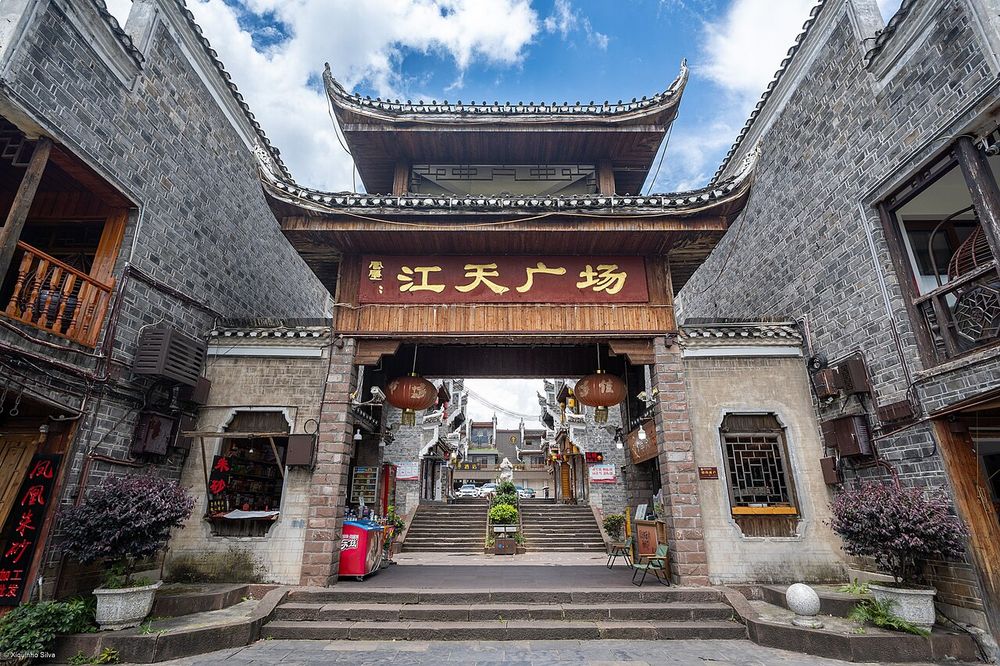
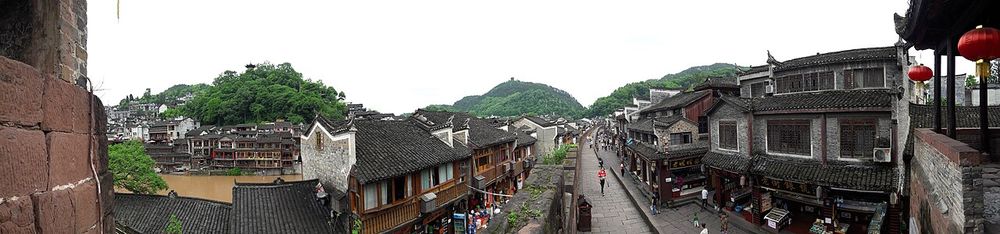
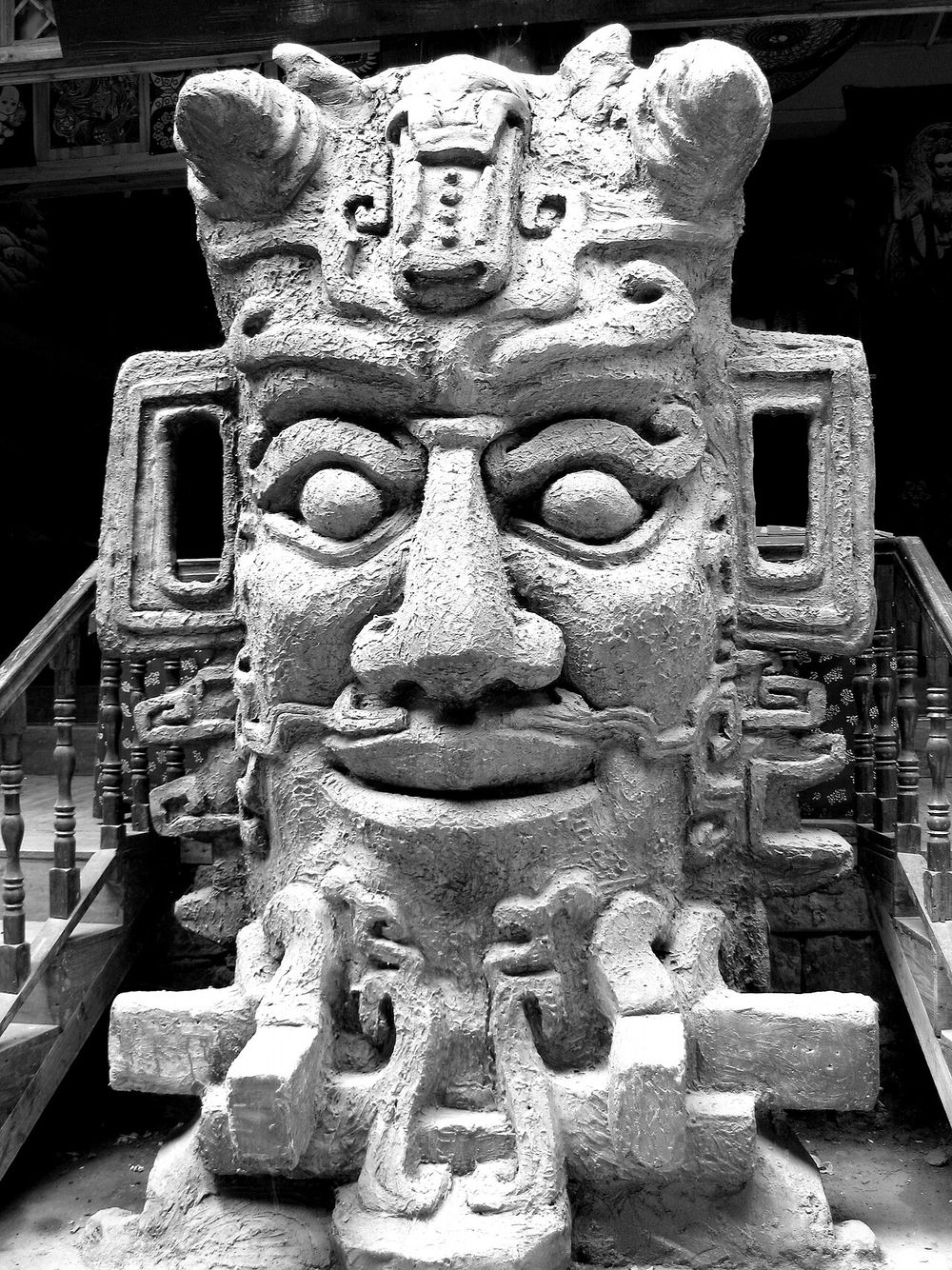
The stepping stones and the riverfront, 2018Chensiyuan, CC BY-SA 4.0, Wikimedia CommonsThe Tuojiang through the townchensiyuan, CC BY-SA 4.0, Wikimedia CommonsStilt houses over the riverchensiyuan, CC BY-SA 4.0, Wikimedia CommonsBoats below the stilt housesRaki_Man, CC BY 3.0, Wikimedia CommonsThe river at duskRaki_Man, CC BY 3.0, Wikimedia CommonsThe riverbank at dusk, 2007于/Yu 回/Hui from Chengdu, China, CC BY-SA 2.0, Wikimedia CommonsHouses reflected in the river, 2019Sunyiming, CC BY-SA 4.0, Wikimedia CommonsGables against a blue sky, 2019Steven Sun, CC BY-SA 4.0, Wikimedia CommonsThe town at night from above, 2019Sunyiming, CC BY-SA 4.0, Wikimedia CommonsThe riverbank lit at night, 2016Ludger Heide, CC BY-SA 2.0, Wikimedia CommonsColoured lights on the water, 2016Ludger Heide, CC BY-SA 2.0, Wikimedia CommonsThe town lit up, 2016Ludger Heide, CC BY-SA 2.0, Wikimedia CommonsThe Hong Bridge at night, 2016Ludger Heide, CC BY-SA 2.0, Wikimedia CommonsThe plank bridge across the river, 2016Ludger Heide, CC BY-SA 2.0, Wikimedia CommonsThe entrance of the Hong Bridge at night, 2010Huangdan2060, CC0, Wikimedia CommonsBoats and the bridge, 2016凌晨疯子, CC BY 2.5, Wikimedia CommonsThe pagoda and the river in winter, 2016凌晨疯子, CC BY 2.5, Wikimedia CommonsThe Hong Bridge by day, 2024xiquinhosilva, CC BY 4.0, Wikimedia CommonsA gate tower of the old town, 2024xiquinhosilva, CC BY 4.0, Wikimedia CommonsThe Wanming Pagoda, 2024xiquinhosilva, CC BY 4.0, Wikimedia CommonsA gateway onto a square, 2024xiquinhosilva, CC BY 4.0, Wikimedia CommonsStepping stones over the brown flood water, 2017Popolon, CC BY-SA 4.0, Wikimedia CommonsThe river after rain, 2017Popolon, CC BY-SA 4.0, Wikimedia CommonsPanorama of the street, the wall and the river, 2017Popolon, CC BY-SA 4.0, Wikimedia CommonsBoats in green water, 2009韩笃一, CC BY-SA 3.0, Wikimedia CommonsThe Tuojiang and the hills, 2009张韡武, CC BY-SA 3.0, Wikimedia CommonsThe riverfront at nightchristiali, CC BY 3.0, Wikimedia CommonsThe pagoda and the houseschristiali, CC BY 3.0, Wikimedia CommonsThe town's name on a stone wall, 2010Huangdan2060, CC0, Wikimedia CommonsA gateway with the town's name, 2026Kurgenera, CC BY-SA 4.0, Wikimedia CommonsA narrow lane by a stream, 2024Lianguanlun, CC BY 4.0, Wikimedia CommonsA boatman in the morning mist, 2010Robert Baxter from China(中国), CC0, Wikimedia CommonsA carved mask figure, 2010Robert Baxter from China(中国), CC0, Wikimedia CommonsWords carved by Shen Congwen's grave, 2008Zhangmoon618, Public domain, Wikimedia CommonsShen Congwen's grave stone, 2008Zhangmoon618, Public domain, Wikimedia Commons
Local legends
These are stories people tell about this place. They are legends, not history, and each one says where it comes from.
LegendThe phoenix that stayed
The town is named after a hill to the south-west shaped like a phoenix; the story goes that a phoenix flying south looked down, found the river so beautiful that it stayed, and turned into the mountain.
Source: A local story of Fenghuang
Later, people who live here will be able to add the stories they grew up with, and say which of these they have heard.
Not certain, and where accounts conflict
Did Rewi Alley really say it?
The saying that Fenghuang and Changting in Fujian are the two most beautiful small towns in China is always credited to him, but we found no original source with the exact words.
Visiting
Tickets and hours
Free to enter at all hours; the combined ticket for nine sights is 128 yuan for three days (students 65).
The houses and museums keep daytime hours.
Last checked 2026-11-12. Free entry and the nine-sight combined ticket from 2026 Sina guides; boat price from Ctrip (2026).
Booking without WeChat
Official page in English No ticket is needed to enter the old town. The nine-sight combined ticket is sold at the visitor centre and the sights.
International booking platform Ctrip (Trip.com) sells boat rides and some sights.
Note Touts at the bus station offer cheap rooms that turn out poor; book through a platform.
Checked 2026-11-12
Where to start
Start at the North Gate, cross by the stepping stones, walk down the east bank to the Hong Bridge, and end at the pagoda.
Get up at dawn for the mist on the river.
Before you go
High-speed trains run to Fenghuang Gucheng station, a short ride from town; Zhangjiajie is about three hours away.
The stepping stones close when the river is high.
Customs and manners
Ask before photographing Miao women in festival dress; some charge for photos.
Do not push on the stepping stones; let people coming the other way pass.
Opening hours are given in the local time of the place. Prices are in the local currency. The figure after ≈ is approximate, at exchange rates checked on 9 November 2026, in .
Look for these
From the stepping stones, find the posts that hold the stilt houses up.
At Shen Congwen's grave, read the words on the stone.
Find the white pagoda from the Hong Bridge.
I am here
Stand at the site, sign in, press the button, and collect its stamp. Your browser will ask to use your location. It is sent to us once to confirm that you are at the site; we keep how far you were from it, not the spot where you stood.
Your stamps are saved to your account, so they follow you to any device. Checking from a browser cannot rule out every false location; stricter checks arrive with the app.
Messages
Share your photos
Photos here show the place, not people. Each one is credited to the visitor who took it and appears after our team has looked at it. A photo with you in it belongs under “I am here”.